


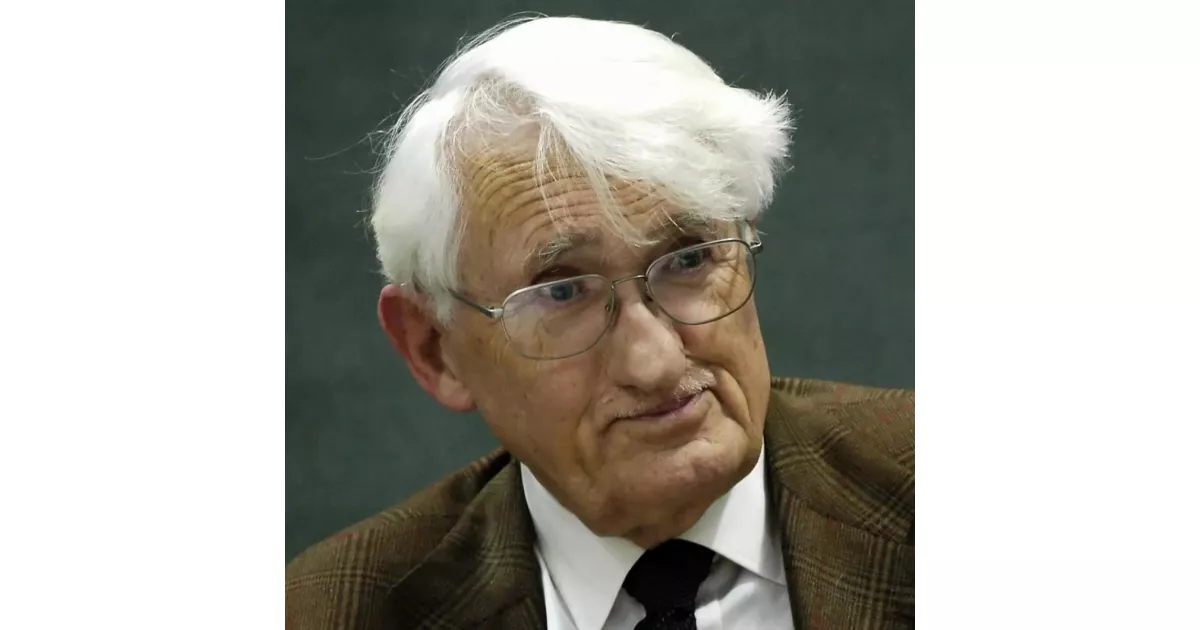
Jürgen Habermas is a prominent German philosopher and social theorist known for his work on communicative rationality and the public sphere. A key figure in the tradition of critical theory and pragmatism, Habermas examines how rational discourse and open communication are essential for a democratic society. His theories explore how individuals can reach mutual understanding and consensus through reasoned argument, ultimately shaping political and social norms. Habermas's analysis of the public sphere emphasizes its role as a space for critical debate and the formation of public opinion, vital for the legitimacy of political power.
June 1929: Birth of Jürgen Habermas
In June 1929, Jürgen Habermas, a German philosopher and social theorist known for his work on communicative rationality and the public sphere, was born.


1929: Habermas Born in Düsseldorf
In 1929, Habermas was born in Düsseldorf, Rhine Province. He was born with a cleft palate and underwent corrective surgery twice during his childhood.
1933: Father Joins Nazi Party
In 1933, Habermas' father, Ernst Habermas, joined the Nazi Party and began advising it from 1939.
1935: Heidegger's Lectures
In 1935, Martin Heidegger's lectures (Introduction to Metaphysics) contained a reference to the "inner truth and greatness" of Nazism.
1939: Father Advised Nazi Party
From 1939, Ernst Habermas, Jürgen Habermas's father, advised the Nazi Party.
August 1944: Anti-Aircraft Warfare
From August 1944, Habermas's detachment waged anti-aircraft warfare against the Allied advances on the Siegfried Line.
1945: Development of the Welfare State
Habermas stated that the "pacification of class conflict" by the welfare state, which had developed in the West "since 1945", refuted Marx and his theory of class struggle.
1945: Germany's Opening to the West
Jürgen Habermas viewed that "Germany's opening to the West" had existed since 1945.
1949: Studies at Göttingen
In 1949, Jürgen Habermas began his studies at the University of Göttingen.
1950: Studies at Zurich
In 1950, Jürgen Habermas studied at the University of Zurich.
1951: Studies at Bonn
In 1951, Jürgen Habermas began his studies at the University of Bonn.
1953: Article in Frankfurter Allgemeine Zeitung
In 1953, Jürgen Habermas wrote an article for the Frankfurter Allgemeine Zeitung expressing outrage at the publication of Martin Heidegger's 1935 lectures which contained a reference to the "inner truth and greatness" of Nazism.
February 1954: Doctorate in Philosophy
In February 1954, Jürgen Habermas earned a doctorate in philosophy from the University of Bonn with his dissertation, "Das Absolute und die Geschichte. Von der Zwiespältigkeit in Schellings Denken".
1954: Essay on Rationalization
In 1954, Jürgen Habermas's essay "The Dialectic of Rationalisation" sketched the outline for his later work, including his critical engagement with the Western Marxists.
1956: Research Assistant to Adorno
In 1956, Jürgen Habermas became Theodor W. Adorno's research assistant at the University of Frankfurt am Main's Institute for Social Research (IfS). He also studied philosophy and sociology under Adorno and Max Horkheimer at the IfS from 1956 to 1959.
1958: Horkheimer Demands Habermas be sacked.
In 1958, Horkheimer tried to block the publication of Student und Politik. Eine soziologische Untersuchung zum politischen Bewusstsein Frankfurter Studenten written by Habermas with Ludwig von Friedeburg and three others, and demanded that Adorno sack Habermas as his assistant.
1959: Studies at IfS Conclude
From 1956 to 1959, Habermas studied philosophy and sociology under Adorno and Max Horkheimer at the Institute for Social Research (IfS).
1959: Birth of Rebekka Habermas
In 1959, Jürgen Habermas's daughter, Rebekka Habermas, a historian of German social and cultural history, was born.
1960: Gadamer's Magnum Opus
In 1960, Hans-Georg Gadamer completed his magnum opus, Truth and Method, and engaged in his debate with Habermas over the possibility of transcending history and culture.
1961: Labeled a Neo-Marxist
Around the time of his habilitation in 1961, Karl-Otto Apel first labelled Jürgen Habermas a neo-Marxist.
1961: Privatdozent in Marburg
In 1961, Jürgen Habermas became a Privatdozent in Marburg.
1961: Habilitation Work
In 1961, Jürgen Habermas completed his habilitation in political science at the University of Marburg. His work was entitled Strukturwandel der Öffentlichkeit. Untersuchungen zu einer Kategorie der bürgerlichen Gesellschaft.
1961: Positivism Dispute Begins
In 1961, the positivism dispute, a political-philosophical dispute between the critical rationalists (Karl Popper, Hans Albert) and the Frankfurt School (Theodor Adorno, Jürgen Habermas), began about the methodology of the social sciences.
1962: Professor at Heidelberg University
In 1962, Jürgen Habermas accepted the position of "extraordinary professor" of philosophy at the University of Heidelberg.
1964: Returns to Frankfurt
In 1964, Jürgen Habermas returned to Frankfurt to take over Horkheimer's chair in philosophy and sociology.
1965: Reconciles with Horkheimer
In 1965, Jürgen Habermas reconciled with Horkheimer, who provided a glowing reference for him to the American Jewish Committee.
1966: Assistant in Frankfurt
From 1966 to 1970, Albrecht Wellmer was Jürgen Habermas's assistant in Frankfurt.
1969: Adorno's Death
Following Adorno's death in 1969, Habermas recommended Leszek Kołakowski to take up the role of director of the Institute for Social Research.
1969: Positivism Dispute Concludes
From 1961 to 1969, the positivism dispute, a political-philosophical dispute between the critical rationalists (Karl Popper, Hans Albert) and the Frankfurt School (Theodor Adorno, Jürgen Habermas), grew into a broad discussion within German sociology.
1970: End of Wellmer's Assistance
From 1966 to 1970, Albrecht Wellmer was Jürgen Habermas's assistant in Frankfurt.
1971: Co-director at Max Planck Institute
In 1971, Jürgen Habermas accepted the position of co-director of the Max Planck Institute for the Study of the Scientific and Technical World in Starnberg and proclaimed his definitive break with the Frankfurt School of critical theory in a letter to Herbert Marcuse.
1973: Lectures on Materialism
From 1973 onwards, Jürgen Habermas delivered lectures and published them in 1976 as Zur Rekonstruktion des Historischen Materialismus (French translation as Après Marx).
1973: Critique of Capitalism
In 1973, Habermas noted "the incompatibility of the imperatives that rule the capitalistic economic system with a democratic process for forming the public will".
1976: Publication of Zur Rekonstruktion des Historischen Materialismus
In 1976, Jürgen Habermas's lectures delivered from 1973 onwards were published as Zur Rekonstruktion des Historischen Materialismus (French translation as Après Marx).
1979: Interview at Starnberg
In a 1979 interview at Starnberg, Jürgen Habermas commented that he valued being considered a Marxist and claimed to be "the last Marxist" as late as 1989.
1980: Habermas's Early Views on Religion
In the decade of 1980, Jürgen Habermas, in the spirit of Marx, argued against religion, seeing it as an "alienating reality" and "control tool."
1981: Influence of Weber
According to Irfan Ahmad, the influence of Max Weber on Habermas's conceptual framework is demonstrated by the indebtedness of the 1981 Theory of Communicative Action to Weber's student Talcott Parsons.
1981: Publication of Theory of Communicative Action
In 1981, Habermas published Theory of Communicative Action, which is based on an adaptation of Talcott Parsons' AGIL Paradigm and criticizes the process of modernization.
1981: Modernity versus Postmodernity
In 1981, Jürgen Habermas offered some early criticisms in an essay, "Modernity versus Postmodernity", which has achieved wide recognition.
1983: Returns to Frankfurt Chair
In 1983, Jürgen Habermas returned to his chair at Frankfurt.
1983: Years at Max Planck Institute ends
In 1983, Jürgen Habermas worked at the Max Planck Institute, two years after the publication of his magnum opus, The Theory of Communicative Action.
1984: Invited to Speak at the University of Frankfurt
In 1984, Jürgen Habermas invited Jacques Derrida to speak at the University of Frankfurt am Main, marking their initial contact.
1984: Elected to American Academy
In 1984, Jürgen Habermas was elected a Foreign Honorary Member of the American Academy of Arts and Sciences.
July 1986: Criticism of German Historians
On 11 July 1986, Jürgen Habermas criticized Ernst Nolte, Michael Stürmer, Klaus Hildebrand and Andreas Hillgruber for "apologistic" history writing in regard to the Nazi era in the Die Zeit.
1986: Receives Leibniz Prize
In 1986, Jürgen Habermas received the Gottfried Wilhelm Leibniz Prize of the Deutsche Forschungsgemeinschaft, the highest honor in German research.
1989: Derrida's Final Rebuttal
In 1989, Jacques Derrida issued his final rebuttal to Habermas's criticisms, after which the two philosophers did not continue the debate directly, though others continued it in the academy.
1989: Publication of English Translation
In 1989, Jürgen Habermas's 1961 habilitation work, Strukturwandel der Öffentlichkeit. Untersuchungen zu einer Kategorie der bürgerlichen Gesellschaft, was published in English translation as The Structural Transformation of the Public Sphere: An Inquiry into a Category of Bourgeois Society.
1989: "Last Marxist"
In a 1979 interview at Starnberg, Jürgen Habermas claimed to be "the last Marxist" as late as 1989.
1994: Retires from Frankfurt
Since he retired from Frankfurt in 1994, Jürgen Habermas continued to publish extensively and held positions at Northwestern University and The New School.
December 2000: Lecture and Debate in Paris
In December 2000, Jürgen Habermas gave a lecture entitled "How to answer the ethical question?" at the Judeities conference in Paris, followed by a heated debate with Jacques Derrida on Heidegger and the possibility of Ethics.
2001: Zeit der Übergänge
Jürgen Habermas published Zeit der Übergänge in 2001.
2002: Opposition to the Iraq War
In 2002, Habermas argued that the United States should not go to war in Iraq.
2002: Publication of Conference Volume
In 2002, the conference volume featuring the lecture and debate between Habermas and Derrida was published at the Editions Galilée in Paris.
February 2003: Opposition to Iraq War and Call for European Unification
In early February 2003, both Habermas and Derrida actively opposed the coming Iraq War. They called for tighter unification of the states of the European Union to create a power capable of opposing American foreign policy in a manifesto that later became the book Old Europe, New Europe, Core Europe.
2004: Kyoto Laureate
In 2004, Jürgen Habermas was the Kyoto Laureate in the Arts and Philosophy section.
March 2005: Speech at Kyoto Symposium
On March 5, 2005, as part of the University of San Diego's Kyoto Symposium, Jürgen Habermas gave a speech entitled The Public Role of Religion in Secular Context, regarding the evolution of separation of church and state.
2005: Publication of Between Naturalism and Religion
In 2005, Habermas stated in his book Between Naturalism and Religion that religious strength is growing and tolerance is needed from both secular and religious people.
2005: Election of Joseph Ratzinger as Pope Benedict XVI
Joseph Ratzinger, who dialogued with Habermas in January 2004, was elected as Pope Benedict XVI in 2005.
2007: Most-Cited Author
In 2007, Jürgen Habermas was listed as the seventh most-cited author in the humanities (including the social sciences) by The Times Higher Education Guide.
2007: English Publication of Conference Volume
In 2007, the conference volume featuring the lecture and debate between Habermas and Derrida was published in English at Fordham University Press.
2007: Publication of The Dialectics of Secularization
In early 2007, Ignatius Press published a dialogue between Habermas and Joseph Ratzinger (Pope Benedict XVI) entitled The Dialectics of Secularization, based on their discussion in January 2004.
2013: Clash with Wolfgang Streeck
In 2013, Habermas clashed with Wolfgang Streeck, who argued the kind of European federalism espoused by Habermas was the root of the continent's crisis.
2017: Supports Macron
In 2017, Jürgen Habermas declared himself a supporter of Emmanuel Macron ahead of the French presidential election.
2023: Death of Rebekka Habermas
In 2023, Rebekka Habermas, daughter of Jürgen Habermas, died.
March 2026: Death in Starnberg
On 14 March 2026, Jürgen Habermas died in Starnberg at the age of 96, as announced by his publisher Suhrkamp Verlag.
March 2026: Death of Jürgen Habermas
On March 14, 2026, Jürgen Habermas died in Starnberg at the age of 96, as announced by his publisher Suhrkamp Verlag.
Mentioned in this timeline
The United States of America is a federal republic primarily...
Emmanuel Macron is the current President of France and Co-Prince...
Germany officially the Federal Republic of Germany is located in...

Iraq officially the Republic of Iraq is a country in...
Hamas is a Sunni Islamist Palestinian nationalist political organization with...
Israel is a Middle Eastern nation located on the eastern...
Trending

3 hours ago Corey Day Secures Stunning Back-to-Back O'Reilly Series Victories at Charlotte

4 days ago Tanner Scott Faces Postseason Pressure During NLDS Opening Game
5 hours ago Hashi Market Opens First West Coast Grocery Store in Cupertino
5 hours ago Updates on NFL Injury Reports and Roster Changes Across Several Teams

5 hours ago Mike Tomlin Receives Praise Following Steelers Departure and Coaching News

5 hours ago Justin Hartley Returns as Colter Shaw in Action-Packed Tracker Season 4
Popular

Ken Paxton is an American politician and lawyer serving as...

Jameis Winston is an American football quarterback currently playing for...

Cristiano Ronaldo widely considered one of the greatest footballers captains...

Michael Joseph Jackson the King of Pop was a highly...

Elon Musk is a visionary entrepreneur and engineer known for...

Bernie Sanders is a prominent American politician and the senior...