


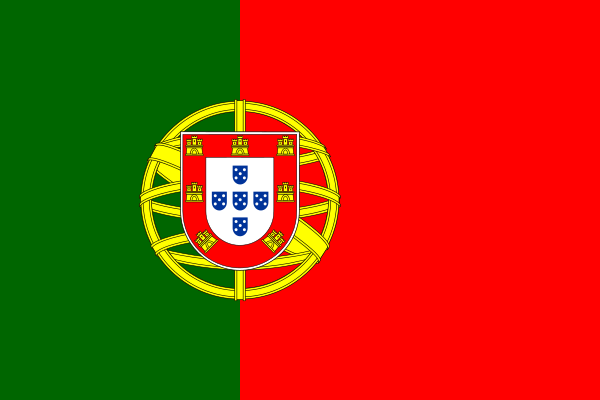
Portugal is a unitary republic located on the Iberian Peninsula in Southwestern Europe. Lisbon is the capital and largest city, with a population exceeding 10.7 million. Mainland Portugal shares borders with Spain to the north and east. Additionally, Madeira and the Azores are autonomous regions in the Atlantic Ocean. The westernmost point of continental Europe is located on the mainland.
1908: Assassination of King Carlos I and Prince Royal Luís Filipe
In 1908, King Carlos I and his son, Luís Filipe, the Prince Royal, were assassinated by republican sympathizers.


1910: Kingdom becomes a Republic
In 1910, Portugal transitioned from a kingdom to a republic.
1910: Monarchy replaced with a republic
In 1910, the monarchy in Portugal was replaced with a republic, marking a significant shift in the country's political structure.
1911: Portugal is a secular state
Portugal is a secular state since 1911 and guarantees religious freedom.
1911: Start of Savage Islands dispute
Since 1911, the Portuguese Savage Islands have been claimed by Spain.
1926: Start of Dictatorship
In 1926, a dictatorship was established in Portugal, marking a significant shift in its political landscape.
1926: Overthrow of the First Republic
In 1926, the First Republic in Portugal was overthrown due to political instability and economic weaknesses, leading to the establishment of the Ditadura Nacional.
1933: Establishment of Estado Novo
In 1933, the Ditadura Nacional in Portugal evolved into the right-wing dictatorship of the Estado Novo under António de Oliveira Salazar.
1949: Organisation of Ibero-American States
In 1949, Portugal joined the Organisation of Ibero-American States.
1949: Founded NATO
In 1949, Portugal was among the countries that founded NATO.
1950: Higher real GDP growth rates
Between 1950 and 1973, Portugal had higher real GDP growth rates.
1953: Industry accounts for 26% of the country's total GDP
Between 1953 and 1973, Portugal's industry accounted for an annual average of 26% of the country's total GDP.
1955: Member of the United Nations
In 1955, Portugal became a member state of the United Nations.
1960: Founded EFTA
In 1960, Portugal was among the countries that founded EFTA.
1961: Founded OECD
In 1961, Portugal was among the countries that founded the OECD.
1961: Regulation of Civil Procedure
In 1961, civil procedure in the Portuguese legal system was regulated by the Civil Procedure Code.
1961: Beginning of the Portuguese Colonial War
In 1961, the Portuguese Colonial War began, lasting until 1974, fueled by the marginalization of indigenous peoples due to economic development projects in overseas provinces.
1966: Regulation of Private Law
In 1966, private law in the Portuguese legal system was regulated by the Civil Code.
1966: Portugal finished third in the FIFA World Cup
Portugal finished third in the 1966 FIFA World Cup.
1973: Industry accounts for 26% of the country's total GDP
Between 1953 and 1973, Portugal's industry accounted for an annual average of 26% of the country's total GDP.
April 1974: Carnation Revolution overthrows Estado Novo
On April 25, 1974, the Carnation Revolution took place, overthrowing the Estado Novo and starting the transition to democracy in Portugal, while also initiating the dissolution of its colonial empire.
1974: Lower real GDP growth rates
Between 1974 and 2019, lower contribution of manufacturing to Portugal's economy has lead to lower real GDP growth rates.
1974: End of Portuguese Colonial War
In 1974, the Portuguese Colonial War ended, marking a significant turning point in Portugal's history.
1974: Overthrow of Dictatorship
In 1974, the dictatorship in Portugal was overthrown, paving the way for the establishment of democracy.
1976: Full establishment of Democracy
In 1976, Portugal fully established its democracy, solidifying the transition that began after the overthrow of the dictatorship.
1976: Legislative election
In 1976, Portugal held a legislative election following the transition to democracy after the Carnation Revolution.
1976: Ratification of the Constitution
In 1976, Portugal ratified its Constitution, establishing the country as a semi-presidential representative democratic republic.
1976: Establishment of autonomous regions
Since 1976, mainland Portugal and the autonomous regions of Portugal (Azores and Madeira) are the largest administrative units.
1982: Regulation of Criminal Law
In 1982, criminal law in the Portuguese legal system was regulated by the Penal Code.
1983: Full member of the Latin Union
In 1983, Portugal became a full member of the Latin Union.
1986: Portugal joined the EEC
In 1986, Portugal joined the European Economic Community (EEC), leading to substantial economic growth.
1996: Founded CPLP
In 1996, Portugal was among the countries that founded the Community of Portuguese Language Countries (CPLP).
1998: José Saramago won the Nobel Prize
José Saramago won the Nobel Prize in 1998.
1999: Dissolution of colonial empire
In 1999, the dissolution of the Portuguese colonial empire completed.
2001: Decriminalization of drug possession and consumption
In 2001, Portugal decriminalized the personal possession and consumption of all drugs, becoming the first country in the world to do so.
2002: Adoption of the Euro
In 2002, Portugal replaced the escudo with the euro as its currency.
2003: Several smaller metropolitan areas
From 2003 to 2008, several smaller metropolitan areas (Algarve, Aveiro, Coimbra, Minho, and Viseu) also held this status.
2004: Portugal finished second in the Euro
Portugal finished second in the Euro 2004.
2006: Bologna process adopted
In 2006, the Bologna process has been adopted by Portuguese universities and polytechnical institutes.
2006: Portugal finished fourth in the FIFA World Cup
Portugal finished fourth in the 2006 FIFA World Cup.
July 2007: First EU-Brazil summit
In July 2007, Portugal hosted the first EU–Brazil summit.
December 2007: Second EU-African Union summit and signing of Treaty of Lisbon
In December 2007, Portugal hosted the second EU–African Union summit and the signing of the Treaty of Lisbon.
2007: Porto Street Circuit WTCC stage
In 2007, the Porto Street Circuit held a stage of the World Touring Car Championship (WTCC).
2008: 340,000 resident foreigners acquired Portuguese citizenship
Between 2008 and 2022, more than 340,000 resident foreigners acquired Portuguese citizenship.
2008: Several smaller metropolitan areas converted into intermunicipal communities
From 2003 to 2008, several smaller metropolitan areas were converted into intermunicipal communities in 2008.
2008: Aguçadoura Wave Farm was tested
In 2008, the Aguçadoura Wave Farm, the world's first commercial wave power farm, was tested in the Aguçadoura test site.
2009: Aguçadoura Wave Farm
In 2009, Portugal has been developing renewable energies investing in the world's first commercial wave power farm, the Aguçadoura Wave Farm.
November 2010: NATO summit
In November 2010, Portugal hosted the NATO summit.
2010: Portugal captured 222,000 metric tons of fish
In 2010, Portugal captured 222,000 metric tons of fish.
2010: Beginning of Portuguese financial crisis
In 2010, Portugal faced a financial crisis that led to an international bailout and austerity measures.
2010: Secondary education compulsory
Since 2010, secondary education (three years) became compulsory in Portugal.
2012: Agricultural self-sufficiency rate of about 81%
As of 2012, Portugal had an agricultural self-sufficiency rate of about 81% due to the cultivation of wheat, maize, and rice.
2013: Decline of incarceration rate
From 2013 to 2021, the incarceration rate has steadily declined in Portugal.
2013: Porto Street Circuit WTCC stage
In 2013, the Porto Street Circuit held a stage of the World Touring Car Championship (WTCC).
2013: Local government reform
Since the 2013 local government reform, Lisbon and Porto are the only two metropolitan areas that also have the legal administrative status of metropolitan areas.
2014: End of Portuguese financial crisis
In 2014, the Portuguese financial crisis ended, but its social impacts remained.
2018: Portugal finished first in the UEFA Nations League
In 2018–19, Portugal finished first in the UEFA Nations League.
2019: Portugal is tolerant towards followers of other faiths
As of 2019, the majority of people in Portugal were shown to be tolerant towards followers of other faiths, with the Muslim community perceiving itself as thoroughly integrated.
2019: Lower real GDP growth rates
Between 1974 and 2019, lower contribution of manufacturing to Portugal's economy has lead to lower real GDP growth rates.
2019: Portugal captured 185,000 metric tons of fish
In 2019, Portugal captured 185,000 metric tons of fish, which was a decrease from 222,000 metric tons in 2010.
2019: 24th within the 41 countries of the EU and OECD in the Social Justice Index
In 2019, Portuguese society displays relatively high rates of socioeconomic equality, with the country ranking 24th within the 41 countries of the EU and OECD in the Social Justice Index.
2020: Portugal ranks sixth in the world in seafood consumption per capita
In 2020, Portugal ranked sixth in the world in seafood consumption per capita, with each Portuguese person consuming an average of 59.36 kilos of fish.
2020: Automobile industry employing 43.247 workers
In 2020, Portugal's automobile industry accounts for 20.2% of the country manufacturing exports and 82.8% of the total value of its exportations employing 43.247 workers.
2021: 80.2% of the Portuguese population are Catholic
According to the 2021 Census, 80.2% of the Portuguese population are Catholic, while 14.7% are nonreligious.
2021: Decline of incarceration rate
From 2013 to 2021, the incarceration rate has steadily declined in Portugal.
2021: Portugal phased out coal-fired generation
In 2021, Portugal phased out coal-fired generation and energy imports have since outpaced electricity exports.
2021: Barranquenho is officially recognised and protected
Since 2021, a particular dialect known as Barranquenho, spoken in Barrancos, is also officially recognised and protected in Portugal.
2022: 60.2% of births were to unmarried women
As of 2022, 60.2% of births in Portugal were to unmarried women, and 24.5% of births were to foreign born women.
2022: 340,000 resident foreigners acquired Portuguese citizenship
Between 2008 and 2022, more than 340,000 resident foreigners acquired Portuguese citizenship, constituting around 3.27% of the country's population in 2022.
2022: White (84.2%)
Between 2022 and 2023, 6.4 million people aged between 18 and 74 years old identified themselves as White (84.2%).
2022: Food insecurity
The percentage of the Portuguese population suffering from moderate or severe food insecurity between 2022 and 2024 was on average 11.9%.
2023: 55.4% of adults rated their health as good or very good
A Eurostat opinion-poll in 2023 found that 55.4% of adults rated their health as good or very good, the third lowest such rating in the European Union.
2023: Oil made up 44% of Portugal's total energy supply
As of 2023, oil made up 44% of Portugal's total energy supply while the country produced 82% of its energy from renewable sources.
2023: Only 10.1% of Portugal's land is suitable for cultivation
As of 2023, only 10.1% of Portugal's land is suitable for cultivation.
2023: White (84.2%)
Between 2022 and 2023, 6.4 million people aged between 18 and 74 years old identified themselves as White (84.2%).
2023: Personnel in the National Republican Guard
In 2023, the National Republican Guard, a gendarmerie force, comprised 23,287 personnel.
2023: Military budget
In 2023, the Portuguese military budget was more than $4 billion, representing 1.48% of GDP.
2023: At-risk-of-poverty rate
In 2023, the at-risk-of-poverty rate before social transfers stood at 40.3%.
2024: Population of 10,749,635
As of 2024, Portugal had a population of 10,749,635, with 52.2% female and 47.8% male.
2024: 8th largest motorway system among 42 European countries
As of 2024, Portugal has the 8th largest motorway system among 42 European countries, with 3,113 km of motorways out of a 14,342 km road network.
2024: Poverty rate
As of 2024, Portugal's poverty rate after social transfers is 15.4% of the population.
2024: Service sector accounted for 76.5% of the country's total economic output
As of 2024, Portugal's service sector accounted for 76.5% of the country's total economic output. Tourism, retail, and telecommunication are all major industries.
2024: Legal-resident foreigners number 1,543,697
As of 2024, legal-resident foreigners in Portugal number 1,543,697, or approximately 14% of the population.
2024: Military personnel
As of 2024, the three branches of the Portuguese Armed Forces numbered 23,678 military personnel.
2024: Total fertility rate estimated at 1.36 children born per woman
As of 2024, the total fertility rate (TFR) in Portugal was estimated at 1.36 children born per woman, one of the lowest in the world. Portugal's population was also the 11th oldest in the world, with a median age of 47.3 years.
2024: Legislative Election
In 2024, Luís Montenegro became Portugal's prime minister after the AD – PSD/CDS Coalition won enough seats to form a minority government following the Portuguese legislative election.
2024: Industry accounts for 21.2% of the country's total GDP
In 2024, Portugal's industry accounted for 21.2% of the country's total GDP.
2024: Agriculture sector accounts for 2.9% of the country's total GDP
In 2024, the Portuguese agriculture sector accounts for 2.9% of the country's total GDP.
2024: Portugal finished first in the UEFA Nations League
In 2024–25, Portugal finished first in the UEFA Nations League.
2024: Infant mortality rate stood at 2,25 deaths per 1,000 live births
Portugal's infant mortality rate stood at 2,25 deaths per 1,000 live births as of 2024.
2025: Portugal has a very high proficiency level in English
According to the EF English Proficiency Index, as of 2025, Portugal has a very high proficiency level in English, having the sixth-highest proficiency score in the world.
2025: Automobile industry produced the biggest share of the country's exportations
As of 2025, Portugal's automobile industry produced the biggest share of the country's exportations, accounting for 20.2% of the country's manufacturing exports and 82.8% of the total value of its exportations.
2025: Prison Population
As of 2025, the prison population in Portugal stood at 12,193 inmates, which is about 0.11% of the country's entire population.
2025: PPP-adjusted GDP per capita
In 2025, Portugal's PPP-adjusted GDP per capita stood at 81% of the EU average.
2025: 23rd best healthcare system in the world
In 2025, Portugal's healthcare system was ranked as the 23rd best in the world. The health system is characterised by three coexisting systems.
2025: Main export markets
In 2025, Portugal's main export markets were Spain at 26% and Germany at 13.9%.
2025: Portugal innovation ranked 16th
In 2025, the European Innovation Scoreboard ranked Portugal-based innovation as 16th, noting increases in R&D, government support, and resource productivity. Portugal was also ranked 31st on the Global Innovation Index in 2025.
2025: Median life expectancy reached 82.95 years
In 2025, the median life expectancy in Portugal reached 82.95 years.
2025: National debt
The national debt of Portugal is estimated at 89.5% relative to GDP as of 2025.
2026: 17 properties in Portugal on the World Heritage List
As of 2026, UNESCO inscribed 17 properties in Portugal on the World Heritage List.
2026: Primeira Liga, ranks 6th in the UEFA ranking
As of 2026, the country's top-level football league, the Primeira Liga, ranks 6th in the UEFA ranking.
2026: Presidential Election
In 2026, António José Seguro won the second round of the Portuguese presidential election and took office as president.
2026: Main import markets
In 2026, Portugal's main import markets were Spain at 32.9% and Germany at 11.9%.
2080: Population will fall to 7.7 million
According to projections by the national statistics office, the population will fall to 7.7 million by 2080 and the population will continue to age.
Mentioned in this timeline
China officially the People's Republic of China PRC is located...
Inflation in economics signifies a rise in the average price...
A bank is a regulated financial institution licensed to accept...
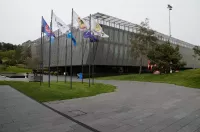
FIFA or the F d ration Internationale de Football Association...
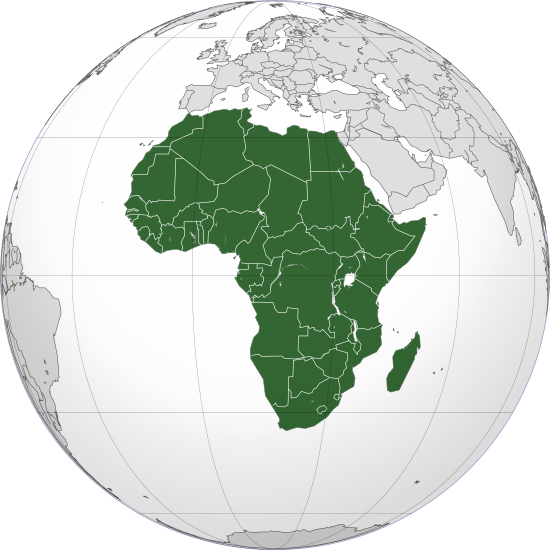
Africa is the second-largest and second-most populous continent home to...
The World Bank is an international financial institution offering loans...
Trending
4 hours ago Liudmila Samsonova Faces Lilli Tagger in WTA Osaka Round of 32 Match

4 hours ago Charlie Cox Discusses Daredevil Ending and Marvel Future After Series Cancellation

4 hours ago Shaquille O'Neal Pursues Fifth College Degree While Emphasizing Value of Real-World Experience

5 hours ago Von Miller Addresses Disappointing Start and Awaits More Playing Opportunities with Dallas Cowboys

5 hours ago Sunil Malhotra Debuts as New Voice of Apu on The Simpsons Replacing Hank Azaria

5 hours ago Speculation Grows Regarding Mike Tomlin’s Potential Move to an NFC Team
Popular

Ilhan Omar is a prominent American politician currently serving as...

Ken Paxton is an American politician and lawyer serving as...

Michael Joseph Jackson the King of Pop was a highly...

Elon Musk is a visionary entrepreneur and engineer known for...

Cristiano Ronaldo widely considered one of the greatest footballers captains...

Greta Thunberg is a Swedish climate activist who gained international...