


Qualified immunity in the U.S. protects government officials from liability in civil lawsuits. This protection applies when officials are performing discretionary functions, shielding them from damages unless they violated clearly established statutory or constitutional rights that a reasonable person would have known. It is similar to sovereign immunity but protects individual employees. The standard is less strict than absolute immunity, protecting officials who make reasonable, albeit mistaken, legal judgments, excluding only the plainly incompetent or those who knowingly break the law. Qualified immunity doesn't protect the government itself from lawsuits.
1967: Supreme Court justifies qualified immunity in Pierson v. Ray
In 1967, the Supreme Court justified qualified immunity as a means of protecting government defendants from financial burdens when acting in good faith in legally murky areas. The Court stated that a policeman should not have to choose between dereliction of duty and being mulcted in damages.


1967: Qualified immunity doctrine introduced in Pierson v. Ray
In 1967, the U.S. Supreme Court introduced the qualified immunity doctrine in Pierson v. Ray, during the civil rights movement. The doctrine aimed to protect law enforcement from frivolous lawsuits when acting in good faith in unclear legal situations.
1971: Bivens v. Six Unknown Named Agents
In 1971, Bivens v. Six Unknown Named Agents was established, arising in civil rights cases.
1982: Qualified immunity created without support in statute's text or legislative history
In 1982, U.S. District Court Judge Lynn Adelman argued that "qualified immunity is a limitation on Section 1983 that the Court created in 1982 without support in the statute's text or legislative history".
1982: Harlow v. Fitzgerald establishes modern test for qualified immunity
In 1982, the modern test for qualified immunity was established in Harlow v. Fitzgerald.
1983: Section 1983 meets Catch-22
Important constitutional questions go unanswered precisely because those questions are yet unanswered. Courts then rely on that judicial silence to conclude there's no equivalent case on the books and Section 1983 meets Catch-22.
1983: Lawsuits arising under 42 USC § 1983
In 1983, 42 USC § 1983 allowed a plaintiff to sue for damages when state officials violate their constitutional or federal rights.
1983: Criticism of qualified immunity as 'gutting' Section 1983
In 1983, critics argued that the Supreme Court's creation of qualified immunity amounts to "gutting" Section 1983 of the United States Code, which allows any citizen to sue a public official who deprives them "of any rights, privileges, or immunities secured by the Constitution and laws".
1983: Yale Law Journal paper Section 1983 cases
In 2017, UCLA law professor Joanna C. Schwartz examined 1,183 Section 1983 cases in a Yale Law Journal paper titled "How Qualified Immunity Fails".
1983: Impact of the Notwithstanding Clause
In 2023, Questions regarding the impact of the Notwithstanding Clause on qualified immunity doctrine were presented to the U.S. Supreme Court in a petition for a writ of certiorari in the case of Hulbert v. Pope, which was denied in relation to 42 U.S.C. § 1983.
1983: Court's basis for qualified immunity
The Court has stated that it bases qualified immunity on three factors: a "good faith" defense at common law, making up for the supposedly mistaken broadening of § 1983, and serving as a "warning" to government officials.
1991: Siegert v. Gilley case
In 1991, the concept of testing whether the official action was covered by qualified immunity was first raised in the case Siegert v. Gilley, in which the Supreme Court affirmed a dismissal of a lawsuit due to a lack of clear demonstration that a constitutional right had been violated at the time of the action.
2001: Saucier v. Katz ruling on qualified immunity
In 2001, in the case of Saucier v. Katz, the court ruled in favor of Saucier due to qualified immunity. The Supreme Court held that the analysis applied to claims of excessive force is not the same as the analysis applied to the merits of the claim. The Court's decision provides a two-step inquiry into claims brought against a government official.
2001: Formalization of rigid order in Saucier v. Katz
In 2001, the U.S. Supreme Court in Saucier v. Katz formalized the rigid order, or sequencing, in which courts must decide the merits of a defendant's qualified immunity defense.
2005: Increased application of qualified immunity in excessive force cases
Around 2005, courts increasingly applied qualified immunity in cases involving excessive or deadly force by police. This application led to criticism that it became a tool to let police brutality go unpunished and deny victims their constitutional rights.
2007: Reuters report review of excess force cases
In 2007, the Reuters report reviewed over 200 cases involving excess force by police.
2009: Pearson change from mandatory sequencing to discretionary sequencing
In 2009, plaintiffs have had a more difficult time moving their case past the qualified immunity stage after the Pearson change from mandatory sequencing to discretionary sequencing.
2009: Modification of mandatory sequencing from Saucier in Pearson v. Callahan
In 2009, the Court modified the mandatory sequencing from Saucier in Pearson v. Callahan, holding that "the Saucier protocol should not be regarded as mandatory in all cases," and that its decision "does not prevent the lower courts from following the Saucier procedure; it simply recognizes that those courts should have the discretion to decide whether that procedure is worthwhile in particular cases."
2009: Pearson et al. v. Callahan overturns Saucier v. Katz
In 2009, the Supreme Court's decision in Pearson et al. v. Callahan overturned its decision in Saucier v. Katz and the two-step inquiry, giving more discretion to the lower courts.
2017: Yale Law Journal paper "How Qualified Immunity Fails"
In 2017, UCLA law professor Joanna C. Schwartz examined 1,183 Section 1983 cases in a Yale Law Journal paper titled "How Qualified Immunity Fails" and found that it was being invoked primarily when it should not have been, and therefore was being ignored or dismissed frequently.
August 2018: Judge Willett calls for reappraisal of qualified immunity analysis
In August 2018, Circuit Judge Don Willett called for "thoughtful reappraisal" of the "'clearly established law' prong of qualified-immunity analysis", citing a tendency for many courts to grant immunity based on no clear precedent, while avoiding the question of whether a Constitutional violation has occurred.
November 2018: Sixth Circuit ruling on police dog bite case
In November 2018, the United States Court of Appeals for the Sixth Circuit found that an earlier court case ruling it unconstitutional for police to sic dogs on suspects who have surrendered by lying on the ground did not apply to a case in which Tennessee police allowed their police dog to bite a surrendered suspect because the suspect had surrendered not by lying down but by sitting on the ground and raising his hands.
2018: Critique of qualified immunity in California Law Review article
In 2018, University of Chicago Law School professor William Baude stated in a California Law Review article that "there is no such defense, there was no such mistake, and lenity [warning] should not apply. And even if these things were otherwise, the doctrine of qualified immunity would not be the best response."
May 30, 2020: U.S. Representative Justin Amash proposes the Ending Qualified Immunity Act
On May 30, 2020, U.S. Representative Justin Amash proposed the Ending Qualified Immunity Act after the killing of George Floyd, stating concerns about police misconduct.
June 3, 2020: Senate resolution calling for the elimination of qualified immunity for law enforcement
On June 3, 2020, Senators Kamala Harris, Edward Markey, and Cory Booker introduced a Senate resolution calling for the elimination of qualified immunity for law enforcement.
June 4, 2020: Introduction of the Ending Qualified Immunity Act in the House of Representatives
On June 4, 2020, Representative Ayanna Pressley and 16 additional cosponsors introduced the Ending Qualified Immunity Act in the House of Representatives.
June 8, 2020: Introduction of the Justice in Policing Act of 2020
On June 8, 2020, the Justice in Policing Act of 2020 (H.R.7120) was introduced by Rep. Karen Bass. The bill's sponsorship by members of the Libertarian, Republican, and Democratic parties made it the first bill to have tripartisan support in Congress.
June 15, 2020: Supreme Court declines to hear cases revisiting qualified immunity
On June 15, 2020, the Supreme Court declined to hear cases involving revisiting qualified immunity.
June 2020: Colorado removes qualified immunity for law enforcement
In June 2020, Colorado passed the Enhance Law Enforcement Integrity Act, becoming the first state to explicitly remove qualified immunity as a defense for law enforcement officers against state law claims.
June 23, 2020: Senator Mike Braun introduces the Reforming Qualified Immunity Act
On June 23, 2020, Senator Mike Braun introduced the Reforming Qualified Immunity Act, proposing that a government employee would have to prove that there was a statute or court case in the relevant jurisdiction showing his or her conduct was authorized to claim qualified immunity.
September 12, 2020: Cosponsors of the Ending Qualified Immunity Act
As of September 12, 2020, the Ending Qualified Immunity Act had 66 cosponsors (65 Democrats and 1 Republican).
November 2, 2020: Supreme Court rules against qualified immunity for prison guards
On November 2, 2020, the Supreme Court ruled in a 7–1 per curiam decision that the 5th Circuit erred in granting two prison guards qualified immunity despite severe abuses.
2020: Reuters report on Supreme Court's favoring of police in qualified immunity cases
In 2020, a Reuters report concluded that "the Supreme Court has built qualified immunity into an often insurmountable police defense by intervening in cases mostly to favor the police".
2020: Reuters report on qualified immunity
In 2020, a Reuters report summarized that qualified immunity had become a nearly failsafe tool to let police brutality go unpunished and deny victims their constitutional rights.
March 2021: New York City Council eliminates qualified immunity
In March 2021, the New York City Council eliminated qualified immunity for city officers concerning state law claims.
April 7, 2021: New Mexico Civil Rights Act signed into law
On April 7, 2021, New Mexico's Governor Michelle Lujan Grisham signed the New Mexico Civil Rights Act, ensuring that public officials cannot use qualified immunity as a defense for violating rights under the state's constitution. This applies only to state law claims.
2022: Restriction of Bivens claims
As of 2022, the Supreme Court has severely restricted the availability of Bivens claims, which allow plaintiffs to sue for damages if federal officials violate their constitutional rights.
2023: Critique of qualified immunity in California Law Review article
In 2023, Cardozo School of Law professor Alexander Reinert critiqued qualified immunity in the context of Supreme Court derogation canon in a California Law Review article.
Mentioned in this timeline
Kamala Harris is an American politician and attorney She served...
Cory Booker is an American politician and lawyer currently serving...
The United States of America is a federal republic primarily...

California is a U S state on the Pacific Coast...
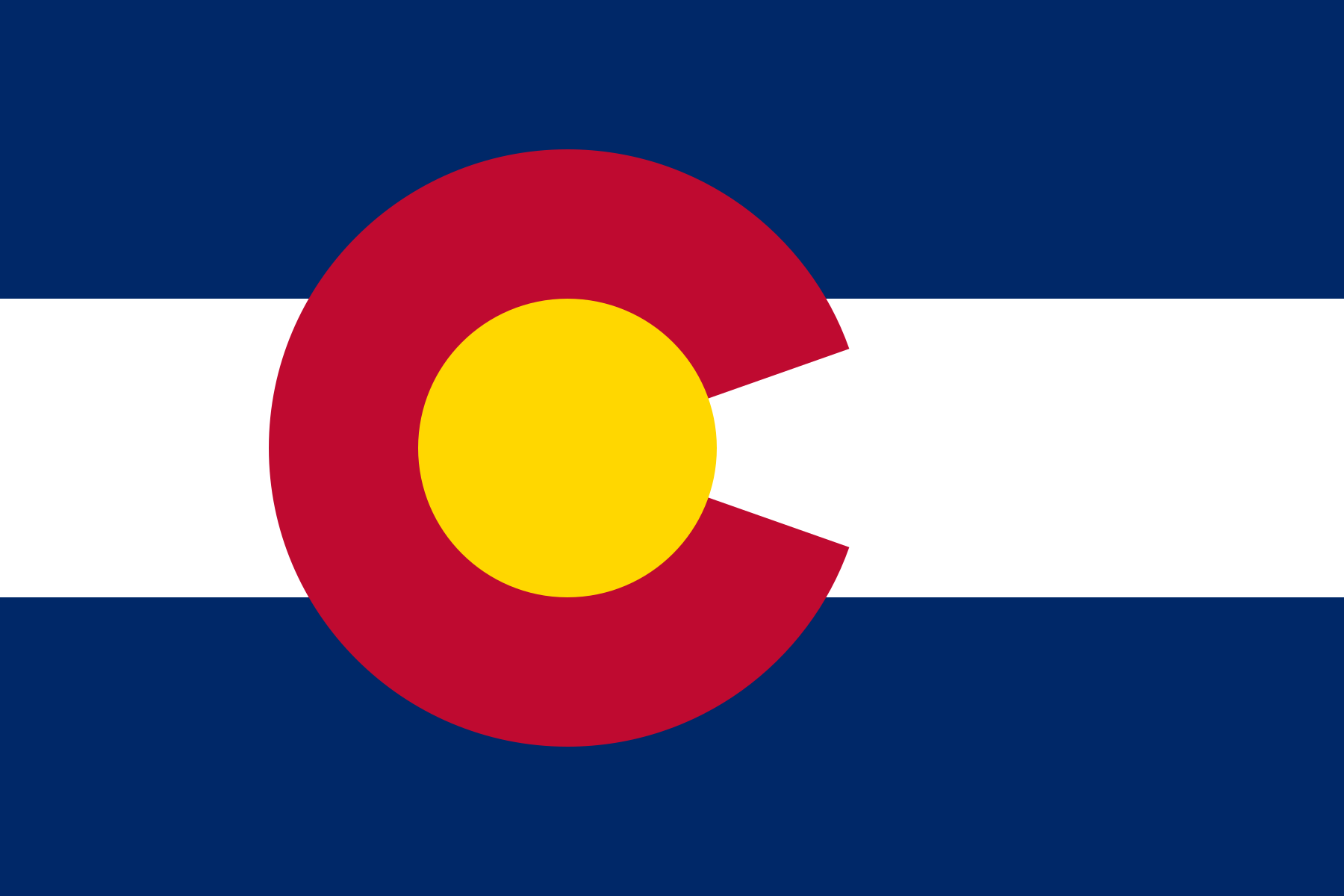
Colorado a Mountain and Southwestern U S state is the...
Karen Bass is an American politician currently serving as the...
Trending

4 hours ago Donald Trump Considers Iran Strike Strategy Amid Rising Middle East Tensions
4 hours ago Josh Brolin and Original Cast Return for Sicario 3

3 hours ago Prince Harry and Meghan Markle Plan No Apology to Prince William and Kate Middleton

4 hours ago Ashley Judd Speaks Out Against Sexual Assault at the University of Kentucky

4 hours ago Ben Affleck and Kerry Washington Collaborate on New Projects and Iconic Scenes

5 hours ago Controversy Surrounds Proposed Trump Presidential Library Development in Miami
Popular

Ken Paxton is an American politician and lawyer serving as...

Elon Musk is a visionary entrepreneur and engineer known for...

Cristiano Ronaldo widely considered one of the greatest footballers captains...

Shakira Isabel Mebarak Ripoll the Queen of Latin Music is...

Jameis Winston is an American football quarterback currently playing for...

Michael Joseph Jackson the King of Pop was a highly...