


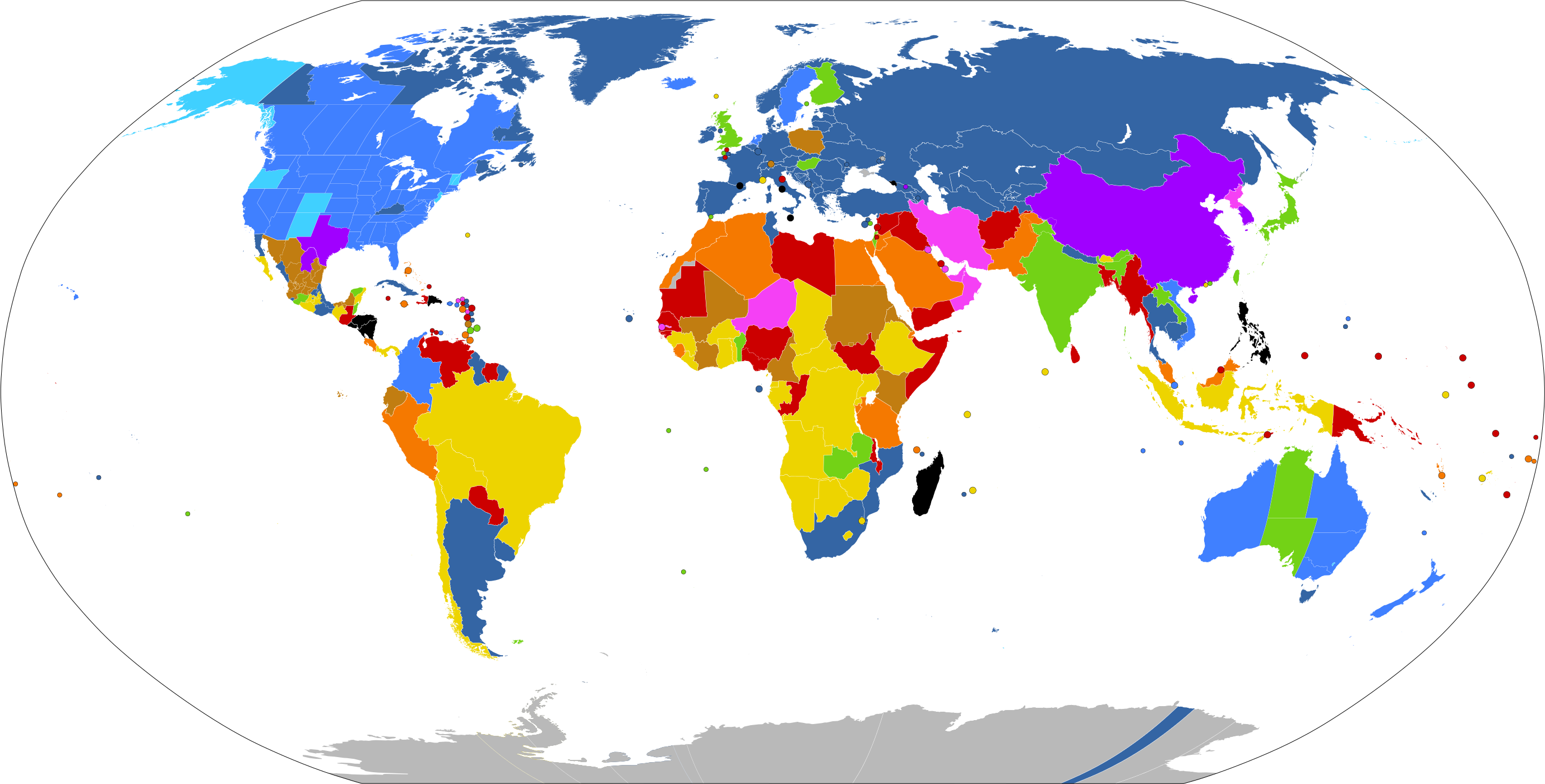
Abortion laws are diverse globally, ranging from unrestricted access to complete bans. Many countries permitting abortion impose gestational limits, often up to 12 weeks for elective procedures and longer for cases involving rape, incest, fetal anomalies, or threats to the woman's well-being. As of 2022, approximately 60% of the global population resided in countries where abortion was legal upon request or for socioeconomic reasons. France made history in 2024 by becoming the first nation to enshrine abortion rights within its constitution.
November 1920: Soviet Union Legalizes Abortion
In November 1920, the Soviet Union took a pioneering step by legalizing abortion in state hospitals under Lenin's leadership, becoming the first modern state to do so.


1920: Ireland Criminalizes Abortion Under Offenses Against Persons Act
Upon gaining independence in 1920, Ireland criminalized abortion under the Offenses Against Persons Act of 1861, reflecting the influence of the Catholic Church.
July 1921: Ukraine Legalizes Abortion
Following the Russian SFSR's lead, the Ukrainian SSR legalized abortion in July 1921, expanding access to the procedure.
1936: Stalin Restricts Abortion in the Soviet Union
In 1936, aiming to boost population growth following substantial losses during World War I and the Russian Civil War, Joseph Stalin imposed restrictions on abortion in the Soviet Union, limiting it to cases with medical justification.
1948: Nuremberg Military Tribunal Rules on Abortion as a Crime
In 1948, the Nuremberg Military Tribunal, in the case of United States v Greifelt and Others, determined that abortion fell under its jurisdiction as a crime against humanity, specifically categorized as murder and extermination.
1948: Japan Legalizes Abortion
Japan legalized abortion in 1948 through the enactment of the Eugenic Protection Law.
May 1949: Japan Amends Eugenic Protection Law
Japan amended its Eugenic Protection Law in May 1949, expanding the grounds for legal abortion to include economic reasons.
1952: Yugoslavia Legalizes Abortion
Yugoslavia took a step towards greater reproductive rights by legalizing abortion on a limited basis in 1952.
1955: Soviet Union Re-legalizes Abortion on Request
In 1955, the Soviet Union reversed its earlier restrictions and re-legalized abortion on request.
1965: Cuba Legalizes Abortion On Request
In 1965, Cuba took a pioneering step by legalizing abortion on request, making it one of the first Latin American countries to do so.
1967: UK Abortion Act
The UK's Abortion Act of 1967 provided clarity on abortion law, legalizing the procedure up to 28 weeks of pregnancy (later reduced to 24 weeks).
1969: Canada Legalizes Abortion
Canada followed the UK's lead and legalized abortion in 1969.
1973: Henry Morgentaler Acquittal
Canadian pro-choice advocate Henry Morgentaler was acquitted by a jury in 1973 in a significant court case related to abortion rights.
1973: Roe V. Wade Established in the US
The landmark Roe V. Wade ruling, establishing a constitutional right to abortion access in the United States, came into effect in 1973, marking a pivotal moment in the history of reproductive rights.
1973: Roe v. Wade and Other Legalizations
The year 1973 marked a pivotal moment in abortion law. The landmark US Supreme Court ruling in Roe v. Wade effectively legalized abortion nationwide. Additionally, Tunisia and Denmark also legalized abortion in the same year.
1974: Austria Legalizes Abortion
Austria joined the growing number of countries legalizing abortion by doing so in 1974.
1974: Overturning of Morgentaler Acquittal and Subsequent Events
In 1974, Henry Morgentaler's acquittal in the 1973 court case was overturned by five judges on the Quebec Court of Appeal. He was imprisoned, appealed the decision, and was later acquitted again. Throughout this period, he spent a total of 10 months in prison, even suffering a heart attack while in solitary confinement.
1976: West Germany Adopts New Abortion Law
Following the West German Supreme Court's overturning of a law legalizing abortion in 1975, a new law was adopted in 1976. This law permitted abortions up to 12 weeks of pregnancy.
1977: New Zealand Legalizes Abortion
New Zealand legalized abortion in 1977.
1978: Italy Legalizes Abortion
Italy took a step towards expanding reproductive rights by legalizing abortion in 1978.
1984: Netherlands Legalizes Abortion
The Netherlands legalized abortion in 1984.
1986: Ireland's Eighth Amendment Strengthens Abortion Ban
In 1986, Ireland's constitution was amended to include the Eighth Amendment, which explicitly acknowledged the right to life of the unborn. This amendment, driven by the Pro Life Amendment Campaign, further solidified the country's stance against abortion, prioritizing the fetus's right to life.
1990: Belgium Legalizes Abortion
Belgium became another European country to legalize abortion in 1990.
1992: Case of Suicidal Pregnant Teen Sparks Debate in Ireland
The case of a 14-year-old pregnant girl in 1992, who threatened suicide if denied an abortion, ignited significant debate and activism in Ireland. This case challenged the strict abortion laws and highlighted the need for greater consideration of the mother's life and mental health in such situations.
2005: UN Human Rights Committee Orders Peru to Compensate Woman Denied Abortion
In a landmark 2005 decision, the UN Human Rights Committee (UN HRC) directed Peru to compensate a woman, identified as K.L., for denying her access to a medically necessary abortion. This marked the first instance of a UN Committee holding a nation accountable for failing to ensure access to safe and legal abortion, establishing a precedent for recognizing abortion as a human right.
2007: Guttmacher Institute and WHO Study on Abortion Rates
A 2007 study by the Guttmacher Institute and the World Health Organization found that abortion rates were comparable in countries where it was legal and illegal. This was attributed to limited access to modern contraceptives in areas with abortion restrictions. The study also indicated a global decline in abortion rates due to improved access to contraception.
2008: Manuela Sentenced to 30 Years in Prison for Obstetric Emergency in El Salvador
In 2008, El Salvador, known for having some of the strictest abortion laws globally, sentenced Manuela to 30 years in prison for aggravated homicide following an obstetric emergency that resulted in the loss of her pregnancy. This case highlighted the severe consequences women in El Salvador face due to these restrictive laws, even in cases of miscarriage or stillbirth.
2010: European Court of Human Rights Rules on Abortion
The European Court of Human Rights issued a ruling in the 2010 case of A, B and C v Ireland, asserting that the European Convention on Human Rights did not explicitly grant a right to abortion.
2012: Care Quality Commission Report Reveals Circumvention of Abortion Law in UK
A 2012 report by the Care Quality Commission in the United Kingdom uncovered that several NHS clinics were bypassing the existing abortion law. These clinics employed forms pre-signed by a single doctor, effectively enabling patients to undergo abortions after consulting with only one medical professional, thereby circumventing the legally mandated procedures.
2012: Uruguay Legalizes Abortion On Request
Uruguay joined the ranks of nations permitting abortion on request in 2012, marking a significant shift in reproductive rights within Latin America.
2013: Ireland Passes Protection of Life During Pregnancy Act
After years of activism and debate, Ireland enacted the Protection of Life During Pregnancy Act in 2013. This law marked a significant shift by recognizing the mother's life as paramount and permitting pregnancy termination in cases where her life was at risk.
2013: American Convention on Human Rights Recognizes Life at Conception
As of 2013, the American Convention on Human Rights, with 23 Latin American participants, declared that human life begins at conception. This declaration reflects the strong influence of the Catholic Church in Latin America, which firmly opposes abortion legalization.
2016: K.L. Receives Compensation, UN HRC Rules on Ireland's Abortion Laws
In 2016, K.L. received the compensation awarded to her by the UN HRC in 2005. Additionally, in the 2016 case of Mellet v Ireland, the UN HRC determined that Ireland's abortion laws violated the International Covenant on Civil and Political Rights. The committee's ruling stemmed from Ireland's ban on abortion even in cases of fatal fetal abnormalities.
December 2018: Ireland's Evolving Stance on Abortion and the "Health of the Mother" Exception
Prior to December 2018, Ireland's abortion laws only permitted termination to save the mother's life, highlighting the restrictiveness of the "health of the mother" exception in practice.
2018: Ireland Legalizes First-Trimester Abortions
In a landmark decision in 2018, Ireland repealed its constitutional ban on abortion. This paved the way for the legalization of abortion up to the first trimester, with procedures covered by the country's public health service, signifying a major advancement in reproductive rights in Ireland.
2019: UN Report Highlights Global Variations in Abortion Laws
A United Nations (UN) report published in 2019, using data collected up to that year, revealed that while abortion is legally permissible in some form in nearly all countries, the specific conditions governing its accessibility vary considerably. The report indicated that in 98% of countries, abortion is allowed to safeguard a woman's life. Other widely accepted justifications for abortion include preserving physical health (72%), mental health (69%), cases of rape or incest (61%), and instances of fetal impairment (61%).
2019: UN Publishes Summary of Legal Grounds for Abortion
In 2019, the United Nations published a comprehensive table summarizing the legal grounds for abortion in all UN member states, UN General Assembly observer states, and some countries with limited recognition. This table, primarily based on data compiled by the UN up to 2019, along with updates, additions, and clarifications from other sources, provided a global overview of abortion laws.
October 2020: Geneva Consensus Declaration Signed by 33 Nations
The Geneva Consensus Declaration (GCD), a controversial international agreement seeking to limit access to abortion, was signed by 33 nations in October 2020.
November 2020: Kenyan Charities Urge Withdrawal from Geneva Consensus Declaration
In November 2020, a coalition of 20 Kenyan charities called on their government to withdraw from the Geneva Consensus Declaration (GCD). This US-led international agreement, signed by 33 nations in October 2020, aimed to restrict access to abortion for girls and women globally.
2021: Argentina Legalizes Abortion On Request
In 2021, Argentina became the largest Latin American country to legalize abortion on request, reflecting a growing trend towards expanded reproductive rights in the region.
2022: Roe V. Wade Overturned by Dobbs v. Jackson
After nearly 50 years, the landmark Roe V. Wade ruling was overturned in 2022 due to the Dobbs v. Jackson decision. This decision stripped away the constitutional right to abortion access, leading to immediate rollbacks of abortion rights in nearly half of US states, with further restrictions anticipated. This effectively made abortion inaccessible across significant portions of the country. Thirteen states, including Arkansas, Idaho, Kentucky, Louisiana, Mississippi, Missouri, North Dakota, Oklahoma, South Dakota, Tennessee, Texas, Utah, and Wyoming, immediately implemented "trigger laws." These laws, designed to take effect upon Roe's overturn, imposed varying statewide abortion bans. Other states, like Idaho, Tennessee, and Texas, with existing bans after six weeks of gestation, had similar laws set to activate 30 days after the ruling.
2022: Global Abortion Laws
As of 2022, approximately 60% of the world's population lived in countries where abortion was legally permitted on request or for socioeconomic reasons.
2022: Colombia Legalizes Abortion On Request
Colombia took a significant step towards expanding reproductive rights by legalizing abortion on request in 2022, joining a growing number of Latin American countries moving in this direction.
2023: 67 Countries Legalize or Decriminalize Abortion
As of 2023, a significant milestone was reached with 67 countries having either legalized or decriminalized abortion on request.
2024: France Protects Abortion Rights in Constitution
In a groundbreaking move, France became the first nation to explicitly enshrine the right to abortion within its constitution in 2024.
Mentioned in this timeline
Ukraine is a country in Eastern Europe the second-largest on...
Texas is the second-largest U S state by area and...

The Union of Soviet Socialist Republics USSR existed from to...
New Zealand is an island country in the southwestern Pacific...
Oklahoma is a U S state located in the South...
Colombia is a country in South America with insular regions...
Trending

3 hours ago ATP Lyon Open Quarterfinal Match Analysis: Daniel Altmaier Faces Taylor Fritz
3 hours ago Karrueche Tran Discusses Deion Sanders Cosmetic Surgery Ultimatum and Relationship

3 hours ago Elena Rybakina Extends WTA Lead Despite Setback in Quest to End Drought

3 hours ago Tennis Prediction Markets Active for Upcoming Professional Matches

3 hours ago Ryan Reynolds Celebrates Milestone 50th Birthday and Shares Insights Into His Private Family Life

4 hours ago IonQ and Quantum Computing Stocks Face Market Evaluation and Potential Industry Shakeout
Popular

Ilhan Omar is a prominent American politician currently serving as...

Ken Paxton is an American politician and lawyer serving as...

Elon Musk is a visionary entrepreneur and engineer known for...

Michael Joseph Jackson the King of Pop was a highly...

Cristiano Ronaldo widely considered one of the greatest footballers captains...

Kathy Hochul is an American politician and lawyer who has...