


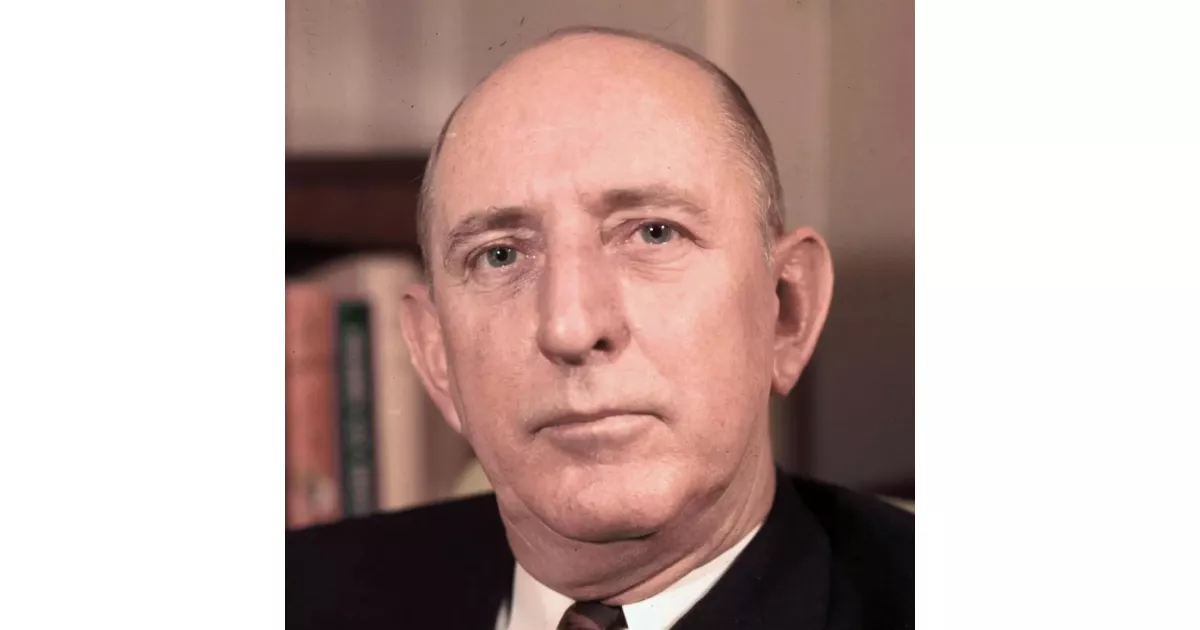
Richard Brevard Russell Jr. was a prominent American politician representing Georgia. He served as the state's 66th Governor from 1931-1933 before a nearly four-decade tenure in the U.S. Senate (1933-1971). By the end of his career, he was the Senate's most senior member. A Southern Democrat, Russell played a significant role in Southern resistance to the civil rights movement throughout his time in the Senate. His long career marked him as a key figure in 20th-century American politics, particularly concerning states' rights and racial segregation.
1908: Georgia's Disenfranchisement of Black Voters
In 1908, Georgia approved a constitutional amendment requiring a literacy test, which effectively disenfranchised most black voters, solidifying the dominance of white conservatives in state government.


1915: Russell enrolls in University of Georgia School of Law
In 1915, Richard Russell enrolled in the University of Georgia School of Law to begin his formal legal education.
1918: Russell earns law degree
In 1918, Richard Russell earned a Bachelor of Laws (LL.B.) degree from the University of Georgia School of Law.
1921: Russell serves in the Georgia House of Representatives
In 1921, Richard Russell Jr. began his service in the Georgia House of Representatives, a position he held until 1931 before becoming Governor of Georgia.
1931: Russell becomes Governor of Georgia
In 1931, Richard Russell Jr. became the 66th Governor of Georgia, holding the position until 1933.
September 1932: First Campaign for Senate
In September 1932, Richard Russell's first campaign for the Senate was held following the death of William J. Harris.
November 1932: Release of Paul Muni film based on Robert Elliot Burns' Autobiography
In November 1932, a popular Paul Muni film was released, based on Robert Elliot Burns' autobiography "I Am A Fugitive from a Georgia Chain Gang!", which detailed Burns' experiences in the Georgia penal system.
1933: Russell joins the Senate
In 1933, Richard Russell Jr. joined the Senate after winning a special election to succeed Senator William J. Harris.
1933: Russell Joins Appropriations Committee
In 1933, upon entering the Senate, Richard Russell Jr. was assigned to the Appropriations Committee, and subsequently became chairman of the Appropriations Subcommittee on Agriculture, granting him significant influence over funding for farmers.
1935: Russell continues to support the New Deal
In 1935, as a rift emerged in the Democratic Party, resulting in filibusters and deadlocks, Russell continued to support President Franklin D. Roosevelt and the New Deal.
1936: Russell Attacks Race-Baiting
In 1936, Richard Russell, during his campaign, often attacked race-baiting tactics, particularly the claim that New Deal legislation would mostly benefit black people.
1936: Russell defeats Talmadge for US Senate seat
In 1936, Russell defeated the former Democratic Governor Eugene Talmadge for the US Senate seat by defending the New Deal as good for Georgia.
1946: Russell sponsors the National School Lunch Act
In 1946, Richard Russell was the main sponsor of the National School Lunch Act, which was eventually named after him.
1948: Russell runs for President at the Democratic National Convention
In 1948, Richard Russell was a candidate for President of the United States at the Democratic National Convention.
1951: Russell becomes Chairman of the Senate Armed Services Committee
In 1951, Richard Russell became chairman of the Senate Armed Services Committee, a position he used to gain defense installations and jobs for Georgia until 1969.
1951: Russell becomes Chairman of Senate Committee on Armed Services
In 1951, Richard Russell became the Chairman of the Senate Committee on Armed Services, a position he held for most of the period until 1969, gaining defense installations and jobs for Georgia.
1952: Russell's Presidential Candidacy
In 1952, Richard Russell ran for the Democratic presidential nomination. His platform emphasized "local self-government," and he aimed to unite Southern Democrats. However, he faced opposition for his refusal to support the party's civil rights plank.
1952: Russell runs for President at the Democratic National Convention
In 1952, Richard Russell was a candidate for President of the United States at the Democratic National Convention.
1954: Supreme Court rules segregation in public schools unconstitutional.
In 1954, the US Supreme Court ruled in Brown v. Board of Education that segregation in public schools was unconstitutional. The ruling caused some senators such as Strom Thurmond, James Eastland, Allen Ellender, and John Stennis to be dispirited.
1956: Russell leads the Southern Caucus
In early 1956, Richard Russell's office was continually used as a meeting place by the Southern Caucus. Russell was the acknowledged leader of the group.
1957: Russell votes against Civil Rights Act of 1957
In 1957, Richard Russell voted against the Civil Rights Act.
1960: Russell votes against Civil Rights Act of 1960
In 1960, Richard Russell voted against the Civil Rights Act.
1960: Russell campaigns for Kennedy-Johnson ticket
In 1960, despite calling the Democratic Party platform a "complete surrender to the NAACP and the other extreme radicals at Los Angeles", Richard Russell agreed to campaign for the Kennedy-Johnson ticket for the 1960 United States presidential election.
May 1961: Kennedy requests Russell place the Presidential wreath
In May 1961, President John F. Kennedy requested Russell place the Presidential wreath at the Tomb of the Unknowns during an appearance at Arlington National Cemetery for a Memorial Day ceremony.
August 31, 1961: Closed Door Meeting for Senate Armed Services Committee
On August 31, 1961, Richard Russell scheduled a closed-door meeting for the Senate Armed Services Committee at the time of Senator Strom Thurmond requesting the committee vote on whether to investigate "a conspiracy to muzzle military anti-Communist drives."
February 1963: Senate Armed Services Committee briefed by Defense Secretary Robert McNamara.
In February 1963, the Senate Armed Services Committee was briefed by Defense Secretary Robert McNamara on policy in the Caribbean. In response to what appeared to be an attack on an American shrimp boat by a "Russian Type Plane", Russell stated that he believed that it would be policy that American airmen would strike down any "Communist jets" in international waters that were attacking vessels.
November 1963: Investigation of President Kennedy's assassination
In November 1963, Richard Russell Jr. became a member of the Warren Commission, tasked with investigating the assassination of President John F. Kennedy.
January 1964: Russell Opposes Civil Rights Legislation
In January 1964, following President Johnson's State of the Union Address, Richard Russell stated that Southern senators would oppose legislation aimed at lifting bars of discrimination, viewing it as "shortsighted and disastrous."
September 1964: Doubts About Single-Bullet Theory
In September 1964, Richard Russell Jr. expressed his disbelief in the single-bullet theory to President Johnson during a telephone conversation. Russell's papers also indicated he was troubled by the Soviet Union's lack of detail regarding Lee Harvey Oswald's time in Russia and the limited information on Oswald's Cuba-related activities.
1964: Service on the Warren Commission
In 1964, Richard Russell Jr. served on the Warren Commission. He initially expressed reservations to President Lyndon B. Johnson about serving due to his lack of confidence in Earl Warren, the commission's head. Russell was part of the commission from 1963 to 1964.
1964: Russell votes against Civil Rights Act of 1964
In 1964, Richard Russell voted against the Civil Rights Act.
1964: Russell warns Johnson against deeper involvement in Vietnam War
In 1964, Richard Russell warned President Johnson against deeper involvement in the Vietnam War.
1964: Russell boycotts the Democratic National Convention
In 1964, after Johnson signed the Civil Rights Act, Richard Russell boycotted the 1964 Democratic National Convention in Atlantic City along with more than a dozen other southern Senators.
1964: Russell boycotts Democratic National Convention after Civil Rights Act
In 1964, after President Lyndon B. Johnson signed the Civil Rights Act into law, Richard Russell led a Southern boycott of the Democratic National Convention.
1964: Russell votes against the Economic Opportunity Act
In 1964, despite sympathizing with its objectives, Russell voted against the Economic Opportunity Act, believing that the legislation was too loosely drawn and would result in huge amounts of waste.
1965: Russell votes against Voting Rights Act of 1965
In 1965, Richard Russell voted against the Voting Rights Act.
June 1968: Warren announces retirement
In June 1968, Chief Justice Earl Warren announced his decision to retire, prompting President Johnson to nominate Abe Fortas for the position. Senator Russell decided in early July to oppose Fortas, bringing most of his fellow Dixiecrats with him.
1968: Russell votes against Civil Rights Act of 1968
In 1968, Richard Russell voted against the Civil Rights Act.
1968: End of Friendship with Lyndon B. Johnson
In 1968, the 20-year friendship between Richard Russell and President Lyndon B. Johnson ended over the nomination of Abe Fortas as Chief Justice.
1969: Russell leaves Chairmanship of Senate Committee on Armed Services
In 1969, Richard Russell left his position as Chairman of the Senate Committee on Armed Services, a position he held for most of the period since 1951.
1969: Russell steps down as Chairman of the Senate Armed Services Committee
In 1969, Richard Russell stepped down as chairman of the Senate Armed Services Committee.
January 1970: Television interview on Kennedy assassination
In January 1970, Richard Russell Jr. stated in a television interview that he accepted that Oswald shot Kennedy but doubted he acted alone. He had previously written a dissenting opinion for the Warren Commission expressing his belief that 'too many things' made him doubt that Oswald planned it all alone, but this opinion was not included in the final report.
January 21, 1971: Death of Richard Russell Jr.
On January 21, 1971, Richard Russell Jr. passed away, marking the end of his nearly 40-year tenure in the United States Senate. At the time of his death, he was the most senior member of the Senate.
1971: Death from Emphysema
In 1971, Richard Russell died from emphysema while still serving in the Senate.
2020: Review of Building Names at University System of Georgia
In 2020, Sachin Shailendra and Steve Wrigley of the University System of Georgia tasked an advisory group to review the names of buildings and colleges across all campuses within the USG.
Mentioned in this timeline
John F Kennedy JFK was the th U S President...
The United States of America is a federal republic primarily...

The Union of Soviet Socialist Republics USSR existed from to...

The Vietnam War was a conflict in Vietnam Laos and...
Los Angeles California's most populous city and Southern California's hub...

Russia is the world's largest country spanning Eastern Europe and...
Trending
3 hours ago Atlanta Hawks Dominate Charlotte Hornets in Record-Breaking 128-81 Season Opener Victory

4 hours ago Paul Bettany and Owen Wilson to Guest Star on Jimmy Kimmel Live
4 hours ago Robert Griffin III Attends UCF Event Amidst Ongoing NFL Injury Updates
4 hours ago Military Boards Quietly Defy Hegseth's Ban on Transgender Troops

1 year ago Aljamain Sterling questions Sean O'Malley's stardom, personality deemed 'a little dry'.
6 hours ago Scott Frost Seeks Five Million Dollars in Legal Dispute Over Nebraska Contract Termination
Popular

Ilhan Omar is a prominent American politician currently serving as...
Ken Paxton is an American politician and lawyer serving as...

Elon Musk is a visionary entrepreneur and engineer known for...

Michael Joseph Jackson the King of Pop was a highly...

Elizabeth Holmes is an American entrepreneur and the founder of...
Barack Obama the th U S President - was the...