


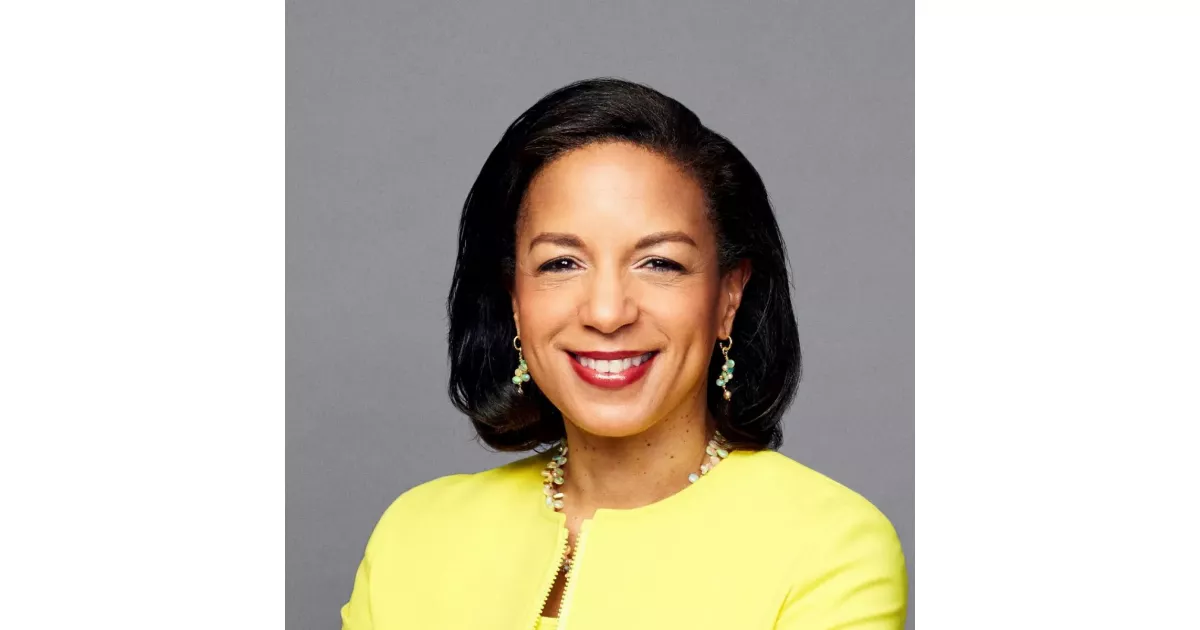
Susan Rice is an American diplomat and public official, prominent within the Democratic Party. She served as the Director of the United States Domestic Policy Council (2021-2023), U.S. Ambassador to the United Nations (2009-2013), and U.S. National Security Advisor (2013-2017). Her career reflects a deep involvement in U.S. foreign and domestic policy under Democratic administrations.
1919: Birth of Emmett J. Rice
In 1919, Emmett J. Rice, Susan Rice's father, was born. He became an economics professor and governor of the Federal Reserve System.


1933: Birth of Lois Rice
In 1933, Lois Rice (née Dickson), Susan Rice's mother, was born. She later helped design the federal Pell Grant subsidy system.
November 17, 1964: Susan Rice Born
On November 17, 1964, Susan Elizabeth Rice was born. She later became a diplomat, policy advisor, and public official in the United States.
1978: Mother's Marriage to Alfred Bradley Fitt
In 1978, Susan Rice's mother married Alfred Bradley Fitt, an attorney and general counsel of the U. S. Congressional Budget Office.
1979: Doctoral dissertation subject
Susan Rice's doctoral dissertation was on the Commonwealth Initiative in Zimbabwe, 1979–1980: Implications for International Peacekeeping.
1980: Doctoral dissertation subject
Susan Rice's doctoral dissertation was on the Commonwealth Initiative in Zimbabwe, 1979–1980: Implications for International Peacekeeping.
1986: Graduation from Stanford University
In 1986, Susan Rice graduated from Stanford University with a Bachelor of Arts (BA) with honors in history. She also won a Truman Scholarship and was elected Phi Beta Kappa.
1988: Earned Master of Philosophy (MPhil) at Oxford
In 1988, Susan Rice earned a Master of Philosophy (MPhil) in International Relations from New College, Oxford as a Rhodes Scholar.
1988: Foreign Policy Aide to Michael Dukakis
In 1988, Susan Rice served as a foreign policy aide to Michael Dukakis during his presidential campaign.
1990: Management Consultant at McKinsey & Company
From 1990, Susan Rice was a management consultant at McKinsey & Company, a global management consulting firm.
1990: Earned Doctor of Philosophy (DPhil) at Oxford
In 1990, Susan Rice earned a Doctor of Philosophy (DPhil) degree in International Relations from New College, Oxford. Her doctoral dissertation was titled "Commonwealth Initiative in Zimbabwe, 1979–1980: Implications for International Peacekeeping".
September 12, 1992: Rice marries Ian Officer Cameron
On September 12, 1992, Rice married former ABC News executive producer Ian Officer Cameron at the St. Albans School chapel in Washington D.C.
1992: Lois Rice joins the Brookings Institution
In 1992, Lois Rice, Susan Rice's mother, joined the Brookings Institution.
1992: Left McKinsey & Company
In early 1992, Susan Rice left her position as a management consultant at McKinsey & Company.
1993: National Security Council Staff
In 1993, Susan Rice began serving on President Bill Clinton's National Security Council staff.
1993: Joined National Security Council
In 1993, Susan Rice joined the National Security Council (NSC) as director for international organizations and peacekeeping.
1994: Rwandan Genocide
In 1994, during the Rwandan genocide, Rice's reported concerns about the political impact of using the term 'genocide' influenced her later views on military interventions.
1995: Special Assistant to the President and Senior Director for African Affairs
From 1995 to 1997, Susan Rice was special assistant to the president and senior director for African affairs at the National Security Council.
1996: Alleged Statement on Mobutu Sese Seko
In 1996, during the Rwandan, Ugandan, AFDL and Angolan invasion of Zaire, Susan Rice is alleged to have said that 'Anything's better than Mobutu,' referring to dictator Mobutu Sese Seko.
1997: Assistant Secretary of State for African Affairs
From 1997, Susan Rice served as the Assistant Secretary of State for African Affairs.
1997: Confirmation Hearing
In 1997, Susan Rice attended a confirmation hearing chaired by Senator John Ashcroft, along with her infant son, while being considered for the position of Assistant Secretary of State for African Affairs. She made a great impression and "sailed through the confirmation process."
1997: Allegations Regarding Sudan Intelligence Offer
In 1997, it was alleged that Susan Rice successfully lobbied for continuing to bar U.S. officials from engaging with the Khartoum government regarding intelligence on Osama bin Laden, but these allegations were later found to be unfounded by the Joint Congressional Inquiry into 9/11 and the 9/11 Commission.
July 7, 1998: Visit to Detained Nigerian President-Elect
On July 7, 1998, Susan Rice was part of an American delegation that visited detained Nigerian president-elect Basorun Moshood Kashimawo Olawale Abiola, who had a fatal heart attack during this meeting.
2000: Co-Recipient of the White House's Samuel Nelson Drew Memorial Award
In 2000, Susan Rice was named a co-recipient of the White House's Samuel Nelson Drew Memorial Award alongside Gayle Smith and Anthony Lake for her role in peace negotiations between Ethiopia and Eritrea during the Eritrean–Ethiopian War, leading to the Algiers Agreement.
2001: Managing Director and Principal at Intellibridge
From 2001, Susan Rice became managing director and principal at Intellibridge.
2001: End of term as Assistant Secretary of State for African Affairs
In 2001, Susan Rice's tenure as assistant secretary of state for African affairs came to an end.
2002: Senior Fellow at the Brookings Institution
From 2002, Susan Rice was a senior fellow at the Brookings Institution.
2002: Rice inducted into Stanford's Black Alumni Hall of Fame
In 2002, Rice was inducted into Stanford's Black Alumni Hall of Fame.
2002: Op-Ed by Timothy M. Carney
In 2002, Timothy M. Carney co-authored an op-ed alleging that in 1997, Susan Rice lobbied against engaging with the Khartoum government regarding intelligence on Osama bin Laden. These allegations were later found to be unfounded.
2004: Foreign Policy Adviser to John Kerry
In 2004, Susan Rice served as a foreign policy adviser to John Kerry during Kerry's presidential campaign.
November 5, 2008: Named to Obama-Biden Transition Advisory Board
On November 5, 2008, Susan Rice was named to the advisory board of the Obama–Biden transition.
December 1, 2008: Nomination as United States Ambassador to the United Nations
On December 1, 2008, President-elect Obama announced that he would nominate Susan Rice to be the United States ambassador to the United Nations, a position which he restored to cabinet level.
2008: Nomination as Ambassador to the United Nations
After Barack Obama won the 2008 presidential election, Susan Rice was nominated as ambassador to the United Nations.
2008: Senior Foreign Policy Adviser to Barack Obama
In 2008, Susan Rice went on leave from the Brookings Institution to serve as a senior foreign policy adviser to Barack Obama in his presidential campaign.
January 22, 2009: Senate Confirmation as Ambassador to the United Nations
On January 22, 2009, the Senate confirmed Susan Rice as ambassador to the United Nations by unanimous consent.
2009: U.S. Ambassador to the United Nations
In 2009, Susan Rice became the 27th U.S. ambassador to the United Nations.
2009: End of time as senior fellow at the Brookings Institution
In 2009, Susan Rice concluded her time as a senior fellow at the Brookings Institution.
March 17, 2011: UN Security Council Resolution 1973
On March 17, 2011, the UK, France, and Lebanon joined the U.S. to vote for United Nations Security Council Resolution 1973. Susan Rice and Hillary Clinton played significant roles in gaining approval for the resolution, aimed at protecting civilians in Libya.
April 2011: Criticism of Gaddafi and Allegations of Atrocities
In April 2011, Susan Rice criticized Muammar Gaddafi's denials of atrocities as "frankly, delusional" during the Libyan Civil War. In a closed-door Security Council meeting in April 2011, Rice reportedly stated that Gaddafi loyalists engaged in atrocities, including sexual violence, and that Gaddafi's troops had been issued Viagra. These claims were later contradicted by investigations from various organizations.
2011: Death of Emmett J. Rice
In 2011, Emmett J. Rice, Susan Rice's father, passed away. He was a Cornell University economics professor.
2011: Advocated for U.S. and NATO intervention in Libya
In 2011, Susan Rice advocated for U.S. and NATO intervention in Libya during her tenure at the United Nations.
January 2012: Condemnation of Russia and China on Syria
In January 2012, after Russia and China vetoed a Security Council resolution calling for Syrian President Bashar al-Assad to step down, Susan Rice condemned both countries for obstructing efforts to peacefully resolve the conflict, stating that the United States stood with the people of Syria.
September 11, 2012: Benghazi Attack and Subsequent Interviews
On September 11, 2012, a U.S. diplomatic facility and CIA annex in Benghazi, Libya, was attacked. In the aftermath, on September 16, Susan Rice appeared on five major interview shows to discuss the attacks using talking points from a CIA memo.
December 13, 2012: Withdrawal from Secretary of State Consideration
On December 13, 2012, Susan Rice, in a letter to President Obama, requested that her name be removed from consideration for Secretary of State due to controversy surrounding her statements about the Benghazi attack.
2012: Negotiating Style Criticisms
In 2012, Susan Rice faced criticisms regarding her negotiating style, with some diplomats calling it 'rude' and overly blunt. Some human rights activists also took issue with Rice and U.S. foreign policy for working against UN statements criticizing Rwanda.
2012: Withdrawal from Secretary of State Consideration
In 2012, Susan Rice withdrew from consideration as a possible replacement for United States Secretary of State Hillary Clinton following controversy related to the attack on a U.S. diplomatic facility in Benghazi.
2012: Review of NPR Interviews
In 2012, columnist Peter Beinart reviewed a series of NPR interviews with Susan Rice from late 2002 and early 2003 and concluded that Rice's position on war was equivocal.
2012: Interview with The New Republic
In 2012, during an interview with The New Republic, Susan Rice addressed her role during the Rwandan genocide.
June 5, 2013: Appointment as National Security Advisor
On June 5, 2013, Susan Rice was picked to succeed Tom Donilon as National Security Advisor following his resignation. The position does not require Senate approval.
July 1, 2013: Swearing-in as National Security Advisor
On July 1, 2013, Susan Rice was officially sworn in as the National Security Advisor.
August 2013: Criticism of Human Rights Violations in Egypt
In August 2013, Susan Rice criticized human rights violations in Egypt, including condemning the Rabaa massacre, where Egyptian security forces killed over 1,000 people. Rice then led a review of U.S. assistance to Egypt, resulting in the cancellation of military exercises and suspension of arms shipments.
August 2013: Opposition to Congressional Authorization for Military Strikes Against Syria
In August 2013, Susan Rice was the lone dissenter in Obama's national security team against seeking congressional authorization for military strikes against Syria's chemical weapons facilities, following the Assad regime's use of sarin gas. Instead, Rice and Kerry pursued a diplomatic solution with Russia, leading to United Nations Security Council Resolution 2118.
2013: Appointment as National Security Advisor
In 2013, President Barack Obama named Susan Rice as national security advisor.
2013: U.S. National Security Advisor
In 2013, Susan Rice became the 23rd U.S. National Security Advisor.
July 2014: Support for Israel's Right to Self-Defense
In July 2014, Susan Rice expressed support for Israel's right to defend itself during the 2014 Israel–Gaza conflict.
2015: Criticism of Netanyahu's planned Speech to Congress
In 2015, Susan Rice criticized Israeli Prime Minister Benjamin Netanyahu for agreeing to speak to Congress about Iran's nuclear program without coordinating with the Obama administration.
2015: Release of the 2015 National Security Strategy
In 2015, Susan Rice released the 2015 National Security Strategy, outlining an "ambitious yet achievable agenda" for U.S. foreign policy and national security during the final two years of Obama's second term. She highlighted U.S. leadership on issues like Ebola, Iran's nuclear program, and sanctions against Russia.
2015: Visit to Pakistan and Warning on Militant Attacks
In 2015, Susan Rice visited Pakistan and warned political and military leaders that militant attacks in Afghanistan by groups based in Pakistan threatened regional security. She also extended an invitation from Obama for Prime Minister Nawaz Sharif to visit the United States.
2015: Supported Iran Nuclear Deal
In 2015, as National Security Advisor, Susan Rice supported U.S. efforts on the Iran nuclear deal.
2015: Remarks on Chinese Intelligence Operations
In a 2015 speech on China–United States relations, Susan Rice addressed the issue of Chinese intelligence operations in the United States, stating that it was a significant economic and national security concern that strained bilateral relations.
December 2016: Visit to the United States by UAE crown prince Mohammed bin Zayed Al Nahyan
In December 2016, United Arab Emirates crown prince Mohammed bin Zayed Al Nahyan visited the United States. During the visit, al-Nahyan met with Trump campaign advisors Steve Bannon, Michael Flynn, and Jared Kushner at Trump Tower in New York.
2016: Period of investigation into unmasking requests
During the 2016 election period and the ensuing presidential transition, as investigated by John Bash, no evidence was found of improper unmasking requests.
2016: Support for Arms Embargo Against South Sudan
In 2016, Susan Rice joined calls for an arms embargo against South Sudan due to the civil war and reported atrocities, but the measure failed to pass at the UN Security Council.
2016: Negotiation of Military Assistance Package for Israel
In 2016, Susan Rice negotiated a new memorandum of understanding between the U.S. and Israel for $38 billion in military assistance, the largest such package in Israel's history.
March 8, 2017: Appointment as Visiting Research Fellow at American University
On March 8, 2017, Susan Rice became a distinguished visiting research fellow in the School of International Service (SIS) at American University, where she planned to work on her next book and mentor students.
April 3, 2017: Report on Request to Unmask Trump Officials
On April 3, 2017, it was reported that as National Security Advisor, Susan Rice had requested the unmasking of some Americans mentioned in intelligence reports related to Donald Trump's campaign and presidential transition. Rice stated she requested the identities to provide context to the intelligence reports, not for political purposes.
August 2017: McMaster's Conclusion on Rice's Actions
In August 2017, it was reported that H. R. McMaster, Susan Rice's successor as National Security Advisor, had concluded that Rice did nothing wrong regarding the unmasking of Trump officials.
September 2017: Testimony to House Intelligence Committee
In September 2017, Susan Rice testified to the House Intelligence Committee that she requested the unmasking due to a redacted intelligence report about an undisclosed visit to the United States by UAE crown prince Mohammed bin Zayed Al Nahyan in December 2016, during which he met with Trump campaign advisors at Trump Tower. Her testimony appeared to alleviate Republican concerns.
2017: Death of Lois Rice
In 2017, Lois Rice (née Dickson), Susan Rice's mother, passed away. She was an education policy scholar.
2017: Rice named commander of the Legion of Honour
In 2017, President François Hollande named Rice a commander of the Legion of Honour for her contributions to Franco-American relations.
2017: End of term as U.S. National Security Advisor
In 2017, Susan Rice's term as the 23rd U.S. National Security Advisor came to an end.
March 28, 2018: Appointment to Netflix Board of Directors
On March 28, 2018, Susan Rice was appointed to the board of directors at Netflix.
April 2019: Rice decides not to run for Senate
In April 2019, Rice announced that she would not run for Senate, after publicly considering challenging Susan Collins in 2020.
May 2020: Barr appoints Bash to examine unmasking
In May 2020, Attorney General Bill Barr appointed federal prosecutor John Bash to examine unmasking conducted by the Obama administration.
June 2020: Rice criticizes Israeli proposals
In June 2020, Rice criticized Israeli proposals to annex parts of the West Bank and Jordan Valley, arguing it would undermine bipartisan support for Israel in the U.S.
July 2020: Rice considered as VP running mate
In July 2020, Rice was widely reported to be under consideration as Joe Biden's vice presidential running mate.
August 11, 2020: Harris selected as Biden's running mate
On August 11, 2020, Kamala Harris was selected as Joe Biden's running mate, instead of Susan Rice, in the 2020 general election.
September 5, 2020: Rice joins Biden-Harris Transition Team
On September 5, 2020, Rice was announced as a member of the advisory council of the Biden-Harris Transition Team, which planned Biden's presidential transition.
October 2020: Inquiry into unmasking concludes
In October 2020, the inquiry led by John Bash into unmasking during the Obama administration concluded with no findings of substantive wrongdoing.
2020: Rice considers challenging Susan Collins
In 2020, after U.S. senator Susan Collins from Maine voted to confirm Brett Kavanaugh to the Supreme Court, Rice publicly considered challenging Collins.
2021: Director of the Domestic Policy Council
From 2021, Susan Rice was the director of the Domestic Policy Council in the Biden administration.
2021: Director of the United States Domestic Policy Council
In 2021, Susan Rice became the 22nd director of the United States Domestic Policy Council.
May 2022: Release of Bash's report
In May 2022, Bash's 52-page report regarding the unmasking inquiry during the Obama administration was released, previously classified top secret. The report found no evidence of improper unmasking requests during the 2016 election period or the presidential transition.
April 2023: Rice possibly negligent in migrant child labor crisis response
In April 2023, journalist Hannah Dreier suggested in a New York Times article that Rice was among the leading White House officials who may have been negligent in response to the uncovered migrant child labor crisis.
April 24, 2023: Biden announces Rice's departure
On April 24, 2023, President Biden announced that Rice would be departing from her position as director of the Domestic Policy Council on May 26, 2023.
May 24, 2023: Rice touts work in domestic and national security policy initiatives
On May 24, 2023, Rice touted her work in domestic and national security policy initiatives during her tenure at the White House.
May 25, 2023: U.S. National Strategy to Counter Antisemitism launched
On May 25, 2023, Rice was part of the Biden administration team that launched the U.S. National Strategy to Counter Antisemitism.
May 26, 2023: Rice's departure from Domestic Policy Council
On May 26, 2023, Rice departed from her position as director of the Domestic Policy Council.
2023: End of term as Director of the Domestic Policy Council
From 2021 to 2023, Susan Rice served as the director of the Domestic Policy Council in the Biden administration.
2023: End of term as Director of the United States Domestic Policy Council
In 2023, Susan Rice's term as the 22nd director of the United States Domestic Policy Council ended.
Mentioned in this timeline

Donald John Trump is an American politician media personality and...

Barack Obama the th U S President - was the...

Hillary Diane Rodham Clinton is a prominent American politician lawyer...
Joe Biden served as the th President of the United...

Benjamin Netanyahu is a prominent Israeli politician who has served...
Kamala Harris is an American politician and attorney She served...
Trending

4 hours ago Alexander Zverev Advances at China Open Amidst Criticism of Masters 1000 Tournament Structures
4 hours ago Electric Vehicles Overtake Gasoline and Diesel Sales in European Market

4 hours ago Houston Cougars Unveil Unique Space-Themed Gridiron Galaxy Helmets for UCF Game

6 hours ago Tennis Updates and Prediction Market Trends Featuring Professional Players
7 hours ago WTA China Open Beijing Tennis Match Predictions and Updates

7 hours ago 2026 Bahrain Grand Prix Unexpectedly Held at Malaysia's Sepang International Circuit
Popular

Jameis Winston is an American football quarterback currently playing for...

Ken Paxton is an American politician and lawyer serving as...

Sylvester Stallone is an iconic American actor screenwriter and filmmaker...

Shakira Isabel Mebarak Ripoll the Queen of Latin Music is...

Elon Musk is a visionary entrepreneur and engineer known for...

Bernie Sanders is a prominent American politician and the senior...