


Marilyn Monroe’s 'Woman'—often discussed in the context of Joyce Carol Oates’s fictionalized biographical novel 'Blonde'—explores the tragic dichotomy between Norma Jeane Mortenson’s private vulnerability and her public persona as the quintessential 20th-century sex symbol. The narrative deconstructs the brutal demands of the Hollywood studio system, the exploitation of female identity, and the relentless scrutiny of the media. It portrays her struggle with mental health, fractured relationships, and the yearning for artistic legitimacy. Ultimately, the story serves as a haunting critique of celebrity culture, illustrating how the icon 'Marilyn' consumed the woman 'Norma Jeane,' leading to a profound sense of isolation and her untimely death. The work acts as a poignant meditation on the cost of fame and the search for authentic selfhood in a world that only values a manufactured image.
1900: Baseline female labour force participation
In 1900, the participation of married women in the United States labour force was recorded at approximately 5.6 to 6 percent, representing a period where employment was predominantly focused on industrial factory roles.


1923: Increase in married women's workforce participation
By 1923, the participation rate of married women in the U.S. labour force rose significantly to 23.8 percent, coinciding with a shift toward office-based employment that required higher levels of education.
1969: Foundation of Komitée für das Frauenstimmrecht
In 1969, the Komitée für das Frauenstimmrecht was founded in Liechtenstein to advocate for women's suffrage.
1989: Harvard University Tenures First Woman in Chemistry
In 1989, Harvard University appointed Cynthia Friend as the institution's first woman to receive tenure in the field of chemistry.
1992: Harvard University Tenures First Woman in Physics
In 1992, Harvard University achieved a milestone by tenuring Melissa Franklin, who became the first woman to hold a tenured position in the university's physics department.
1992: Disparity in Engineering Academia
In 1992, although women earned 9 percent of PhDs in the field of engineering, only one percent of those graduates successfully transitioned into professor roles.
1994: Tenure Disparity in Psychology
Despite women earning the majority of PhDs in the field of psychology, in 1994 they held only 19 percent of the available tenured academic positions.
1995: Representation of Women in Science and Engineering Faculty and Leadership
By 1995, women accounted for 11 percent of professors within science and engineering disciplines, and represented less than 1 percent of engineering school deans with only 311 women in those positions.
2000: Baseline for Maternal Mortality Reduction
The year 2000 serves as the baseline for a global trend that saw the rate of maternal mortality decrease by 40% between 2000 and 2023.
2005: Educational Achievement Milestone
During the 2005/2006 academic year, women in the United States reached a significant educational milestone, earning a majority of degrees including 62% of associate degrees, 58% of bachelor's degrees, 60% of master's degrees, and 50% of doctorates.
2005: Women's Suffrage Granted in Kuwait
In 2005, women in Kuwait officially gained the legal right to vote, marking a significant milestone in the country's political history.
2006: Continued Educational Dominance
By the conclusion of the 2005/2006 academic year in 2006, data confirmed that women in the United States had surpassed men in educational attainment, securing 62% of associate degrees, 58% of bachelor's degrees, 60% of master's degrees, and 50% of doctorates.
2010: World Health Organization Statistical Reporting Period Commencement
Starting in 2010, the World Health Organization began the collection and analysis of data regarding global induced abortion statistics, which ultimately indicated that 56 million abortions occurred annually through 2014.
2011: Execution for Witchcraft in Saudi Arabia
In 2011, a woman was executed by beheading in Saudi Arabia following her conviction for the crimes of witchcraft and sorcery, reflecting the country's ongoing legal stance on these practices.
2012: Underrepresentation of Women in the Vienna Philharmonic
As of 2012, women accounted for only 6% of the musicians in the top-ranked Vienna Philharmonic orchestra, underscoring ongoing gender gaps within prestigious orchestral institutions.
2014: Conclusion of World Health Organization Abortion Data Study
By the conclusion of the 2010-2014 reporting period in 2014, the World Health Organization identified that approximately 25 million of the 56 million annual induced abortions worldwide were classified as unsafe, leading to significant maternal mortality rates.
2015: Gender Disparity in Montreal Symphony Orchestra Soloists
In 2015, an article revealed that 84% of concerto soloists performing with the Montreal Symphony Orchestra were men, highlighting a significant gender imbalance in classical music solo performance.
2015: Global Gender Population Ratio Analysis
In 2015, global demographic data indicated that there were approximately 1018 men for every 1000 women within the total human population.
2015: Women's Suffrage Granted in Saudi Arabia
The year 2015 saw a major change in Saudi Arabian law as women were granted the right to vote for the first time.
January 2019: Global representation of women in national assemblies
In January 2019, statistics indicated that women remained underrepresented in government worldwide, with the global average of women serving in national assemblies recorded at 24.3%.
2020: Global Gender Literacy Gap
In 2020, statistics showed that 87% of women globally were literate compared to 90% of men, with specific regional disparities highlighted by a 59% literacy rate for women in sub-Saharan Africa.
2023: Global Maternal Mortality Statistics
In 2023, approximately 260,000 women globally died due to complications related to pregnancy, delivery, or abortion, with the vast majority of these preventable deaths concentrated in low-income regions like sub-Saharan Africa and South Asia.
2025: Status of Women's Voting Rights in Vatican City
As of 2025, women in Vatican City are permitted to vote only within a limited lay capacity, highlighting ongoing restrictions.
Mentioned in this timeline
The United States of America is a federal republic primarily...

Nigeria located in West Africa is the continent's most populous...

Saudi Arabia officially the Kingdom of Saudi Arabia KSA is...
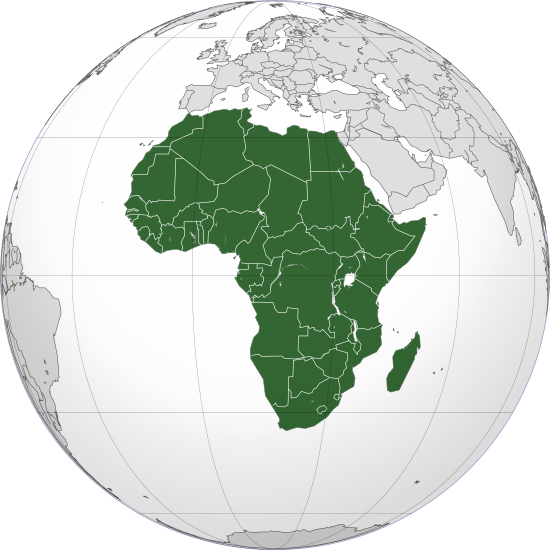
Africa is the second-largest and second-most populous continent home to...

Music involves arranging sounds to create form harmony melody rhythm...

The World Health Organization WHO is a specialized agency of...
Trending

4 hours ago Skeet Ulrich Discusses Scream Franchise Future Following Melissa Barrera’s Departure

4 hours ago Stephanie Vaquer Defends Women's World Title At WWE Money in the Bank Event
4 hours ago Dameon Pierce Emerges as Potential Replacement Amidst Philadelphia Eagles Running Back Injury Crisis
4 hours ago Kamil Majchrzak Faces Yannick Hanfmann at the 2026 ATP Shanghai Masters Tournament

6 hours ago Coco Gauff Faces Elise Mertens in WTA China Open Round of 16 Match

6 hours ago Tennis Prediction Markets for Upcoming October 2026 Matches
Popular

Ken Paxton is an American politician and lawyer serving as...

Elon Musk is a visionary entrepreneur and engineer known for...

Cristiano Ronaldo widely considered one of the greatest footballers captains...

Shakira Isabel Mebarak Ripoll the Queen of Latin Music is...

Jameis Winston is an American football quarterback currently playing for...

Bernie Sanders is a prominent American politician and the senior...