History of Angola in Timeline


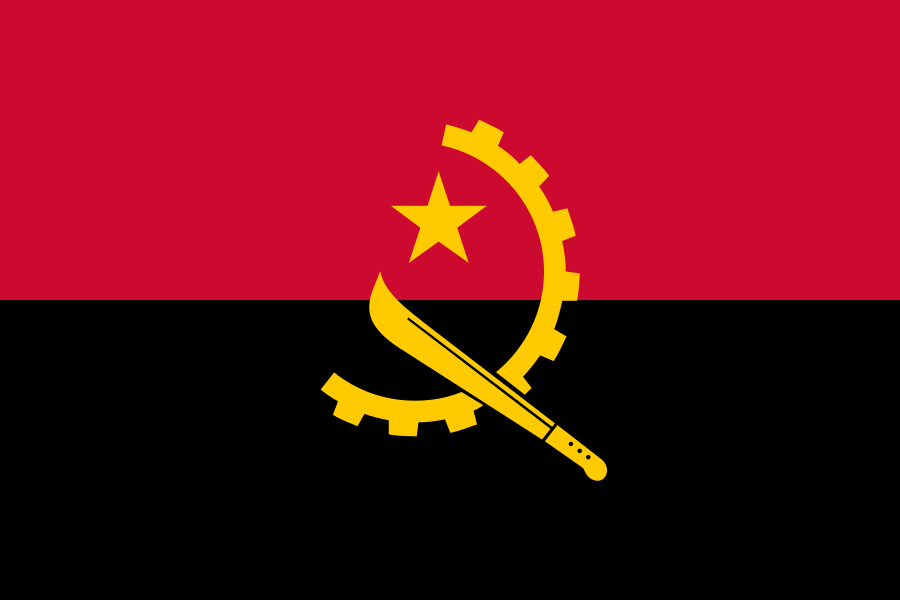
Angola is a country located on the western coast of Southern Africa. It is the second-largest Portuguese-speaking country, after Brazil, in both area and population, and the seventh-largest country in Africa. Angola is bordered by Namibia to the south, the Democratic Republic of the Congo to the north, Zambia to the east, and the Atlantic Ocean to the west. The country includes the exclave province of Cabinda. Luanda is its capital and most populous city.
1925: Vernay Expedition
In 1925, Arthur Stannard Vernay, an English-born American naturalist explorer, conducted an expedition to Angola.


1939: Portuguese Army Operations against the Mucubal
Between 1939 and 1943, the Portuguese army carried out operations against the Mucubal people in Angola, resulting in numerous deaths and imprisonment in concentration camps.
1943: Prisoners Deaths in Captivity
Between 1939 and 1943, many Mucubal prisoners died in captivity from undernourishment, violence and forced labour.
1951: Temperature increase
Since 1951, Angola's annual average temperature has increased by 1.4°C due to climate change.
October 1961: MPLA Attempts to Move Headquarters and Create Common Front
In October 1961, the MPLA attempted to move its headquarters and create a common front with the FNLA, but the offer was declined, leading to conflict.
1961: Armed conflict since 1961
Angola experienced almost continual armed conflict from 1961.
1961: Factionalism Hampering Nationalist Movements
Between 1961 and 1975, political and military factionalism severely hampered the three rival nationalist movements in Angola.
1961: Start of Anti-Colonial Struggle
In 1961, Angola began a protracted anti-colonial struggle against Portugal.
1961: Baixa de Cassanje Revolt
In 1961, the Baixa de Cassanje revolt erupted, marking the beginning of an armed conflict and a protracted war of independence in Angola.
1966: Founding of UNITA
In 1966, the National Union for the Total Independence of Angola (UNITA), a guerrilla movement, was founded by Jonas Savimbi.
1968: Cabinda Gulf Oil Company discovered oil under Portuguese rule from 1968 onwards
Most of Cabinda's oil along its coast was discovered under Portuguese rule by the Cabinda Gulf Oil Company (CABGOC) from 1968 onwards.
1972: Release of Sambizanga
In 1972, Sarah Maldoror's film, Sambizanga, was released at the Carthage Film Festival winning the Tanit d'Or.
1974: End of Anti-Colonial Struggle
In 1974, the protracted anti-colonial struggle in Angola came to an end.
January 1975: Mombasa Agreement
In early January 1975, the leaders of the FNLA, UNITA, and MPLA met in Mombasa and agreed to form a coalition government.
March 1975: Violence Breaks Out in Luanda
In March 1975, sporadic violence broke out in Luanda after the FNLA attacked the MPLA's political headquarters.
August 1975: MPLA Requests Soviet Assistance
In August 1975, the MPLA requested direct military assistance from the Soviet Union, which declined to send troops but offered advisors, while Cuba sent combat personnel.
November 1975: Independence Date Set
In January 1975, the Alvor Agreement set Angola's independence date for 11 November 1975.
1975: Competition Among MPLA, UNITA, and FNLA
Between 1961 and 1975, the MPLA, UNITA, and the FNLA competed for influence in Angola, with the Soviet Union and Cuba backing the MPLA.
1975: Implementation of Scientific Socialism
Between 1975 and 1991, the MPLA implemented a political and economic system in Angola based on scientific socialism, including nationalization.
1975: Independence and Civil War
In 1975, Angola achieved independence as a one-party republic but immediately descended into a devastating civil war involving multiple factions.
1975: Angolan Civil War Start
In 1975, the Angolan Civil War began, leading to significant damage to the education system, including the looting and destruction of nearly half of all schools.
1975: Highest level of destruction after the 1975 independence
The highest level of destruction and socio-economic damage in Angola took place after the 1975 independence, during the long years of civil war.
1977: Attempted Coup by OCA
In 1977, the ruling MPLA in Angola survived an attempted coup d'état by the Maoist-oriented Communist Organisation of Angola (OCA).
1990: Forest Cover in 1990
In 1990, forest cover in Angola was around 79,262,780 hectares (ha) of forest.
1990: MPLA Abandons Marxism
In 1990, the MPLA abandoned its Marxist ideology and declared social democracy as its new platform.
May 1991: Bicesse Accords Reached
In May 1991, Angola reached a peace agreement with UNITA, the Bicesse Accords, scheduling general elections for September 1992.
1991: End of Scientific Socialism
Between 1975 and 1991, the MPLA implemented a political and economic system in Angola based on scientific socialism, including nationalization.
September 1992: General Elections and UNITA Objections
In September 1992, general elections were held in Angola, but UNITA objected to the results and returned to war.
1995: 1995 census estimated Cabinda's population
According to a 1995 census, Cabinda had an estimated population of 600,000, approximately 400,000 of whom were citizens of neighbouring countries.
1995: School Attendance Rate
In 1995, 71.2 percent of children ages 7 to 14 years in Angola were attending school, although disparities existed between rural and urban areas.
1997: Open Society Foundations Launched Activities
In 1997, George Soros's Open Society Foundations launched its activities in Angola.
1998: Net Primary Enrollment Rate
In 1998, the most recent year for which data are available, Angola's net primary enrollment rate was 61 percent, reflecting the percentage of students of official primary school age who are enrolled.
1999: Gross Primary Enrollment Rate
In 1999, Angola's gross primary enrollment rate was 74 percent, indicating the proportion of students enrolled in primary school regardless of their age.
2001: Literacy Rates by Gender
As of 2001, 82.9% of men and 54.2% of women in Angola were literate.
2001: Angola's highest annual average GDP growth between 2001 and 2010
In the period 2001–10, Angola had the world's highest annual average GDP growth, at 11.1%.
February 2002: Death of Jonas Savimbi
On 22 February 2002, Jonas Savimbi, the leader of UNITA, was killed in a skirmish with government troops in Angola.
2002: Political stability achieved in Angola in 2002
Although Angola achieved political stability in 2002, its economy has grown significantly since then, mainly due to fast-rising earnings in the oil sector, the country faces huge social and economic problems.
2002: End of Angolan Civil War
In 2002, the Angolan Civil War ended, after causing widespread damage to the education system and infrastructure.
2002: Recovery of agriculture after the Angolan Civil War in 2002
Smallholder and plantation agriculture dramatically dropped during the Angolan Civil War, but began to recover after 2002.
2002: Resettlement of displaced persons following peace settlement of 2002
The security brought about by the 2002 peace settlement in Angola allowed the resettlement of 4 million displaced persons and a resulting large-scale increase in agriculture production.
2003: Manifesto for Portuguese Right-Wing Party
In 2003, Diogo Pacheco de Amorim created a manifesto for the Portuguese right-wing party New Democracy which inspired the separatist movement in Angola.
2004: Increased Budgetary Allocations for Education
In 2004, budgetary allocations for education in Angola were increased, but the education system continued to be extremely under-funded.
2004: End of initial collaboration
In 2004, the initial collaboration between George Soros's Open Society Foundations and the Angolan government on developing primary school education ended.
2005: Angola's average GDP growth in 2005
Angola experienced an average GDP growth of 20% between 2005 and 2007, becoming the fastest-growing economy in Africa and one of the fastest-growing in the world.
2005: Angola's economy grew 18% in 2005
Angola's economy grew 18% in 2005.
2005: Teacher Recruitment and Training
In 2005, the Ministry of Education in Angola recruited 20,000 new teachers and continued to implement teacher training programs to address the shortage of qualified educators.
2006: Angola's economy grew 26% in 2006
Angola's economy grew 26% in 2006.
2006: Angola's First FIFA World Cup Appearance
In 2006, the Angola national football team qualified for the FIFA World Cup for the first time, but were eliminated after the group stage.
2007: Angola's average GDP growth in 2007
Angola experienced an average GDP growth of 20% between 2005 and 2007, becoming the fastest-growing economy in Africa and one of the fastest-growing in the world.
2007: Angola's economy grew 17.6% in 2007
Angola's economy grew 17.6% in 2007.
2007: Angola ranked forty-two of forty-eight sub-Saharan African states in 2007
In 2007, Angola ranked forty-two of forty-eight sub-Saharan African states on the Index of African Governance list.
2007: Separatist Movement Launched
In 2007, a separatist movement was launched in the diamond-rich Lunda Norte Province of Angola.
June 2008: Institutionalisation of the Constitutional Court in June 2008
In June 2008, specifically on 25 June 2008, the Constitutional Court in Angola was institutionalised, and its Judicial Counsellors assumed their positions before the President of the Republic.
September 2008: Validation of Candidacies for Legislative Elections of 2008
In September 2008, the Constitutional Court in Angola validated the candidacies of the political parties for the legislative elections of 5 September 2008.
2008: Study on poverty in Angola in 2008
A study carried out in 2008 by the Angolan Instituto Nacional de Estatística found that roughly 58% in rural areas and only 19% in the urban areas are "poor" according to UN norms, and an overall rate of 37%.
2008: Elections Held
Following the elections in 2008 and 2012, an MPLA-ruled dominant-party system emerged in Angola.
2009: Angola's economy contracted an estimated −0.3% in 2009
Due to the global recession, the economy of Angola contracted an estimated −0.3% in 2009.
2010: Africa Cup of Nations Hosted by Angola
In 2010, Angola hosted the Africa Cup of Nations, marking a significant event in the country's football history.
2010: New constitution adopted in 2010
In 2010, a new constitution was adopted in Angola, doing away with presidential elections and introducing a system where the president and vice-president of the winning party in parliamentary elections automatically assume those roles.
2010: Angolan Media Libraries Network
In 2010, the Angolan government initiated the Angolan Media Libraries Network project, establishing facilities throughout the country to enhance public access to information and knowledge.
2010: Constitution of 2010 established broad outlines of government structure
In 2010, the Constitution of 2010 established the broad outlines of government structure and delineated the rights and duties of citizens in Angola.
2011: Split in Separatist Movement
In 2011, a hardline faction split from the Commission of the Legal-Sociological Manifesto of the Lunda Tchokwé Protectorate (CMJSPLT) in Angola.
2011: Bilateral trade between China and Angola reached $27.67 billion in 2011
In 2011, bilateral trade between China and Angola reached $27.67 billion, representing an 11.5% year-on-year increase. China's imports, mainly crude oil and diamonds, increased 9.1% to $24.89 billion, while China's exports to Angola, including mechanical and electrical products, machinery parts, and construction materials, surged 38.8%.
2011: Runner-up in African Nations Championship
In 2011, the Angola national football team finished as runner-up in the African Nations Championship.
2011: Adult Literacy Rate
In 2011, the adult literacy rate in Angola was estimated to be 70.4% according to the UNESCO Institute for Statistics.
August 2012: 2012 parliamentary elections in Angola
In August 2012, the parliamentary elections in Angola, in which the ruling Popular Movement for the Liberation of Angola won more than 70% of the vote, suffered from serious flaws, including outdated and inaccurate voter rolls. Voter turnout dropped from 80% in 2008 to 60% in 2012.
2012: Report on human rights abuses in Angola in 2012
A 2012 report by the U.S. Department of State highlighted official corruption and impunity, limits on freedoms of assembly, association, speech, and press, and cruel and excessive punishment as significant human rights abuses in Angola.
2012: Elections Held
Following the elections in 2008 and 2012, an MPLA-ruled dominant-party system emerged in Angola.
December 2013: Inflation rate in Angola in December 2013
According to a study by Deloitte, the monetary policy led by Banco Nacional de Angola (BNA) allowed a decrease in the inflation rate put at 7.96% in December 2013, which contributed to the sector's growth trend.
2013: Angola's score on the 2013 Ibrahim Index of African Governance
Angola was ranked 39 out of 52 sub-Saharan African countries on the 2013 Ibrahim Index of African Governance, scoring poorly in participation and human rights, sustainable economic opportunity, and human development.
January 2014: Angola chaired the International Conference for the Great Lakes Region since January 2014
Since January 2014, the Republic of Angola has been chairing the International Conference for the Great Lakes Region (CIRGL).
September 2014: Computerisation of Classrooms
In September 2014, the Angolan Ministry of Education announced a 16 million Euro investment in the computerisation of over 300 classrooms across the country, which included teacher training at a national level to improve the quality of teaching.
October 2014: Angola elected as non-permanent member of the United Nations Security Council in October 2014
On 16 October 2014, Angola was elected for the second time as a non-permanent member of the United Nations Security Council, with 190 favorable votes out of a total of 193.
2014: Angola classified as 'not free' in the Freedom in the World 2014 report
Angola was classified as 'not free' by Freedom House in the Freedom in the World 2014 report.
2014: Expected economic growth of Angola in 2014
Angola's economy is expected to grow by 3.9 per cent in 2014, according to the International Monetary Fund (IMF), with robust growth in the non-oil economy driven mainly by strong performance in the agricultural sector offsetting a temporary drop in oil production.
2014: National Vaccination Campaign Against Measles
In 2014, Angola launched a national vaccination campaign against measles, aiming to reach every child under ten years old across all 18 provinces. This initiative was part of the Strategic Plan for the Elimination of Measles 2014–2020 by the Angolan Ministry of Health, which also included strengthening routine immunization and active epidemiological surveillance.
2014: National Festival of Angolan Culture Resumes
In 2014, Angola resumed the National Festival of Angolan Culture after a 25-year break, holding the festival in all provincial capitals for 20 days with the theme "Culture as a Factor of Peace and Development."
2014: New penal code took effect in Angola in 2014
In 2014, a new penal code took effect in Angola, with the classification of money-laundering as a crime being one of the new additions to the legislation.
January 2015: Angola's term of office as non-permanent member of the United Nations Security Council began in January 2015
Angola's term of office as a non-permanent member of the United Nations Security Council began on 1 January 2015.
December 2015: Yellow Fever Outbreak
In December 2015, Angola experienced its worst yellow fever outbreak in three decades. The outbreak began in Luanda and spread to at least 16 provinces.
2015: Increased Adult Literacy Rate
By 2015, the adult literacy rate in Angola had increased to 71.1%.
2015: Forest Area Under Public Ownership
In 2015, 100% of the forest area in Angola was reported to be under public ownership.
2015: Angolan Armed Forces Manpower Estimates in 2015
In 2015, the total manpower of the Angolan Armed Forces (FAA) was estimated to be 107,000, with an additional 10,000 in paramilitary forces.
August 2016: Yellow Fever Outbreak Subsides
By August 2016, a yellow fever outbreak that started in December 2015, began to subside, with nearly 4,000 suspected infections and as many as 369 deaths.
December 2016: Angola's term of office as non-permanent member of the United Nations Security Council expired in December 2016
Angola's term of office as a non-permanent member of the United Nations Security Council expired on 31 December 2016.
2016: Severe Drought and Food Crisis
In 2016, a drought in Angola caused the worst food crisis in Southern Africa in 25 years, affecting 1.4 million people.
August 2017: President dos Santos stepped down from MPLA leadership in 2017
In August 2017, after 38 years of rule, President dos Santos stepped down from MPLA leadership. It was determined that the leader of the winning party at the parliamentary elections in August 2017 would become the next president of Angola, and the MPLA selected former Defence Minister João Lourenço as Santos' chosen successor.
2017: Media Libraries Network Plan
By 2017, the plan for the Angolan Media Libraries Network envisaged establishing one media library in each Angolan province, aiming to provide resources to both fixed locations and isolated populations via mobile libraries.
2017: José Eduardo dos Santos Steps Down
In 2017, José Eduardo dos Santos stepped down as President of Angola after 38 years, succeeded by João Lourenço.
2018: Forest Landscape Integrity Index
In 2018, Angola had a Forest Landscape Integrity Index mean score of 8.35/10, ranking it 23rd globally.
2019: Homosexual acts decriminalised in Angola in 2019
In 2019, homosexual acts were decriminalised in Angola, and the government also prohibited discrimination based on sexual orientation.
August 2020: José Filomeno dos Santos sentenced for fraud and corruption in August 2020
In August 2020, José Filomeno dos Santos, son of Angola's former president, was sentenced to five years in jail for fraud and corruption.
2020: Forest Cover in 2020
In 2020, forest cover in Angola was around 53% of the total land area, equivalent to 66,607,380 hectares (ha) of forest.
2020: Strategic Plan for the Elimination of Measles 2014-2020
In 2020, the Strategic Plan for the Elimination of Measles 2014-2020 created by the Angolan Ministry of Health, which includes strengthening routine immunisation, a proper dealing with measles cases, national campaigns, introducing a second dose of vaccination in the national routine vaccination calendar and active epidemiological surveillance for measles came to end.
2021: Angola's biggest import partners in 2021
As of 2021, Angola's biggest import partners were the European Union, followed by China, Togo, the United States, and Brazil. More than half of Angola's exports go to China, followed by a significantly smaller amount to India, the European Union, and the United Arab Emirates.
July 2022: Death of José Eduardo dos Santos
In July 2022, ex-president José Eduardo dos Santos died in Spain.
August 2022: MPLA Wins Election
In August 2022, the ruling party, MPLA, won another majority and President Lourenço won a second five-year term in Angola's election.
March 2023: Angola deployed troops to the Democratic Republic of the Congo in March 2023
In March 2023, 500 Angolan personnel were deployed to the Democratic Republic of the Congo (Kinshasa) due to the resurgence of the M23.
2023: Angola's greenhouse gas emissions in 2023
In 2023, Angola emitted 174.71 million tonnes of greenhouse gases, which accounted for approximately 0.32% of the total global emissions, ranking Angola as the 46th highest emitting country.
September 2024: Angola divided into twenty-one provinces as of September 2024
As of September 2024, Angola is divided into twenty-one provinces (províncias) and 162 municipalities. The municipalities are further divided into 559 communes (townships).
2024: Angola classified as 'not free' in the Freedom in the World 2024 report
Angola was classified as 'not free' by Freedom House in the Freedom in the World 2024 report.
2024: Global Innovation Index rank in 2024
Angola was ranked 133rd in the Global Innovation Index in 2024.
2024: Angolan Population Estimate
As of 2024, the Angolan population is estimated at 36.6 million.
2024: Global Hunger Index
In 2024, the Global Hunger Index ranked Angola 103rd out of 127 countries, indicating a serious level of hunger with a GHI score of 26.6.
2025: Angola's pledged reduction in greenhouse gas emissions by 2025
Angola has pledged a 14% reduction in its greenhouse gas emissions by 2025, with an additional 10% reduction contingent on international support.
2025: Global Innovation Index rank in 2025
Angola stepped back to the 138th rank in the Global Innovation Index in 2025.
2025: Premiere of "The Adventures of Angosat"
In 2025, Angola premiered its first musical film, "The Adventures of Angosat" composed by local rapper Isis Hembe.
Mentioned in this timeline
The United States of America is a federal republic of...

The stock market is where buyers and sellers trade stocks...
The Union of Soviet Socialist Republics USSR existed from to...
India officially the Republic of India is a South Asian...

The Catholic Church the largest Christian church globally with over...
China officially the People's Republic of China PRC is located...
Trending
21 days ago Arizona Wildcats Final Four Fever: Law Enforcement and Fans Gear Up for Celebrations
46 minutes ago American Airlines and Alaska Air consider revenue sharing, but deny merger.

2 hours ago High-Speed Chase Ends in Arrest on 101 Freeway After Wild Pursuit

2 hours ago Peter Thiel's Stark expands drone defense, partners with Inleap, strengthens ties with Milei.

2 hours ago Blake Shelton Refuses Divorce, Prioritizes Marriage with Gwen Stefani Amidst Marital Difficulties

2 hours ago Ana de Armas to Star in 'Sweat' and Lead Apple TV's 'Safe Houses'
Popular
William Franklin Graham III known as Franklin Graham is an...
Lindsey Graham is an American politician and attorney who has...

Paula White-Cain is a prominent American televangelist and key figure...
Kashyap Pramod Patel known as Kash Patel is an American...
Michael Joseph Jackson the King of Pop was a highly...
George Soros is a Hungarian-American investor and philanthropist with a...