History of CIA activities in Indonesia in Timeline


The CIA's involvement in Indonesia was extensive and controversial. In the 1950s, the CIA covertly supported regional rebellions against President Sukarno, including providing aid to the PRRI/Permesta rebels. This support included providing arms and logistical assistance. The CIA also engaged in propaganda efforts and paramilitary operations aimed at destabilizing Sukarno's government, due to his neutralist stance during the Cold War and increasing ties with communist countries. A key activity was the covert support for the Indonesian military in 1965-66 during the anti-communist purge, providing lists of suspected communists to the Indonesian army, contributing to widespread human rights abuses. The long-term impact of these actions continues to be debated.
1942: Mailuku Evacuated to Australia
In 1942, before the Dutch surrendered to the Japanese, J.F. Mailuku (codename HUMPY) was evacuated to Australia. He would later travel to the United States and be recruited and trained by the OSS.


1942: Japanese Take Control of Indonesia
In 1942, the Japanese took control of Indonesia from the Dutch, who had colonized the islands since the 17th century. This marked a significant shift in power during World War II.
September 15, 1945: OSS Major Crockett Arrives in Batavia
On September 15, 1945, OSS Major Frederick E. Crockett arrived in Batavia aboard HMS Cumberland to command operation ICEBERG. The mission consisted of two teams focused on espionage, counterintelligence, research, analysis, and radio operations.
September 20, 1945: President Truman Abolishes the OSS
On September 20, 1945, President Truman signed an executive order to abolish the Office of Strategic Services (OSS). This action led to the reorganization of intelligence operations with the War Department temporarily taking control of the OSS branches and renaming departments.
September 27, 1945: First American Contact with Indonesian President Sukarno
On September 27, 1945, the OSS achieved a major intelligence success with the first American contact with Indonesian President Sukarno. Sukarno promised support for the British occupation but warned of resistance against Dutch attempts to regain control, surprising the British Southeast Asian Command (SEAC).
October 1, 1945: OSS Abolishment Takes Effect
On October 1, 1945, the abolishment of the Office of Strategic Services (OSS) took effect. Following this, departments were renamed, and the Strategic Services Unit (SSU) and the Interim Research Intelligence Service (IRIS) were established to collect information and recover military personnel.
1945: Indonesian Declaration of Independence and U.S. Sympathy
In 1945, Indonesians declared their independence amidst Dutch control, sparking a violent four-year revolution. The United States sympathized with the Indonesian people and supported their independence, providing policymakers with insights into the revolution's evolution through the ICEBERG mission in Batavia.
1945: Indonesian Independence Declared
In 1945, Indonesians declared their independence from the Japanese empire. This declaration initiated a period of rebellion and negotiation before the Netherlands recognized Indonesia's independent status.
1945: The OSS Officially Disbanded
In 1945, the OSS officially disbanded, marking the end of Donovan's intelligence career. Despite this, his ideas for a postwar intelligence agency had already been established in stations in Southeast Asia.
1949: Dutch Campaign to Reoccupy Colonies
In 1949, the Dutch launched a campaign to reoccupy its colonies, leading the CIA to express concerns about the actions of the Dutch police jeopardizing economic activity and the reputation of the United Nations. The CIA feared it could unite Asian countries against the United States or be used by the Soviet Union for propaganda.
1956: Sukarno Visits the United States
In 1956, shortly after his visit to the United States, Sukarno visited both China and the Soviet Union. The United States interpreted these visits as Sukarno choosing the communist side.
1956: Regional Commanders Demand Autonomy
In 1956, the Indonesian government under Sukarno faced a threat to its legitimacy as several regional commanders began demanding autonomy from Jakarta. Sukarno eventually took action to remove the dissident commanders after mediation failed.
September 25, 1957: Eisenhower Orders the CIA to Overthrow Sukarno
On September 25, 1957, President Eisenhower ordered the CIA to overthrow the Sukarno government. Soviet intelligence quickly learned of the plans and publicized the "American Plot to Overthrow Sukarno" in an Indian newspaper.
January 8, 1958: OCB Luncheon on Indonesia Developments
On January 8, 1958, at an OCB (Operations Coordination Board) Luncheon, Mr. Dulles reported on developments in Indonesia, referring to indications that the Bandung Council proposed to establish a Free Government of Indonesia. It was agreed that supplying arms would be unwise due to the possibility of a communist-dominated government.
February 7, 1958: Sumatran Dissidents Demand Anti-Communist Government
On February 7, 1958, the dissidents of Sumatra were anticipated to demand the establishment of an anti-communist government, threatening a rival regime if the demand was denied. They rejected compromise proposals from the Djuanda Cabinet due to distrust of Sukarno, viewing negotiations as Sukarno's tactic to stall the formation of the rival regime.
February 9, 1958: Rebel Colonel Issues Ultimatum
On February 9, 1958, rebel Colonel Maludin Simbolon issued an ultimatum on behalf of the Dewan Banteng, calling for the formation of a new central government.
February 1958: Declaration of the Revolutionary Government of the Republic of Indonesia-Permesta Movement
In February 1958, dissident military commanders in Central Sumatera and North Sulawesi declared the Revolutionary Government of the Republic of Indonesia-Permesta Movement. They aimed to overthrow the Sukarno regime, joined by civilian politicians from the Masyumi Party who opposed the growing influence of the communist party (PKI).
February 21, 1958: Indonesian military obliterates radio stations in Sumatra
On February 21, 1958, the Indonesian military obliterated the radio stations in Sumatra through bombings and established a naval blockade along the coast.
April 19, 1958: CIA pilots bomb Indonesia's outer islands
On April 19, 1958, CIA pilots began bombing Indonesia's outer islands, targeting military and civilian sites. These actions resulted in hundreds of civilian deaths and widespread anger among the Indonesian populace. This was done despite Eisenhower's orders.
May 2, 1958: Board of national estimates outlines the position of the Indonesian Communist Party (PKI)
On May 2, 1958, a memorandum from the board of national estimates outlined the position of the Indonesian Communist Party (PKI), noting its support of Sukarno and its significant influence, control over pro-government groups, expansion in rural areas, and military strength.
May 1958: CIA supports Permesta rebels
In May 1958, the CIA utilized Civil Air Transport (CAT) B-26 aircraft from Manado, North Sulawesi, to provide support for Permesta rebels. These planes transported personnel, supplies, and equipment to assist the rebels fighting against President Sukarno's government.
1958: Sukarno Relies on Communist Party to mobilize mass support
In 1958, Sukarno depended on the Communist Party, PKI, as it allowed him to mobilize mass support for his own political objectives much easier
1958: Military loyal to Sukarno launches invasions
In 1958, military forces loyal to Sukarno's central government initiated airborne and seaborne invasions of the rebel strongholds Padang and Manado. These actions led to the military defeat of the rebels by the end of the year.
1959: Sukarno Relies on Communist Party to mobilize mass support
In 1959, Sukarno depended on the Communist Party, PKI, as it allowed him to mobilize mass support for his own political objectives much easier
August 1961: Rebel guerilla bands surrender
By August 1961, the last remaining rebel guerilla bands in Indonesia surrendered, marking the end of the military conflict.
1961: Indonesia making strong economic progress
According to a 1961 internal memo by Jack Lydman, Indonesia's economy was the strongest it had been in the past three years. Indonesians were economically well-off and self-sufficient, reducing reliance on Soviet and American superpowers, except for modern arms. The U.S. was pleased with Djuanda's economic leadership.
1961: Sukarno determined to invade West New Guinea
In late 1961, President Sukarno expressed his determination to invade West New Guinea, claiming it belonged to Indonesia. Fearing that U.S. opposition would lead Indonesia to seek support from other Communist governments, the U.S. pushed for a resolution.
November 1962: CIA warns of Soviet military build-up in Indonesia
In November 1962, Lyman B. Kirkpatrick, executive director of the CIA, sent a memorandum forwarding the US Air Force Department assessment about the Soviet Union military build-up in Indonesia. The assessment drew parallels between the increasing Soviet military presence in Indonesia and the pattern observed in Cuba, suggesting a potential risk of the Soviet Union stationing medium-range ballistic missiles (MRBM) or intermediate-range ballistic missiles (IRBM) in Indonesian territory.
1962: New York Agreement approved by the United Nations
In 1962, the U.S. advocated for the New York Agreement, which was approved by the United Nations. This agreement allowed for a brief transitional period for Indonesia to control West New Guinea.
1963: Start date of documents revealed in 2017
In 1963, documents were produced that were later declassified in 2017, revealing that the US government had detailed knowledge of the killings, welcomed them, and actively encouraged and facilitated the massacres to further their geopolitical interests in the region.
August 17, 1964: Sukarno's Pro-Communist Speech on Independence Day
On August 17, 1964, Sukarno delivered a pro-communist speech for Indonesia's Independence Day, which the PKI quickly aligned itself to, benefiting both the PKI and President Sukarno.
October 1964: CIA Believes Sukarno Involved with Indonesian Communist Party
In October 1964, a CIA report indicated that the CIA believed Sukarno was at least indirectly involved with the Indonesian Communist Party (PKI). The report accused Sukarno of leaving the PKI unchallenged to protect his own interests and power.
December 1964: Discussion of President Sukarno's Health
In December 1964, at a meeting in New York related to foreign relations, the U.S. secretary inquired about President Sukarno's health. Deputy PriMin Subandrio responded about a stone in President Sukarno's right kidney.
1964: US planned to move tens of thousands of dollars to an anti-Indonesian Communist Party
One day after the US planned to move tens of thousands of dollars to an anti-Indonesian Communist Party in 1964, a four-page memo written by the then active Far East Division Chief, William E. Colby, had its text erased.
February 14, 1965: Memo outs CIA agent
On February 14, 1965, a memo identified William Palmer, head of the American Motion Picture Association of Indonesia (AMPAI), as a secret service agent serving the U.S. government. The memo alleged collusion between Palmer and the U.S. ambassador Howard Jones, also accused of being a CIA agent.
May 1965: Sukarno Expresses Concerns over Imbalance of Power in Indonesia
In May 1965, President Sukarno openly expressed his concerns over the imbalance of power that had developed in Indonesia and implemented steps to balance political power more evenly.
June 1965: CIA determines Indonesia capable of launching surface-to-air missiles
In June 1965, the CIA determined that Indonesia had the capability to launch surface-to-air missiles from approximately six locations within the country.
August 1965: Indonesia Plans to Sever Diplomatic Relations
In August 1965, The United States received a message from the Indonesian government that stated plans to sever diplomatic relations. The Indonesian communist party which was rapidly increasing in strength was pressuring President Sukarno to break away from U.S. relations and support.
September 29, 1965: CIA releases memo regarding Indonesia's interest in nuclear program
On September 29, 1965, a CIA memo revealed Indonesia's growing interest in acquiring materials for a nuclear program. An Indonesian official mentioned negotiations with China for nuclear research, with plans to develop reactors by 1970.
October 1, 1965: Kidnapping and Execution of Indonesian Army Generals
On October 1, 1965, six senior Indonesian army generals were kidnapped and executed by the "30 September Movement," led by Lt. Colonel Untung. The movement also included parts of the Indonesian army and air force, as well as members of Communist organizations.
October 5, 1965: British Diplomat Calls for "a little shooting in Indonesia"
On October 5, 1965, British diplomat Sir Andrew Gilchrist advocated for violence in Indonesia as a catalyst for change, influencing action against the PKI. American officials supported this sentiment.
October 6, 1965: CIA memo on the "30 September Movement"
According to a declassified CIA memo from October 6, 1965, the "30 September Movement" included parts of the Indonesian army and air force, as well as members of several Communist organizations. Radio messages claimed the movement was "American-inspired" and that the President was under their protection, and they established a left-wing "Revolutionary Council".
October 1965: Indonesian Army and allies launch campaign against PKI
Following the failed 30 September Movement of 1965, the Indonesian Army and its paramilitary allies launched a campaign against the PKI and its allies. This led to the deaths of up to 500,000 PKI supporters between October 1965 and March 1966.
October 1965: Green Endorses Indonesian Military Destroying PKI
In October 1965, Ambassador Marshall Green endorsed the Indonesian military "destroying PKI" through executions in a telegram.
October 1965: Indonesia announces nuclear weapon development
In October 1965, Indonesia withdrew from the United Nations and announced the development of a nuclear weapon, expected to be ready by October 1965.
October 1965: Soeharto's Plan to Take Over the Government
In October 1965, Soeharto, as the new head of the Indonesian army, initiated a plan to prosecute and kill PKI members and supporters, aiming for a complete government takeover. The U.S. ambassador publicly denied any CIA involvement in attempts to overthrow Sukarno.
October 1965: Indonesian Army Considers Overthrowing Sukarno
In October 1965, a German Embassy officer received information that the Indonesian Army was considering overthrowing Sukarno, hoping for Western sympathy should they do so.
November 1965: Report on Spread of Executions and Role of Youth Groups
In November 1965, a report by Edward E. Masters examined the spread of large scale executions to multiple provinces and the role of youth groups in helping resolve the "main problem" of housing and feeding PKI prisoners by executing them or killing them before they were captured.
November 1965: Coup attempt
In November 1965, another coup was attempted but also proved unsuccessful. Following the coup attempt, Sukarno wanted to make it clear that Indonesia was in alliance with the Communist axis and wanted to make it known that he found the media at the time to be slanderous to their regime, their party, and other Communist governments.
November 1965: Anti-PKI Sentiment and Actions
In November 1965, anti-PKI groups demonstrated, attempting to remove the party from politics. A CIA situations report indicated anti-Chinese sentiment and victimization of Chinese nationals, with raids on Chinese-owned shops. The report also indicated widespread anti-Communist sentiment among the population.
November 25, 1965: British Intelligence Report on PKI Executions
On November 25, 1965, British intelligence reported mass executions of PKI members in Indonesia, with victims often being forced to commit suicide or shot in the back. The American consulate in Medan reported a "reign of terror" against the PKI.
December 1965: CIA searches for missile site near Djampang-Kulon
In December 1965, the CIA searched for another missile site near Djampang-Kulon, conducting missions within 25 nautical miles of the area. Photography was hindered by haze and clouds.
1965: Sukarno sides with communist interests
By 1965, Sukarno was perceived to be decisively siding with communist interests, even as the United Nations supported the formation of Malaysia. Despite U.S. Air Superiority, Sukarno's government remained in power.
1965: CIA not involved in the uprising
During the mid-1960s, communication to Indonesia was problematic due to the suspicion that Red China was taking charge. In 1965 The CIA wasn't part of the uprising of the council of generals and was busy with the Vietnam War at the time.
1965: CIA Activity in Indonesia
In 1965, the CIA recruited Malik to drive a "political wedge between the left and the right in Indonesia" and build a shadow government to fight against Sukarno and the PKI. $500,000 U.S. dollars was given to support the Indonesian army, Soeharto, and Gestapu through the CIA.
February 1966: Green Expresses Approval of Communist Massacre
In February 1966, Ambassador Marshall Green expressed approval that "the Communists . . . have been decimated by wholesale massacre."
March 1966: End of killings of PKI supporters
Between October 1965 and March 1966, up to 500,000 PKI supporters were killed by the Indonesian Army and its allies.
April 1966: U.S. Embassy Estimates of PKI Fatalities
In April 1966, an air-gram to Washington estimated fatalities in the fight against the Indonesian Communist Party had reached between 100,000 and 1,000,000, according to declassified documentation.
August 1966: Marshall Green Admits to Providing Lists of Communist Leaders
In August 1966, Ambassador Marshall Green admitted in an airgram to Washington, drafted by Martens and approved by Masters, that lists of Communist leaders were being used by Indonesian security authorities.
August 1966: U.S. Embassy's List of Communist Leaders
In August 1966, the U.S. Embassy prepared a list of Communist leaders, with attribution to the Embassy removed, which was then used by Indonesian security officials. This activity is marked with controversy.
1966: CIA memo reveals interest in American business interests in Indonesia
In 1966, a secret CIA memo reveals that the CIA was particularly interested in American business interests in Indonesia, especially after Sukarno's attempts to nationalize key industries. In April and May of 1966, the Soeharto government "signed agreements with U.S. Rubber and Goodyear, providing for the payment of $4.1 million to U.S. Rubber and $4.5 million to Goodyear over a period of seven years."
1966: End date of documents revealed in 2017
In 1966, documents were produced that were later declassified in 2017, revealing that the US government had detailed knowledge of the killings, welcomed them, and actively encouraged and facilitated the massacres to further their geopolitical interests in the region.
February 22, 1967: Soeharto Officially Named President of Indonesia
On February 22, 1967, Soeharto, who had been residing in the United States, was officially named the President of Indonesia.
August 1967: Indonesia joins ASEAN
In August 1967, Indonesia joined Malaysia, Singapore, the Philippines, and Thailand to form the Association of Southeast Asian Nations (ASEAN), further straining the Indonesian-Soviet relationship.
1967: Ambassador Green Confirms 500,000 Deaths
In 1967, Ambassador Green confirmed at least 500,000 people were killed in the conflict in Indonesia during a Senate Foreign Relations Committee hearing.
1967: Start of Soeharto's Dictatorship
In 1967, the fight against the Indonesian Communist Party led to President Soeharto's rise to power and the start of a brutal dictatorship that lasted until 1998.
1967: Petroleum Output
In 1967, the petroleum output was less than 750,000 barrels per day.
1968: Czech disinformation operations
In 1968, Ladislav Bittman, a former deputy director of Czech disinformation operations, defected to the West and said in his book, The Deception Game, that "the Czechs had no direct and persuasive evidence that Palmer was a CIA employee and could only suspect him to be one."
1968: Consular visit and report on Indonesian conditions
In 1968, a Consular officer and his wife visited Indonesia to report on the current conditions to the Department of State. The declassified summary report indicated economic stagnation, with limited efforts to improve the situation except for United Nations projects and interest from Japanese and American businessmen. The report also reflected Western opinions that Indonesia couldn't win open elections and separatist movements struggled to accept a union without conflict.
1968: Foreign Relations of the United States
The State Department volume Foreign Relations of the United States documents U.S. involvement in the Indonesian mass killings of leftists in the 1960s.
1969: Petroleum Output Reaches 750,000 Barrels Per Day
In 1969, Indonesia's crude petroleum output reached 750,000 barrels per day, which was about 50% higher than in 1967.
1970: Planned development of nuclear reactors
According to a memo released by the CIA on September 29, 1965, Indonesia planned to be able to develop their own nuclear reactors by 1970.
1970: Indonesia plans to build their own nuclear reactors
In 1970, Indonesia was expected to build their own reactors. The country would gain access to large amounts of uranium and thorium. Peking was not expected to agree to help even though they have a mutual interest.
1970: Sukarno's Death
In 1970, Sukarno died as a broken man under house arrest. He blamed the CIA for the majority of at least six assassination attempts on his life.
1970: American business interests benefitted greatly from the Soeharto regime
In 1970, a report confirms that American business interests benefitted greatly from the Soeharto regime, stating that "in the case of crude petroleum, substantial benefits have begun to be obtained...Output reached 750,000 barrels per day in 1969 -- about 50% higher than in 1967 -- and investment in the industry is now amounting to $100 million annually." The memorandum reveals that "agreements with some 30 foreign companies to explore the country's oil resources have already been reached and expectations are high that important new oilfields will be found," while also noting that increased petroleum production had "little impact" on the Indonesian economy itself.
July 1975: Soeharto and Ford meet at Camp David
In July 1975, during a meeting at Camp David, Soeharto claimed to U.S. President Gerald Ford that the East Timor independence movement was "almost Communist" and that the majority of voters wanted to unify with Indonesia.
1975: Ford and Kissinger give consent to Indonesia to invade East Timor
In 1975, President Ford and Secretary of State Henry Kissinger met with President Soeharto in Indonesia and gave their consent to allow Indonesia to continue the invasion of East Timor.
1975: Rockefeller Commission Investigates CIA Assassination Attempts
In 1975, the Rockefeller Commission looked into claims that the CIA had been involved in assassination attempts on foreign leaders. The Ford administration attempted to block the investigation into these assassinations, but was unsuccessful. Richard Cheney excised the 86-page section of the commission's report dealing with assassination and those pages were not made available to the public on White House orders. The smaller section of the report also investigates CIA actions against the president of the Dominican Republic, Rafael Trujillo. Although the report briefly mentions plans against Congolese President Patrice Lumumba and Indonesia's President Sukarno.
1975: US government plays a key role in the Indonesian takeover of East Timor
In 1975, the US government played a key role in the Indonesian takeover of East Timor, with General Soeharto believing he had the United States' blessing for the invasion during a state visit from Henry Kissinger and Gerald Ford.
1985: Christian Science Monitor suggests Czech Disinformation Department responsible for CIA agent story
In 1985, the Christian Science Monitor ran a story suggesting that the Czech Disinformation Department may have been responsible for the story that Palmer was a CIA agent.
May 1990: States News Service Report on U.S. Involvement in Killings
In May 1990, the States News Service published a study by Kathy Kadane highlighting U.S. involvement in the killings, quoting Robert J. Martens, who stated that U.S. officials provided a list of approximately 5,000 names of Communist operatives to the Indonesian Army.
July 1990: The New York Times Article Challenges Accuracy of Kadane's Report
In July 1990, The New York Times published an article challenging the accuracy of Kathy Kadane's report, with officials denying CIA or embassy involvement in compiling the list of PKI members.
July 1990: States News Service Defends Kadane's Work
In July 1990, The States News Service issued a memo defending the accuracy of Kathy Kadane's work. They also published excerpts from interviews with Green, Lydman, and Masters in rebuttal to statements made to the New York Times.
1996: CIA Retrospective Report on Sukarno and the PKI
In 1996, a CIA retrospective report admitted Sukarno was not a puppet of the Communists, the PKI had virtually no ethnic Chinese members, and the average PKI member was suspicious of the Chinese, concluding Sukarno and Aidit would not have offered any outside power a piece of the action in the September 30 affair.
1998: End of Soeharto's Dictatorship
In 1998, Soeharto's 31-year dictatorship, which began in 1967 following the fight against the Indonesian Communist Party, came to an end.
1999: East Timorese killed by Indonesian troops
From 1975 to 1999, up to 180,000 East Timorese were estimated to have been killed by Indonesian troops or died of enforced starvation and other causes resulting from the occupation.
1999: East Timor Independence Vote and Indonesian Military Actions
In 1999, East Timor voted for independence while under Indonesian military occupation. The Indonesian government armed paramilitary groups, resulting in over 1,500 deaths, the forced displacement of over 250,000 people, and the destruction of 80% of the country's infrastructure. The United States government was aware of these events but prioritized relations with the Indonesian military.
1999: East Timor Independence Vote and Indonesian Military's "Scorched Earth Campaign"
In 1999, East Timor voted for independence, leading the Indonesian military and its proxies to launch a "scorched earth campaign." This resulted in over 1,500 Timorese deaths, the forced displacement of over 250,000 people into West Timor, and the destruction of approximately 80% of the country's infrastructure. The CIA noted the Indonesian military aided or worked with pro-integration militias.
1999: CIA and MI6 knew almost everything the Indonesians were planning
In 1999, The Guardian stated that MI6 and the CIA knew almost everything the Indonesians were planning regarding the East Timor invasion.
2001: Robinson Asserts US Role in Mass Killings
In 2001, Historian Geoffrey B. Robinson asserted that U.S. government officials sought to divert attention from any possible US role, questioning the integrity of scholars who disagreed with them. Robinson also posits that the mass killings would not have happened absent the support of the U.S. and other powerful Western governments.
2001: Declassification of documents pertaining to the Indonesian Army's fight against the Indonesian Communist Party
In 2001, documentation pertaining to the Indonesian Army's fight against the Indonesian Communist Party was declassified and released. The documents contained details of the conflict including the U.S. Embassy's estimates of PKI fatalities.
2001: CIA Attempts to Prevent Publication of State Department Volume
In 2001, the CIA attempted to prevent the publication of the State Department volume Foreign Relations of the United States, 1964–1968, which documents U.S. involvement in the Indonesian mass killings of leftists in the 1960s.
2005: CIA's Clyde McAvoy Interview
In a 2005 interview, CIA's Clyde McAvoy admitted that the CIA trained, housed, and supplied Adam Malik, stating, "I recruited and ran Adam Malik. He was the highest-ranking Indonesian we ever recruited."
2006: Commission for Reception, Truth, and Reconciliation releases report on East Timor invasion
In 2006, the Commission for Reception, Truth, and Reconciliation (CAVR) released a report regarding the reality of the East Timor invasion. The commission gathered documents and information about the invasion and the roles played by different powers.
January 2014: Joshua Oppenheimer Corroborates U.S. Involvement
In January 2014, documentary filmmaker Joshua Oppenheimer corroborated Kathy Kadane's account of U.S. involvement in the killings.
December 10, 2014: Introduction of "Sense of the Senate Resolution"
On December 10, 2014, Senator Tom Udall (D-NM) introduced a "Sense of the Senate Resolution" which condemned the killings and called for the declassification of all documents pertaining to U.S. involvement in the events.
2016: Request for Declassification and Tribunal Conclusion
In 2016, Indonesia's human rights commission requested the U.S. government declassify files detailing CIA involvement in the killings. A tribunal in The Hague concluded the killings were crimes against humanity, with the U.S. and other Western governments complicit.
October 17, 2017: Declassified Documents Reveal US Knowledge and Encouragement
On October 17, 2017, declassified documents from the US embassy in Jakarta, covering 1963–1966, revealed that the US government had detailed knowledge of the killings, welcomed them, and actively encouraged and facilitated the massacres to further their geopolitical interests in the region.
2020: Publication of "The Jakarta Method"
In his 2020 book, "The Jakarta Method" by Vincent Bevins, he notes that US officials had provided kill lists of suspected communists to foreign regimes in Guatemala in 1954 and Iraq in 1963. He also notes managers of US-owned plantations provided the Indonesian army with lists of "troublesome" communists and union organizers.
Mentioned in this timeline
The United States of America is a federal republic primarily...
The White House located at Pennsylvania Avenue NW in Washington...
Gerald Ford the th U S President served from -...
The Union of Soviet Socialist Republics USSR existed from to...
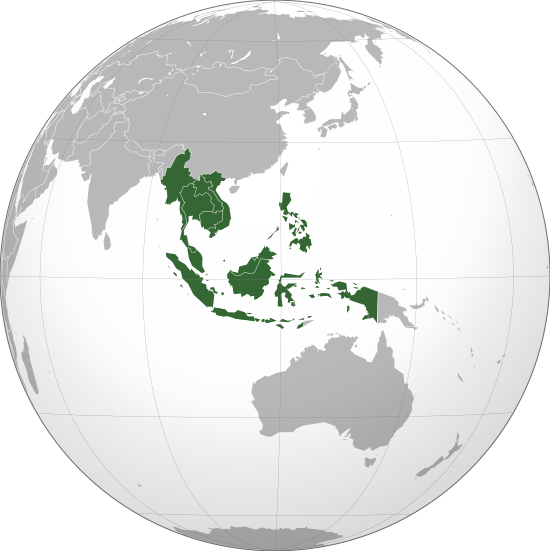
The Association of Southeast Asian Nations ASEAN is a regional...

The Guardian is a British daily newspaper founded in as...
Trending

5 hours ago Paul Rudd Discusses His Boring Daily Diet and Struggles With Phone Addiction
6 hours ago San Francisco Fleet Week 2026 Features Blue Angels and Air Shows

7 hours ago Michele Tafoya Campaigns for Minnesota US Senate Seat
7 hours ago US Administration Considers New Deportation Strategies for Immigrants and Refugees
7 hours ago Caitlin Clark Defends Teammate Kelsey Mitchell Amid Online Harassment

7 hours ago Oscar De La Hoya and Dana White Reignite Bitter Public Feud
Popular

Ken Paxton is an American politician and lawyer serving as...

Elon Musk is a visionary entrepreneur and engineer known for...

Cristiano Ronaldo widely considered one of the greatest footballers captains...

Jameis Winston is an American football quarterback currently playing for...

Shakira Isabel Mebarak Ripoll the Queen of Latin Music is...

Michael Joseph Jackson the King of Pop was a highly...