


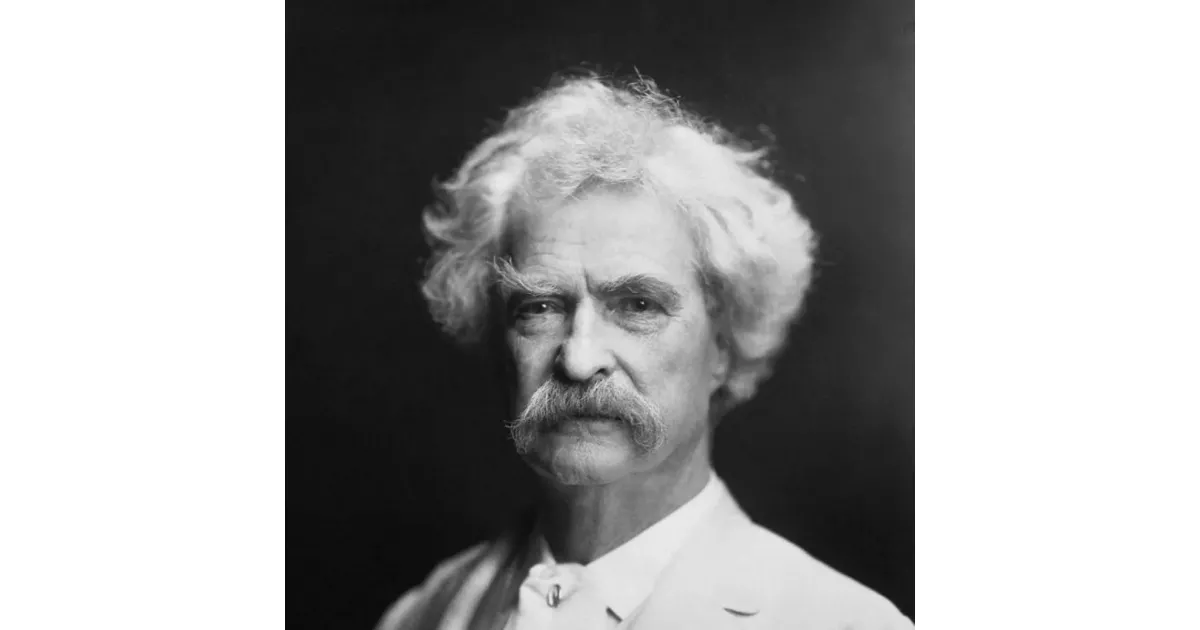
Mark Twain, the pen name of Samuel Langhorne Clemens, was a celebrated American author and humorist considered by many to be the father of American literature. His most famous works include *The Adventures of Tom Sawyer* and *Adventures of Huckleberry Finn*, with the latter often lauded as the "Great American Novel". Twain also penned works such as *A Connecticut Yankee in King Arthur's Court* and co-authored *The Gilded Age*. His writing significantly influenced subsequent American literature, shaping its style and themes for generations to come.
October 1900: Return to America
In October 1900, Mark Twain returned to America after earning enough money to pay off his debts.


October 16, 1900: Twain Describes His Transformation to Anti-Imperialism
On October 16, 1900, Mark Twain described his transformation and political awakening to anti-imperialism in the New York Herald, in the context of the Philippine–American War.
1900: Twain's preference for Joan of Arc
In 1900, Mark Twain stated, "I like Joan of Arc best of all my books, it is the best".
1900: Boxer Uprising
In 1900, the Boxer Uprising occurred, which led to the events that Twain later criticized.
January 1901: Vice-President of the Anti-Imperialist League of New York
In January 1901, Mark Twain began serving as vice-president of the Anti-Imperialist League of New York, becoming a prominent opponent of imperialism.
February 1901: To the Person Sitting in Darkness
In February 1901, Mark Twain's response to hearing of Ament's methods, "To the Person Sitting in Darkness," was published in the North American Review, dealing with examples of imperialism in China, South Africa, and the U.S. occupation of the Philippines.
April 1901: To My Missionary Critics
In April 1901, Mark Twain's article "To My Missionary Critics" was published in The North American Review, continuing his attack but shifting the focus from Ament to his missionary superiors, the American Board of Commissioners for Foreign Missions.
1901: Vice President of the American Anti-Imperialist League
In 1901, Mark Twain became the vice president of the American Anti-Imperialist League. He strongly opposed the Philippine-American War and American colonialism.
1901: Twain became Vice-President of the American Anti-Imperialist League
In 1901, Mark Twain became the vice-president of the American Anti-Imperialist League shortly after his return from Europe, which opposed the annexation of the Philippines by the United States.
1901: Twain's Votes for Women speech
In 1901, Mark Twain showed his support for women's suffrage with his "Votes for Women" speech.
1901: Honorary Degree from Yale University
In 1901, Mark Twain was awarded an honorary Doctor of Letters (D.Litt.) by Yale University.
1901: Invited to Speak at Princeton University
In 1901, Mark Twain was invited to speak at Princeton University's Cliosophic Literary Society, where he was made an honorary member.
1902: Doctor of Law from the University of Missouri
In 1902, the University of Missouri awarded Mark Twain a Doctor of Law.
1904: Wearing white suits after wife's death
After the death of his wife in 1904, Mark Twain began wearing white suits on the lecture circuit, eventually becoming his trademark.
1904: Death of Twain's wife
In 1904, Mark Twain's wife died while they were staying at the Villa di Quarto in Florence. She had been Twain's de facto editor and censor throughout their married life, and after her death, he published works that she had not approved of.
1904: Death of Olivia Langdon Clemens
Olivia Langdon Clemens, Mark Twain's wife, died in 1904 after 34 years of marriage. All of the Clemens family are buried in Elmira's Woodlawn Cemetery.
March 22, 1905: Rejection of The War Prayer
On March 22, 1905, Harper's Bazaar rejected Mark Twain's pacifist story titled The War Prayer, deeming it "not quite suited to a woman's magazine".
1905: Manuscripts written
Between 1897 and 1905, Mark Twain wrote three versions of The Mysterious Stranger: the Hannibal, Eseldorf, and Print Shop versions.
1905: Brooklyn Public Library banned Twain's books
In 1905, The Adventures of Huckleberry Finn and The Adventures of Tom Sawyer were banned from the children's department of the Brooklyn Public Library due to their language.
1905: Publication of "King Leopold's Soliloquy"
In 1905, Twain published a satirical pamphlet titled "King Leopold's Soliloquy". The pamphlet addressed Belgian atrocities in the Congo Free State.
April 1906: Aid to Ina Coolbrith after San Francisco Earthquake
In April 1906, Mark Twain offered autographed photographs to be sold to benefit his friend Ina Coolbrith, who lost most of her possessions in the 1906 San Francisco earthquake. He later sat for a new portrait session to further aid her.
1906: Testimony Before Congressional Committee
In 1906, Twain testified before a Congressional joint committee in favor of a bill extending copyright protection to the author's lifetime plus 50 years.
1907: Meeting Dorothy Quick
In 1907, Mark Twain met Dorothy Quick (age 11) on a transatlantic crossing. Their friendship lasted until his death.
1907: Doctorate of Law from Oxford University
In 1907, Oxford University awarded Mark Twain a Doctorate of Law.
1907: Party Insanity
In his 1907 book, Christian Science, Mark Twain proposed that Democrats and Republicans were insane.
1908: Twain's preference for Joan of Arc
In 1908, Mark Twain reiterated, "I like Joan of Arc best of all my books, it is the best".
May 20, 1909: Death of Henry Rogers
On May 20, 1909, Twain's close friend Henry Rogers died suddenly, contributing to Twain's deep depression.
December 24, 1909: Death of Jean Clemens
On December 24, 1909, Twain's daughter Jean died, deepening Twain's gloom.
1909: Death of Ament
Dr. William Scott Ament, whom Twain criticized, died in 1909.
1909: Twain Predicts Death
In 1909, Mark Twain predicted that he would die when Halley's Comet returned, mirroring his birth. He expressed that he expected to 'go out with it'.
1909: Twain's Remark on Halley's Comet
In 1909, Mark Twain spoke about being born two weeks after Halley's Comet's closest approach.
1909: Filmed by Thomas Edison
In 1909, Thomas Edison filmed Mark Twain at his home in Redding, Connecticut. Part of the footage was used in the two-reel short film 'The Prince and the Pauper'. This is the only known existing film footage of Twain.
April 21, 1910: Mark Twain's Death
Mark Twain, whose real name was Samuel Langhorne Clemens, died on April 21, 1910. He was an American writer, humorist, and essayist, widely regarded as one of the greatest humorists the United States has produced.
1910: Twain's Death
Mark Twain remained vice-president of the American Anti-Imperialist League until his death in 1910.
1916: Publication of N.C. Wyeth's illustrated edition
In 1916, N.C. Wyeth's celebrated illustrated edition of Mark Twain's work was published.
1916: Publication of The Mysterious Stranger
In 1916, The Mysterious Stranger, an anti-religious work by Mark Twain, was published after his death.
1916: Publication of The War Prayer
Mark Twain's short pacifist story, The War Prayer, remained unpublished until 1916 due to a contract with Harper & Brothers, and was later used as campaigning material by anti-war activists in the 1960s.
1924: Posthumous Publication of The Incident in the Philippines
In 1924, The Incident in the Philippines, written by Mark Twain, was posthumously published. The writing was in response to the Moro Crater Massacre.
1962: Death of Daughter Clara
Clara Clemens, Mark Twain's daughter, died in 1962. She was one of Twain's three daughters.
1962: Publication of Letters from the Earth
In 1962, Letters from the Earth, some of Mark Twain's suppressed works irreverent toward conventional religion, was published after his daughter Clara reversed her position in response to Soviet propaganda about the withholding.
1972: Publication of Little Bessie
In 1972, Little Bessie, a story ridiculing Christianity, was first published in the collection Mark Twain's Fables of Man.
1992: Publication of neglected anti-imperialism writings
In 1992, many of Mark Twain's neglected and previously uncollected writings on anti-imperialism appeared for the first time in book form.
1995: Crandall named Connecticut's official heroine
Thanks to Mark Twain's efforts, in 1995, the Connecticut legislature voted a pension for Prudence Crandall and named her Connecticut's official heroine for her work toward the education of young African-American women.
November 2010: Publication of Twain's autobiography
In November 2010, 100 years after his death, the University of California published the first volume of Mark Twain's autobiography, which had over 736 pages. It became an unexpected best-seller.
November 2010: Publication of Autobiography of Mark Twain
In November 2010, 100 years after his death, the publication of Autobiography of Mark Twain started, in which Twain's frankest views on religion appeared.
Mentioned in this timeline
The United States of America is a federal republic primarily...

California is a U S state on the Pacific Coast...

San Francisco is the fourth-most populous city in California and...
An earthquake is a sudden intense shaking of the Earth's...

China officially the People's Republic of China PRC is located...

Africa is the second-largest and second-most populous continent home to...
Trending
4 hours ago Venezuela Releases Dozens of Political Prisoners Following High-Level Talks

4 hours ago Caitríona Balfe Discusses Career Fulfillment, New Movie Projects, and Outlander Departure

4 hours ago Florida Shoppers Question Value and Policy of Publix BOGO Deals

4 hours ago Alina Habba Marries Turkish Billionaire Turhan Mildon in Star-Packed New York Ceremony

4 hours ago Brock Bowers Returns to Practice Ahead of Raiders vs. Saints Week 3 Matchup

4 hours ago Donald Trump Targets Republican Congresswoman María Elvira Salazar Over Immigration Policy Criticism
Popular

Jameis Winston is an American football quarterback currently playing for...

Ken Paxton is an American politician and lawyer serving as...

Shakira Isabel Mebarak Ripoll the Queen of Latin Music is...

Michael Joseph Jackson the King of Pop was a highly...

Cristiano Ronaldo widely considered one of the greatest footballers captains...

Sylvester Stallone is an iconic American actor screenwriter and filmmaker...