History of Paris in Timeline


Paris is the capital and largest city of France, situated on the Seine River in the Île-de-France region. As of January 2026, the city had an estimated population of 2.04 million within its 105.4 square kilometers, and a metropolitan population of 13.2 million, making it the largest metropolitan area in the European Union. Known as the "City of Light," Paris has been a major global center for finance, diplomacy, commerce, culture, fashion, and gastronomy since the 17th century.
1 hour ago : Eyehategod Announces 2026 Concert Dates in Paris and Marseille. European Politics Discussed.
Eyehategod will perform in Paris and Marseille in 2026. A discussion about Europe's political role and its relationship with the U.S. and Israel.


1900: Universal Exposition
In 1900, Paris hosted the Universal Exposition, which resulted in the construction of the Pont Alexandre III, the Grand Palais, the Petit Palais, and the first Paris Métro line.
1900: Inauguration of Paris Métro
In 1900, the first line of the Paris Métro network was inaugurated, marking the beginning of the city's widely used local transport system.
1900: Michelin Guide Standard
Since 1900, the Michelin Guide has been a standard guide to French restaurants, awarding its highest award, three stars, to the best restaurants in France.
1901: Paris Population Growth
By 1901, the population of Paris had grown to approximately 2,715,000. Artists from around the world began making Paris their home.
1911: Olympia Paris Invention
In 1911, the dance hall Olympia Paris invented the grand staircase as a setting for its shows, competing with its great rival, the Folies Bergère.
1913: Ballets Russes Performances
In 1913, the first performances of Diaghilev's Ballets Russes took place at the Théâtre des Champs-Élysées.
1921: Paris population peak
In 1921, the population of Paris reached its historical peak of 2.9 million.
1929: Annexation of Bois de Boulogne and Bois de Vincennes
In 1929, the Bois de Boulogne and Bois de Vincennes forest parks were annexed to the city of Paris, increasing its area.
December 1933: First Rugby League Game
In December 1933, the first rugby league game in France was held in Paris, an exhibition match between the Australia national team and a British League Select XIII.
1938: FIFA World Cup Finals
Paris hosted the finals of the 1938 FIFA World Cup.
June 1940: German Army Marches into Paris
On 14 June 1940, the German army marched into Paris, which had been declared an "open city".
July 1942: Arrest of Jews
On 16–17 July 1942, French police arrested 12,884 Jews, including 4,115 children, and confined them at the Vel d'Hiv before their deportation to Auschwitz.
August 1944: Liberation of Paris
On 25 August 1944, the city of Paris was liberated by the French 2nd Armoured Division and the 4th Infantry Division of the United States Army.
1946: Le Lido Opening
In 1946, Le Lido, a famous Paris music hall, opened on the Champs-Élysées.
1949: Buildings date from 1949 and before
Sixty-two percent of buildings in Paris date from 1949 and before.
1951: Crazy Horse Saloon Opening
In 1951, the Crazy Horse Saloon, featuring strip-tease, dance, and magic, opened in Paris.
1954: Rugby League World Cup
In 1954, the Rugby League World Cup was first held in Paris with the Parc des Princes hosting the opening match and the final.
1954: Paris Population Declines
In 1954, the population of Paris began to decline as middle-class families moved to the suburbs.
April 1956: Paris Twinned
Since April 1956, Paris is exclusively and reciprocally twinned with another city.
November 1958: UNESCO Headquarters in Paris
Since November 1958, the United Nations Educational, Scientific and Cultural Organization (UNESCO) has had its headquarters in Paris.
1960: UEFA European Championships Finals
Paris hosted the finals of the 1960 UEFA European Championships.
August 1961: FLN attacks Paris policemen
In August 1961, the pro-independence FLN killed 11 Paris policemen, leading to a curfew on Muslims of Algeria.
October 1961: Algerian Protest
On 17 October 1961, a peaceful protest demonstration of Algerians against the curfew led to violent confrontations with the police, resulting in at least 40 deaths.
1961: Delouvrier's political initiative
Difficult areas are scattered among social housing districts created by Delouvrier's 1961 "ville nouvelle" political initiative.
1961: Paul Delouvrier becomes head of the Paris region
In 1961, Paul Delouvrier became head of the Paris region and promised to resolve the disconnect between Paris and its suburbs. Two of his ambitious projects were the construction of five suburban "villes nouvelles" and the RER commuter train network.
1962: Migration to the suburbs
A dramatic migration of residents to the suburbs occurred between 1962 and 1975.
1962: OAS Bombings in Paris
Throughout 1962, the anti-independence Organisation armée secrète (OAS) carried out a series of bombings in Paris.
1967: Orchestre de Paris Establishment
The Orchestre de Paris was established in 1967.
May 1968: Student Protests and General Strike
In May 1968, students occupied the Sorbonne and erected barricades, which led to a two-week general strike involving Parisian blue-collar workers.
1968: Student Demonstrations
In 1968, student demonstrations preceded the break up of the University of Paris.
1968: Paris becomes a department
In 1968, the greater administrative Seine department was reorganised and Paris became a department in itself.
1969: Tour Maine-Montparnasse Construction
Construction of the Tour Maine-Montparnasse began in 1969; it was completed in 1973.
1970: Break up of the University of Paris
In 1970, the University of Paris was broken up into thirteen autonomous universities.
1972: Rugby League World Cup Group Game
The newly rebuilt Parc des Princes was used for a group game of the 1972 Rugby League World Cup.
1973: Completion of Périphérique Expressway
In 1973, the Périphérique expressway encircling the city was completed.
1973: Tour Montparnasse becomes tallest building
In 1973, the Tour Montparnasse, standing at 210 meters, became the tallest building in both Paris and France.
1974: Buildings built between 1949 and 1974
20 percent of buildings in Paris were built between 1949 and 1974.
1974: Charles de Gaulle Airport Opened
Charles de Gaulle Airport, located on the edge of the northern suburbs of Paris, opened to commercial traffic in 1974.
1974: Paris Granted Municipal Autonomy
In 1974, Paris was granted municipal autonomy by the National Assembly.
1975: Migration to the suburbs
A dramatic migration of residents to the suburbs occurred between 1962 and 1975.
1975: Paris Granted City Status
In 1975, the National Assembly changed the status of Paris to that of other French cities.
1975: Tour de France Finish
Since 1975, the final stage of the Tour de France finishes in Paris on the Champs-Elysées.
March 1977: Jacques Chirac Elected Mayor
In March 1977, Jacques Chirac was elected as the first modern elected mayor of Paris since 1871.
1977: Centre Georges Pompidou
In 1977, President Georges Pompidou started the Centre Georges Pompidou.
1977: District de la région parisienne renamed
In 1977, the district of the Paris region was renamed "Île-de-France".
1977: Creation of new parks
Since 1977, the city of Paris has created 166 new parks.
1983: Louvre Pyramid
In 1983, President François Mitterrand had the Louvre Pyramid with its underground courtyard built; it was completed in 1989.
1984: UEFA European Championships Finals
Paris hosted the finals of the 1984 UEFA European Championships.
1985: Opéra Bastille
In 1985, President François Mitterrand had the Opéra Bastille built; it was completed in 1989.
1986: Musée d'Orsay
In 1986, Valéry Giscard d'Estaing began the Musée d'Orsay.
1986: Médiathèque Musicale Mahler Opening
The Médiathèque Musicale Mahler opened in 1986 and contains collections related to music.
1987: Parc de la Villette Creation
In 1987, the Parc de la Villette was created.
1989: Opéra Bastille
In 1989, President François Mitterrand had the Opéra Bastille built; it was started in 1985.
1990: Paris Population Declines Further
In 1990, the population of Paris further declined.
1991: Seine Designated a UNESCO World Heritage Site
In 1991, parts of the city along the Seine were designated as a UNESCO World Heritage Site.
1991: Bank of Seine Classified as UNESCO Site
In 1991, the bank of the Seine was classified as a UNESCO World Heritage Site.
1992: Parc André Citroën Creation
In 1992, the Parc André Citroën was created.
1993: Charles de Gaulle Becomes Busiest Airport
In 1993, Charles de Gaulle Airport became the busiest Parisian airport.
1994: François Mitterrand Library Completion
The François Mitterrand Library (nicknamed Très Grande Bibliothèque) was completed in 1994 to a design of Dominique Perrault and contains four glass towers.
1996: Arrondissement Mayors and Deputy Mayors
As of 1996, there were 20 arrondissement mayors and 120 deputy mayors in Paris.
1996: Bibliothèque Nationale de France
In 1996, President François Mitterrand began the new site of the Bibliothèque nationale de France.
1998: FIFA World Cup Finals
Paris hosted the finals of the 1998 FIFA World Cup.
1999: Population increase start
In 1999, the population increased from 2,125,246.
2000: Increase in Foot Trips
From 2000 to 2018, the number of trips made by foot in the Grand Paris metropolis increased by 50%.
March 2001: Bertrand Delanoë Elected Mayor
In March 2001, Bertrand Delanoë became the first socialist mayor of Paris.
2003: Heat Wave
During the 2003 heat wave, temperatures in Paris exceeded 30 °C for weeks, reaching 40 °C on some days.
2006: Catalans Dragons Enter British Rugby
In 2006, Catalans Dragons became the first French side to enter the British rugby league system following PSG's withdrawal.
2006: Musée du quai Branly
In 2006, Jacques Chirac started the Musée du quai Branly.
2007: Grand Paris Project Launched
In 2007, President Nicolas Sarkozy launched the Grand Paris project to better integrate Paris with its surrounding towns.
2007: Parc Clichy-Batignolles Creation
In 2007, the Parc Clichy-Batignolles was created.
2007: Merger of Levallois SCB and Paris Basket Racing to create Metropolitans 92
In 2007, the basketball teams Levallois SCB and Paris Basket Racing merged to create the club Metropolitans 92, which plays some of its games at the Stade Pierre de Coubertin.
2007: Employment Landscape
In 2007, the majority of Paris's salaried employees filled 370,000 business services jobs, concentrated in the north-western arrondissements. Paris's financial service companies are concentrated in the central-western arrondissement banking and insurance district.
2007: Rugby World Cup Finals
Paris hosted the finals of the 2007 Rugby World Cup at the Stade de France.
March 2008: Bertrand Delanoë Re-elected
In March 2008, Bertrand Delanoë was re-elected as the socialist mayor of Paris.
2008: Mosque attendance in Paris
An IFOP survey in 2008 reported that, of immigrants from predominantly Muslim countries, 25 percent went to the mosque regularly, 41 percent practised the religion, and 34 percent were believers, but did not practice the religion.
2008: Sustainable Transport Award
In 2008, Paris received the Sustainable Transport Award for its sustainable transportation systems.
2009: Education Levels in Paris
In 2009, around 40 percent of Parisians held a licence-level diploma or higher, which was the highest proportion in France.
2010: Employees in La Défense
In 2010, La Défense was the workplace of 144,600 employees, with 38% working in finance and insurance and 16% in business support services.
2010: Salaried Employees in the Paris Region
In 2010, the Paris Region had 5.4 million salaried employees, with 2.2 million concentrated in 39 business districts.
2011: Number of Residences in Paris
In 2011, the City of Paris had 1,356,074 residences, with 85.9% being main residences, 6.8% secondary residences, and 7.3% empty.
2011: Tour First becomes tallest building
In 2011, the Tour First in La Défense district of Courbevoie surpassed the Tour Montparnasse to become the tallest building in Paris and France.
2011: Paris population
In 2011, the population of Paris reached 2.25 million.
2011: Religious affiliation survey in Paris
In a 2011 survey, 61 percent of residents of the Paris Region identified themselves as Roman Catholic, 7 percent as Muslims, 4 percent as Protestants, 2 percent as Jewish, and 25 percent as without religion.
2012: Jobs in the Paris Region
At the 2012 census, 59.5% of jobs in the Paris Region were in market services, 26.9% in non-market services, 8.2% in manufacturing and utilities, 5.2% in construction, and 0.2% in agriculture.
2012: Muslim population in Paris
In 2012 and 2013, it was estimated that there were almost 500,000 Muslims in the City of Paris.
2012: Poverty Line Statistics
In 2012, 14 percent of households in Paris earned less than €977 per month, which was the official poverty line.
2012: Paris most densely populated city in the EU
In 2012, according to Eurostat, the Commune of Paris was the most densely populated city in the European Union with 21,616 people per square kilometre.
2012: Electricity Generation
In 2012, around 50% of electricity generated in the Île-de-France came from cogeneration energy plants.
2012: British and US citizens in Paris
In 2012, there were 8,810 British citizens and 10,019 United States citizens living in the City of Paris, and 20,466 British citizens and 16,408 United States citizens living in the entire Paris Region.
2012: Immigrant Residents of Paris
In the 2012 census, there were 135,853 immigrants from Europe, 112,369 from the Maghreb, 70,852 from sub-Saharan Africa and Egypt, 5,059 from Turkey, 91,297 from Asia outside Turkey, 38,858 from the Americas, and 1,365 from the South Pacific residing in the City of Paris.
June 2013: Promenade des Berges de la Seine Inaugurated
In June 2013, Bertrand Delanoë inaugurated the Promenade des Berges de la Seine.
2013: Start of Population Fall
Between 2013 and 2023, the population fell by 122,919, or about five percent.
2013: Muslim population in Paris
In 2012 and 2013, it was estimated that there were almost 500,000 Muslims in the City of Paris.
2013: Promenade des Berges de la Seine
In 2013, the Promenade des Berges de la Seine, which features floating gardens, was created.
October 2014: Louis Vuitton Foundation Opening
In October 2014, the Contemporary Art museum of the Louis Vuitton Foundation, designed by architect Frank Gehry, opened in the Bois de Boulogne.
2014: Nobel Prize Winner
In 2014, Patrick Modiano, based most of his literary work on the depiction of the city during World War II and the 1960s–1970s, won the Nobel Prize in Literature.
2014: Jewish population in Paris Region
In 2014, the Jewish population of the Paris Region was estimated to be 282,000, the largest concentration of Jews in the world outside of Israel and the United States.
2014: Citroën Assembly Plant Closing
In 2014, the manufacturing industry in Paris suffered a major loss with the closing of a major Aulnay-sous-Bois Citroën assembly plant.
January 2015: Paris Terrorist Attacks
In January 2015, a series of attacks occurred in the Paris region, including the shooting at the offices of Charlie Hebdo, resulting in 17 deaths. Al-Qaeda claimed responsibility for the attacks.
January 2015: Philharmonie de Paris Opening
In January 2015, the Philharmonie de Paris, the modern symphonic concert hall of Paris, opened.
December 2015: Union of the Right wins regional election
In December 2015, the Union of the Right, a coalition of centrist and right-wing parties led by Valérie Pécresse, narrowly won the regional election, defeating a coalition of Socialists and ecologists.
2015: Paris Métro ridership
In 2015, Paris's Métro network carried about 5.23 million passengers daily.
2015: Métropole du Grand Paris Population
In 2015, the Métropole du Grand Paris had a population of 6.945 million people.
2015: Aerospace Companies Employment
In 2015, the Paris region's 800 aerospace companies employed 100,000 workers.
January 2016: Patrick Ollier Elected President
In January 2016, Patrick Ollier was elected the first president of the metropolitan council.
January 2016: Métropole du Grand Paris comes into existence
In January 2016, measures to unite Paris with its suburbs began when the Métropole du Grand Paris came into existence.
January 2016: Metropolis of Grand Paris Created
On 1 January 2016, the new area, named the Metropolis of Grand Paris, with a population of 6.7 million, was created.
April 2016: Paris Agreement Signed
On 22 April 2016, the Paris Agreement was signed by 196 nations of the United Nations Framework Convention on Climate Change in Paris.
September 2016: Cost of Living Survey
In September 2016, a worldwide cost of living survey by the Economist Intelligence Unit found Paris to be the seventh most expensive city in the world, and the second most expensive in Europe.
2016: Tourism-Related Employment
In 2016, 393,008 workers in Greater Paris, or 12.4 percent of the total workforce, were engaged in tourism-related sectors such as hotels, catering, transport and leisure.
2016: Airbnb Tourism Tax
In 2016, Airbnb paid the Paris city government 7.3 million euros in tourism tax.
2016: UEFA European Championships Finals
Paris hosted the finals of the 2016 UEFA European Championships.
2017: Social housing in Paris
In 2017, social or public housing accounted for 19.9 percent of Paris's residences, with distribution varying from 2.6 percent in the 7th arrondissement to 39.9 percent in the 19th arrondissement.
2017: Cost of Living Ranking
In 2017, the Economist Intelligence Unit ranked Paris as the seventh most expensive city in the world based on a survey made in September 2016.
2017: Paris agglomeration population
In 2017, the Paris agglomeration's population of 10,785,092 made it the largest urban area in the European Union.
2018: Charles de Gaulle Airport Ranking
As of 2018, Charles de Gaulle Airport was the third-busiest airport in Europe.
2018: Increase in Foot Trips
From 2000 to 2018, the number of trips made by foot in the Grand Paris metropolis increased by 50%.
2018: Avenue Montaigne is most expensive residential street
In 2018, Avenue Montaigne was the most expensive residential street in Paris, with an average price of 22,372 euros per square meter.
2018: Airline Destination Ranking
In 2018, Paris was the second-busiest airline destination in the world, with 19.10 million visitors, behind Bangkok (22.78 million) but ahead of London (19.09 million) based on the Euromonitor Global Cities Destination Index.
2018: Michelin Star Restaurants
In 2018, of the 27 Michelin three-star restaurants in France, ten were located in Paris.
2018: Increase of homeless persons
There was an increase of 588 homeless persons in Paris since 2018.
February 2019: Paris NGO counts homeless persons
In February 2019, a Paris NGO counted 3,641 homeless persons in the city, with most having been homeless for over a year.
April 2019: Notre Dame Cathedral Fire
On 15 April 2019, the Notre Dame Cathedral caught fire, causing significant damage to the roof and spire.
July 2019: Record High Temperature
In July 2019, a record high temperature of 42.6 °C (108.7 °F) was recorded in Paris.
2019: Hotel and Airbnb Statistics
In 2019, Greater Paris had 2,056 hotels, including 94 five-star hotels, with a total of 121,646 rooms. Additionally, Greater Paris had 60,000 homes registered with Airbnb.
2019: Record Number of Visitors
In 2019, Greater Paris received a record 38 million visitors, measured by hotel arrivals. These included 12.2 million French visitors. The greatest number of foreign visitors came from the United States (2.6 million), the United Kingdom (1.2 million), Germany (981 thousand), and China (711 thousand).
2019: Population in Paris Region
In 2019, the Paris region's population accounted for 18.8 percent of metropolitan France.
2019: Airport Traffic
In 2019, the three commercial international airports serving Paris (Charles de Gaulle Airport, Orly Airport, and Beauvais-Tillé Airport) recorded traffic of 112 million passengers, making them the 5th busiest airport system in the world.
2019: Tourism Figures Compared to 2021 and 2022
In 2019, tourism in Paris was higher than both 2021 and 2022.
2020: Paris ranking in the world
As of 2020, Paris is the fourth largest municipality in the European Union and the 34th most densely populated city in the world.
2020: Basic Competencies
By 2020, the Métropole du Grand Paris's basic competencies will include urban planning, housing, and protection of the environment.
2020: Visitors Cité des sciences et de l'industrie
In 2020, the Cité des sciences et de l'industrie had 984,000 visitors
2020: Creation of Paris Centre
In 2020, the creation of Paris Centre, a unified administrative division, took effect.
2020: Immigrant population in Paris
In 2020–2021, about 6 million people, or 41% of the population of the Paris Region, were either immigrants (21%) or had at least one immigrant parent (20%).
May 2021: Bourse de Commerce Reopens
In May 2021, the Bourse de Commerce reopened as a contemporary art museum after delays due to the COVID-19 pandemic.
2021: Immigrant population in Paris
In 2020–2021, about 6 million people, or 41% of the population of the Paris Region, were either immigrants (21%) or had at least one immigrant parent (20%).
2021: Most-Visited Museums
In 2021, the Louvre received 2.8 million visitors, holding its position as the world's most-visited museum. The second-most visited museum was the Centre Georges Pompidou, with 1.5 million visitors.
2021: Fortune Global 500 companies headquarters in Paris Region
In 2021, the top French companies listed in the Fortune Global 500 all have their headquarters in the Paris Region.
2021: Tourism Increase
In 2021, tourism in the Paris region increased by 95 percent compared to 2022, although it remained lower than in 2019.
2021: Unemployment Rate
In the 4th trimester of 2021, the unemployment rate in Paris was six percent, compared with 7.4 percent in the whole of France. This was the lowest rate in thirteen years.
January 2022: Population of Paris
In January 2022, the population of the City of Paris was 2,165,423, according to the INSEE.
2022: Ninth-Highest Cost of Living
In 2022, Paris had the ninth-highest cost of living in the world.
2022: Top Cultural Attractions
In 2022, Paris's top cultural attractions were the Louvre Museum (7.7 million visitors), the Eiffel Tower (5.8 million visitors), the Musée d'Orsay (3.27 million visitors) and the Centre Pompidou (3 million visitors).
2022: Tourism Recovery
In 2022, tourism continued to recover in the Paris region with 44 million visitors, a 95 percent increase over 2021, but still 13 percent lower than in 2019.
2022: Transportation Statistics
In the period of 2022-2023, a survey of trips in Paris was conducted with results showing 53.3% of trips were made on foot, 30% on public transport, 11.2% on bicycles and 4.3% on cars.
2022: UEFA Champions League Finals
Paris held six UEFA Champions League finals, including the 2022 edition.
January 2023: Population of Paris Decreases
In January 2023, the population of the City of Paris was 2,102,650, according to the INSEE.
2023: Charles de Gaulle Airport Ranking
In 2023, Charles de Gaulle Airport was the 4th busiest airport in the world by international traffic.
2023: Sustainable Transport Award
In 2023, Paris received the Sustainable Transport Award for its sustainable transportation systems.
2023: Rugby World Cup Finals
Paris hosted the finals of the 2023 Rugby World Cup at the Stade de France.
December 2024: Reopening of the Notre Dame Cathedral
The Notre Dame Cathedral reopened on 7 December 2024, after it caught fire on 15 April 2019.
2024: Paris Classified as an "Alpha+" City
As of 2024, Paris was classified as an "Alpha+" city by the Globalization and World Cities Research Network.
2024: Most Attractive City
As of 2024, Paris was considered the most attractive city in the world for 4 years in a row by the Euromonitor Global Cities Destination Index.
2024: Charles de Gaulle Airport Busiest in EU
In 2024, Charles de Gaulle Airport was the busiest airport in the European Union.
2024: Target for Walkable Trips
In 2024, Paris aims to increase its mode share beyond 53% of all trips by foot.
2025: Paris Average Annual Precipitation
As of 2025, Paris has an average annual precipitation of 641 mm.
January 2026: Metropolitan Population of Paris
As of January 2026, the metropolitan population of Paris is estimated to be 13.2 million.
2026: Emmanuel Grégoire Elected Mayor
In 2026, Emmanuel Grégoire was elected the mayor of Paris.
2030: Completion of Grand Paris Express
The Grand Paris Express system is scheduled to be completed by 2030.
Mentioned in this timeline

Basketball is a team sport played on a rectangular court...
The United States of America is a federal republic located...
Hong Kong is a densely populated special administrative region of...
Germany officially the Federal Republic of Germany is located in...

World War II - was a global conflict between the...
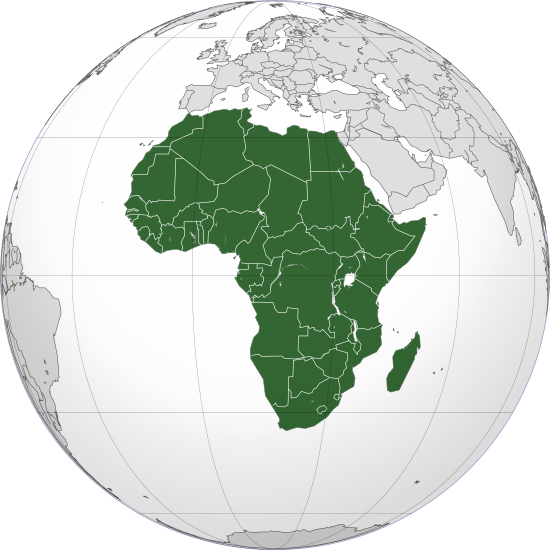
Africa is the second-largest and second-most populous continent home to...
Trending

15 minutes ago Jennie Garth reveals struggles with depression, divorce, and self-love journey.

15 minutes ago Arthur Rinderknech faces Alex Michelsen at ATP Munich; Betting odds previewed.
16 minutes ago Bollywood legend Asha Bhosle passes away at 92; tributes pour in from celebrities.
1 hour ago OpenText expands European cloud offerings with AWS, Google Cloud, and sovereign AI.

1 hour ago Real Madrid faces boardroom turmoil, denies sporting director rumors, soul searching at Bernabéu.
11 days ago Alaska Airlines reveals new International Business Class Suites for long-haul flights.
Popular

Paula White-Cain is a prominent American televangelist and key figure...

Melania Trump is a Slovenian-American former model who served as...

William Franklin Graham III commonly known as Franklin Graham is...

Eric Swalwell is an American lawyer and politician currently serving...

J D Vance is an American politician and author He...

Viktor Orb n is a prominent Hungarian politician and lawyer...