Childhood and Education Journey of Winston Churchill in Timeline


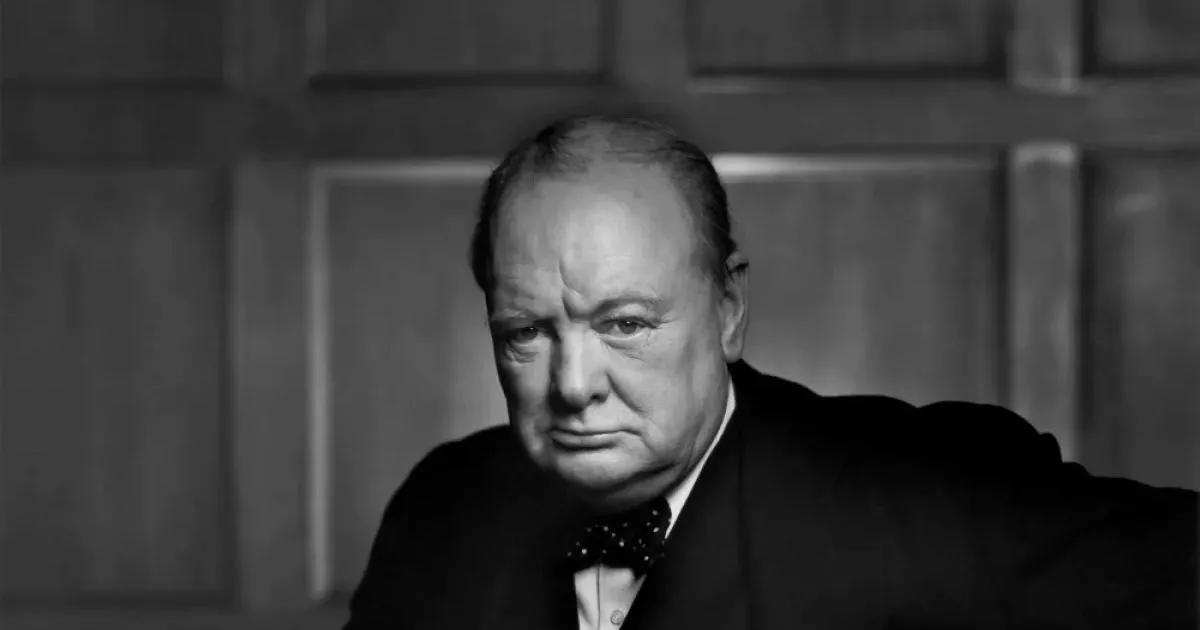
How education and upbringing influenced the life of Winston Churchill. A timeline of key moments.
Winston Churchill was a prominent British statesman, military officer, and writer who served as Prime Minister of the United Kingdom during World War II (1940-1945) and again from 1951-1955. He was a Member of Parliament for 62 years, representing five constituencies. Ideologically aligned with economic liberalism and imperialism, he led the Conservative Party from 1940 to 1955, having previously been a member of the Liberal Party from 1904 to 1924. His leadership during WWII cemented his place as one of the most important figures in British history.
1901: Lecture tour in Paris, Madrid, and Gibraltar
In spring 1901, Churchill gave lectures in Paris, Madrid, and Gibraltar.


1904: Churchill Critical of Aliens Bill
In 1904, Churchill was critical of the proposed Aliens Bill, opposing antisemitism.
September 1908: Churchill Marries Clementine Hozier
In September 1908, Winston Churchill married Clementine Hozier.
September 1908: Marriage to Clementine Hozier
On September 12, 1908, Churchill married Clementine Hozier at St Margaret's, Westminster. They honeymooned in Baveno, Venice, and Veveří Castle in Moravia.
July 1909: Diana Churchill's Birth
In July 1909, Diana, the first child of Winston and Clementine Churchill, was born.
1909: Birth of Daughter, Diana
In 1909, Churchill's first daughter, Diana, was born.
December 1910: General election
In December 1910, Asquith called a general election and the Liberals were re-elected with Churchill secure in Dundee.
January 1911: Siege of Sidney Street
In January 1911, Churchill was involved in the Siege of Sidney Street where he stood with the police and allowed the house where burglars were hiding to burn down rather than risk British lives.
April 1911: Agadir Crisis
During the Agadir Crisis in April 1911, Churchill proposed an alliance with France and Russia to protect Belgium, Denmark, and the Netherlands against potential German expansion, which significantly influenced his perspective on naval expansion.
May 1911: Randolph Churchill's Birth
Randolph, the second child of Winston and Clementine Churchill, was born in May 1911.
1912: Irish Home Rule Bill
In 1912, Churchill supported Asquith's government's introduction of the Home Rule Bill and opposed the Partition of Ireland, urging Ulster Unionists to accept it.
1912: German Naval Law
In 1912, after Germany increased warship production through its Naval Law, Churchill pledged that Britain would build two warships for every new German battleship but Germany refused mutual de-escalation.
October 1914: Sarah Churchill's Birth
In October 1914, Sarah, the third child of Winston and Clementine Churchill, was born.
1915: Churchill Began Painting
After resigning from the Admiralty in 1915, Churchill began painting as an amateur artist, often using the pseudonym "Charles Morin".
October 1916: Asquith resigns
In October 1916, Asquith resigned as prime minister.
May 1917: Churchill inspects the French war effort
In May 1917, Lloyd George sent Churchill to inspect the French war effort.
June 1918: Ending of a second strike
In June 1918, Churchill ended a second strike by threatening to conscript strikers into the army.
November 1918: Marigold Churchill's Birth
In November 1918, Marigold, the fourth child of Winston and Clementine Churchill, was born.
November 1918: Birth of Marigold
In November 1918, four days after the Armistice, Churchill's fourth child, Marigold, was born.
December 1918: General election campaign
During the campaign in December 1918, Churchill called for nationalization of the railways, control on monopolies, tax reform, and the creation of a League of Nations to prevent wars.
1918: Women's Suffrage
In 1918, women's suffrage remained unresolved until 1918.
January 1921: Inheritance from Frances Vane
In January 1921, Churchill unexpectedly inherited money from the estate of Frances Vane, Marchioness of Londonderry, a life-changing figure.
February 1922: Churchill speaks on Irish unity in the House of Commons
Speaking in the House of Commons on 16 February 1922, Churchill stated: "What Irishmen all over the world most desire is not hostility against this country, but the unity of their own".
September 1922: Mary Churchill's Birth and Chartwell Purchase
In September 1922, Mary, the Churchills' last child, was born and later that month, the Churchills bought Chartwell.
October 1922: Appendectomy and loss of seat
In October 1922, Churchill underwent an appendectomy. While he was in hospital, Lloyd George's coalition was dissolved, and in the general election, Churchill lost his Dundee seat.
November 1922: General election
In November 1922, a political debacle ensued which resulted in the Conservative withdrawal from the government, precipitating the general election.
1927: Meeting with Mussolini in Rome
In early 1927, Churchill visited Rome and met with Mussolini, praising him for his stance against Leninism.
1929: Defeat in General Election and Beginning of Marlborough Biography
In the 1929 general election, Churchill retained his seat, but the Conservatives were defeated, and he began working on "Marlborough: His Life and Times".
1930: Advocacy for a "United States of Europe"
In 1930, Churchill was an early proponent of pan-Europeanism, calling for a "United States of Europe" in an article.
January 1932: Accident in New York
In January 1932, Churchill was struck by a car in New York, resulting in a head wound and neuritis, leading to convalescence in Nassau.
1932: Visit to Battlefields and Illness
In 1932, Churchill visited his ancestor's battlefields and met Ernst Hanfstaengl in Munich. He later suffered from paratyphoid fever, leading to hospitalization.
January 1944: Churchill Returns to London After Illness and Travel
On 14 January 1944, Churchill flew to Gibraltar and sailed home, returning to London on 18 January, after being abroad or seriously ill for 203 of the past 371 days since January 1943.
June 1944: D-Day and Visit to Normandy
In June 1944, Churchill wanted to cross the Channel on D-Day but was vetoed by the King. He visited Normandy on 12 June, and on 22–23 July, he went to Cherbourg and Arromanches to see the Mulberry Harbour.
September 1944: Second Quebec Conference
In September 1944, Churchill met with Roosevelt at the Second Quebec Conference, where they agreed on the Morgenthau Plan for the Allied occupation of Germany, aimed at demilitarization and de-industrialization. However, the plan faced opposition from Eden and US Secretary of State Cordell Hull, who eventually persuaded Churchill and Roosevelt to disown it due to its infeasibility.
October 1944: Fourth Moscow Conference and Percentages Agreement
In October 1944, Churchill and Eden met with Stalin and Molotov at the fourth Moscow conference, resulting in the "Percentages agreement." This agreement effectively divided post-war control in the Balkans, with Russia gaining 90% control of Romania and 75% of Bulgaria, while the United Kingdom and the United States would have 90% control of Greece. Hungary and Yugoslavia would be 50% each.
February 1945: Malta Conference and Yalta Conference
In February 1945, Churchill and Roosevelt met for the Malta Conference leading up to the Yalta Conference from February 4 to 11. The Yalta Conference addressed the establishment of the United Nations Organisation and the post-war status of Poland. Churchill faced criticism regarding the agreement on Poland, but Jenkins argued that Churchill achieved the best possible outcome given Roosevelt's ill health.
February 1945: Bombing of Dresden
On the nights of February 13–15, 1945, British and US bombers attacked Dresden, resulting in a high number of civilian casualties. The attacks were part of an area bombing campaign initiated by Churchill with the aim of shortening the war. Churchill later regretted the bombing due to the excessive civilian casualties.
May 1945: Commissioning of Operation Unthinkable
In May 1945, Winston Churchill commissioned the Chiefs of Staff Committee to develop a plan for a potential military campaign against the USSR, code-named Operation Unthinkable, which involved a surprise attack on Soviet troops stationed in Germany.
May 1945: Resignation and Reappointment as Prime Minister
On May 23, 1945, with a general election approaching and Labour ministers refusing to continue the coalition, Churchill resigned as prime minister. Later that day, he accepted the King's invitation to form a new government, known as the National Government or caretaker ministry. He was formally reappointed on May 28.
May 1945: Germany's Surrender and VE Day
On May 7, 1945, the Allies accepted Germany's surrender at SHAEF headquarters in Reims. The next day, May 8, was Victory in Europe Day (VE Day), and Churchill broadcast to the nation that Germany had surrendered and a final ceasefire would take effect. Churchill appeared on the balcony of Buckingham Palace with the Royal Family and addressed a large crowd in Whitehall.
July 1945: Hypothetical Start Date for Operation Unthinkable
The hypothetical start date for the Allied invasion of Soviet-held Europe as part of Operation Unthinkable, the proposed military campaign against the USSR, was set for July 1, 1945.
August 1946: Implementation of Operation Keelhaul
In August 1946, the Western Allies began implementing Operation Keelhaul, which involved the forcible repatriation of Soviet citizens, including prisoners of war, to the Soviet Union. This policy was later extended to Eastern European refugees, many of whom were anti-communist.
May 1947: Continuation of Operation Keelhaul
In May 1947, Operation Keelhaul continued, involving the forcible repatriation of Soviet citizens and Eastern European refugees to the Soviet Union, a policy that had begun in August 1946.
1947: India's Independence and Churchill's Stance
Following the independence of India in 1947, Churchill adopted a pragmatic stance towards empire, although he continued to use imperial rhetoric.
1948: Start of the Malayan Emergency
In 1948, the Malayan Emergency, a guerrilla war fought by Communist fighters against Commonwealth forces, began and continued until 1960. Churchill's government maintained the military response to the crisis.
1949: Support for the Creation of the Council of Europe
In 1949, Churchill supported the creation of the Council of Europe.
1950: Labour Wins General Election
In 1950, the Labour Party won the general election, but with a significantly reduced majority.
October 1951: Conservative Victory and Return as Prime Minister
In October 1951, despite losing the popular vote, the Conservatives secured a majority of 17 seats in the general election, leading to Churchill's return as prime minister. Eden was appointed Foreign Affairs Minister.
December 1951: George VI's Concerns About Churchill's Health
By December 1951, George VI became concerned about Churchill's declining health and considered asking him to step down in favor of Eden. However, the King himself had health issues and died in February 1952.
1951: Support for the European Coal and Steel Community
In 1951, Churchill supported the creation of the European Coal and Steel Community, with the stipulation that Britain should not join any federal grouping.
January 1952: Transatlantic Visits and Relationship with Truman
From January 1952 to July 1954, Churchill made four official transatlantic visits, fostering a good relationship with Truman. Disagreements arose over the European Defence Community (EDC), as well as British interests in Egypt and the Middle East.
February 1952: Death of King George VI
King George VI, who had been concerned about Churchill's health in December 1951, died on February 6, 1952.
1952: Mau Mau Uprising in British Kenya
Churchill's government adopted a military strategy for the Mau Mau Uprising in British Kenya, which began in 1952 and continued until 1960.
March 1953: Death of Stalin and Churchill's Summit Proposal
After Stalin's death in March 1953, Churchill sought a summit meeting with the Soviets, but Eisenhower refused due to fears of Soviet propaganda.
April 1953: Knighthood and Order of the Garter
In spring 1953, Churchill accepted the Order of the Garter at Queen Elizabeth II's request, and on April 24, 1953, he was knighted as Sir Winston.
June 1953: Serious Stroke and Recuperation
On the evening of June 23, 1953, Churchill suffered a serious stroke. The matter was kept secret, and Churchill went to Chartwell to recuperate. He had recovered by November.
July 1954: Meeting at the White House with Eisenhower
Churchill met with Eisenhower again in June/July 1954 at the White House.
July 1954: Transatlantic Visits and Relationship with Truman
From January 1952 to July 1954, Churchill made four official transatlantic visits, fostering a good relationship with Truman. Disagreements arose over the European Defence Community (EDC), as well as British interests in Egypt and the Middle East.
October 1954: Agreement on Evacuation of British Troops from Suez
In October 1954, much to Churchill's dismay, an agreement was reached on the phased evacuation of British troops from their Suez base. Britain also agreed to terminate its rule in Anglo-Egyptian Sudan by 1956.
November 1954: 80th Birthday Portrait Presentation
On 30 November 1954, at a public ceremony in Westminster Hall celebrating Churchill's 80th birthday, the joint Houses of Parliament presented him with a full-length portrait painted by Graham Sutherland.
1954: Macmillan Appointed Minister of Defence
In 1954, Harold Macmillan, who had been appointed Minister of Housing and Local Government with a commitment to build 300,000 new houses per year, was promoted to Minister of Defence.
April 1955: Resignation as Prime Minister
Churchill remained in office as prime minister until his resignation on April 5, 1955.
April 1955: Retirement and Succession by Eden
Churchill retired in April 1955 and was succeeded by Eden as Prime Minister.
July 1955: Four-Power Summit
A four-power summit was proposed by the Soviets, but it did not meet until July 1955, three months after Churchill's retirement.
1956: Termination of British Rule in Anglo-Egyptian Sudan
In 1956, Britain terminated its rule in Anglo-Egyptian Sudan as part of an agreement with Nasser, who abandoned Egyptian claims over the region. This was part of an agreement reached in October 1954.
1959: Conservative Landslide and Reduced Majority
In 1959, despite the Conservative landslide in the general election, Churchill's own majority fell by more than 1,000.
1960: End of Malayan Emergency and Mau Mau Uprising
The Malayan Emergency, which began in 1948, and the Mau Mau Uprising in British Kenya, which started in 1952, both concluded in 1960.
June 1962: Hip Fracture in Monte Carlo
In June 1962, at the age of 87, Churchill had a fall in Monte Carlo and broke his hip. He was flown back to a London hospital and remained there for 3 weeks. According to Jenkins, Churchill was never the same after this incident.
1963: Honorary Citizenship of the United States
In 1963, US President John F. Kennedy proclaimed Churchill an honorary citizen of the United States, acting under authorization granted by an Act of Congress, but Churchill was unable to attend the White House ceremony.
1964: Standing Down at the General Election
Churchill remained a Member of Parliament until he stood down at the 1964 general election.
January 1965: Final Stroke and Death
On January 10, 1965, Churchill suffered his final stroke and died at his London home on January 24, aged 90. He was given a state funeral, and his coffin was taken by boat along the River Thames to Waterloo Station before being transported to the family plot at St Martin's Church, Bladon.
1965: Churchill's Death and Chartwell
Chartwell was the home of Winston Churchill until his death in 1965.
Mentioned in this timeline
John F Kennedy JFK was the th U S President...
Elizabeth II reigned as Queen of the United Kingdom and...
The White House located at Pennsylvania Avenue NW in Washington...
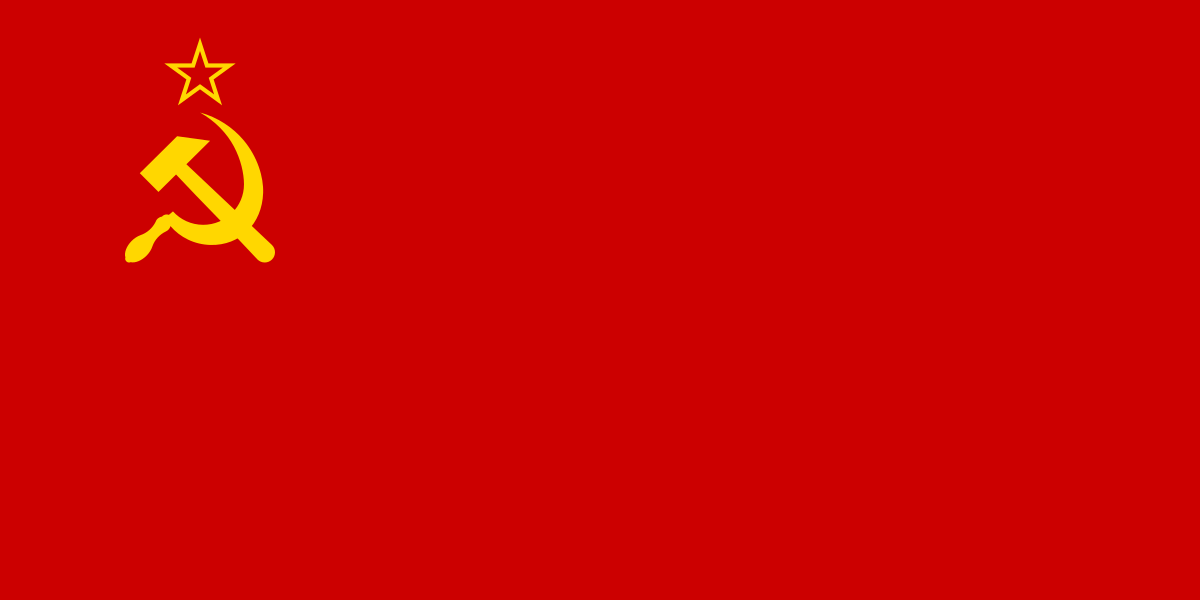
The Union of Soviet Socialist Republics USSR existed from to...

Sudan officially the Republic of the Sudan is a country...
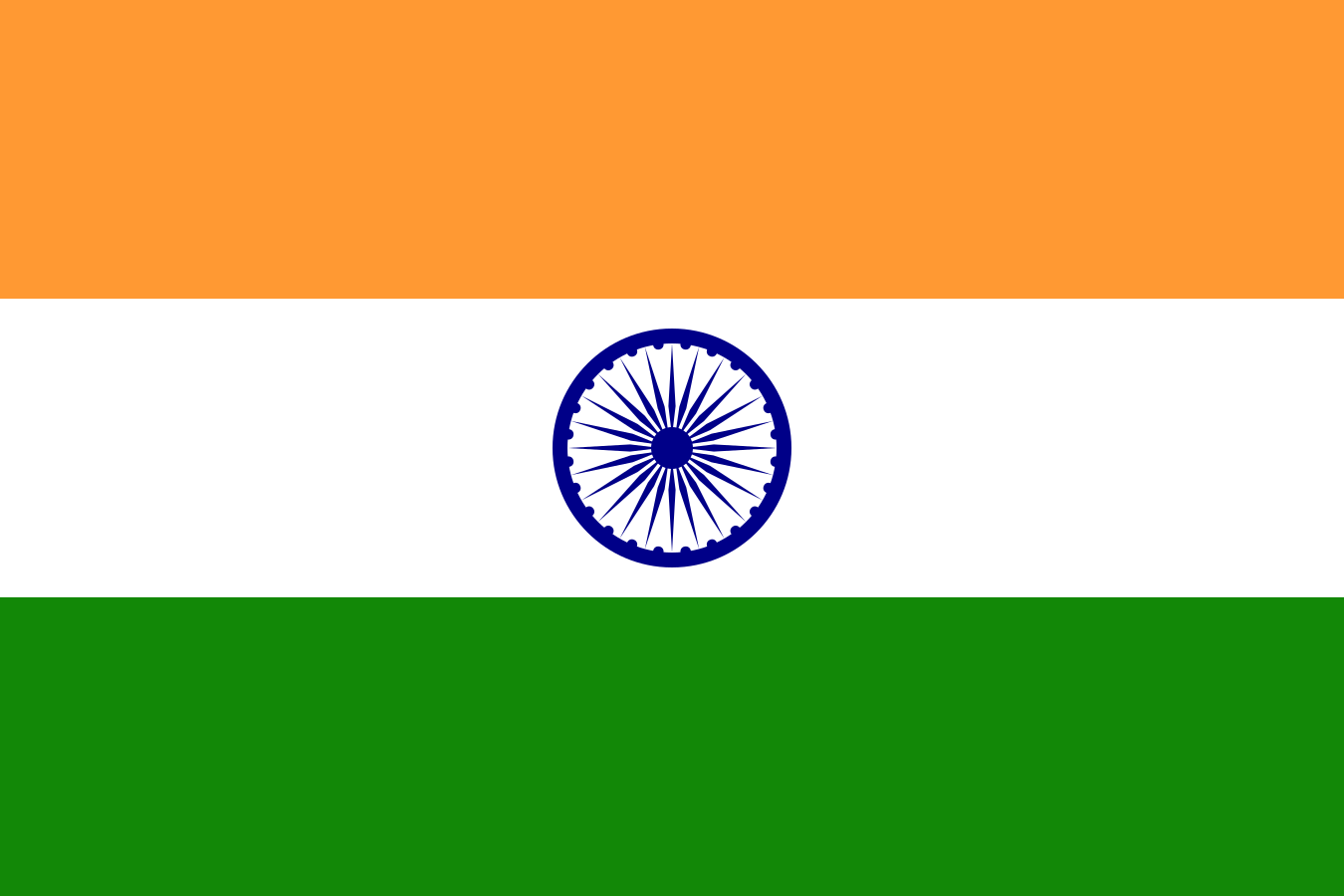
India officially the Republic of India is a South Asian...
Trending
4 hours ago Sassuolo vs Lazio Serie A Match Preview and Streaming Information

4 hours ago Sauce Gardner Faces Criticism Following Difficult NFL Trade Deadline Performance
4 hours ago Trisha Paytas Breaks Silence Regarding Ethan Klein Amid Ongoing Cheating Scandal Allegations

4 hours ago Martín Landaluce Faces Alexander Zverev at ATP Vienna Tournament

4 hours ago Chicago Bears Weigh Options Regarding Khalil Mack Potential Trade
5 hours ago DeForest Buckner Faces Trade Speculation Amid Indianapolis Colts Struggles
Popular

Ilhan Omar is a prominent American politician currently serving as...

Ken Paxton is an American politician and lawyer serving as...

Elon Musk is a visionary entrepreneur and engineer known for...
William Franklin Graham III known as Franklin Graham is an...
Barack Obama the th U S President - was the...

Nicki Minaj born Onika Tanya Maraj-Petty is a highly influential...