Early Life and Education of Condoleezza Rice: A Complete Timeline


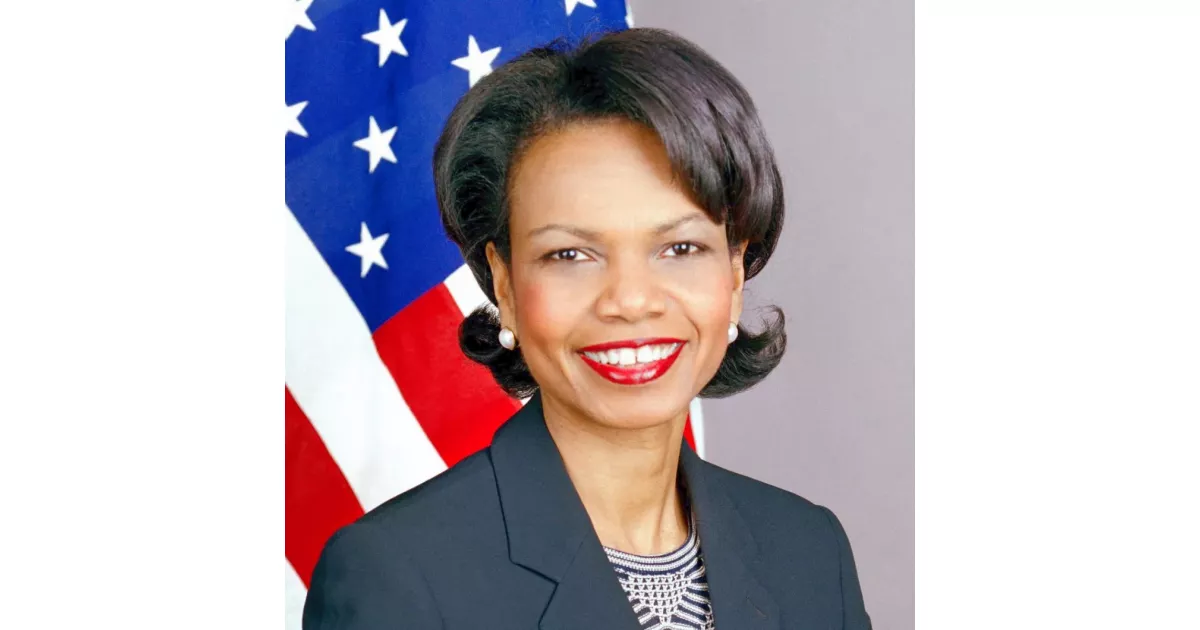
Discover the defining moments in the early life of Condoleezza Rice. From birth to education, explore key events.
Condoleezza Rice is a prominent American diplomat and political scientist. She served as the 66th U.S. Secretary of State (2005-2009) and the 19th U.S. National Security Advisor (2001-2005) under President George W. Bush. Rice holds the distinction of being the first female African-American Secretary of State and the first woman to serve as National Security Advisor. Currently, she is the director of Stanford University's Hoover Institution, a position she has held since 2020. A Republican, Rice was, at one time, the highest-ranking woman in the presidential line of succession.
1952: Discrimination against her father to vote in Alabama
In 1952, Condoleezza Rice's father was not allowed to register to vote by the Democrats in Jim Crow Alabama.


November 14, 1954: Condoleezza Rice's birth
On November 14, 1954, Condoleezza Rice, an American diplomat and political scientist who later served as the 66th United States Secretary of State and the 19th U.S. National Security Advisor, was born.
September 15, 1963: 16th Street Baptist Church Bombing
On September 15, 1963, Condoleezza Rice's schoolmate, Denise McNair, was murdered in the bombing of the Sixteenth Street Baptist Church in Birmingham. Rice was eight years old at the time.
1963: Rice remembers the 16th Street Baptist Church Bombing
In 1963, Condoleezza Rice recalls the bombing of the 16th Street Baptist Church. She was a few blocks away at her father's church. Her friend, Denise McNair, was killed in the bombing.
1967: Family moved to Denver, Colorado
In 1967, Condoleezza Rice's family moved to Denver, Colorado.
1971: Graduated from St. Mary's Academy
In 1971, Condoleezza Rice graduated from St. Mary's Academy at the age of 16.
1974: Inducted into Phi Beta Kappa society
In 1974, at age 19, Condoleezza Rice was inducted into Phi Beta Kappa society, and was awarded a B.A. degree cum laude in political science by the University of Denver.
1975: Obtained MA degree from the University of Notre Dame
In 1975, Condoleezza Rice obtained an MA degree in political science from the University of Notre Dame.
1979: Studied Russian at Moscow State University
In the summer of 1979, Condoleezza Rice studied Russian at Moscow State University and interned with the RAND Corporation in Santa Monica, California.
1980: Fellow at Stanford University's Arms Control and Disarmament Program
From 1980 to 1981, Condoleezza Rice was a fellow at Stanford University's Arms Control and Disarmament Program, having won a Ford Foundation Dual Expertise Fellowship in Soviet Studies and International Security.
1981: Hired as assistant professor at Stanford University
Condoleezza Rice was hired by Stanford University as an assistant professor of political science from 1981 to 1987.
1981: Continued as a fellow at Stanford University
From 1980 to 1981, Condoleezza Rice was a fellow at Stanford University's Arms Control and Disarmament Program, having won a Ford Foundation Dual Expertise Fellowship in Soviet Studies and International Security.
1981: Received PhD from the University of Denver
In 1981, Condoleezza Rice received a PhD from the School of International Studies at the University of Denver.
1981: Received PhD in political science
In 1981, at age 26, Condoleezza Rice received her PhD in political science from the Josef Korbel School of International Studies at the University of Denver.
1982: George Shultz became Ronald Reagan's secretary of state
From 1982 to 1989, George Shultz was Ronald Reagan's secretary of state.
1982: Changed political affiliation to Republican
In 1982, Condoleezza Rice changed her political affiliation from Democrat to Republican, partly due to disagreements with Jimmy Carter's foreign policy and her father's influence.
1985: North Korea signed the Nuclear Non-Proliferation Treaty
In 1985, North Korea signed the Nuclear Non-Proliferation Treaty.
1985: Death of Angelena Rice
In 1985, Rice's mother, Angelena Rice, died of breast cancer at the age of 61, when Rice was 30 years old.
1987: Promoted to associate professor at Stanford
In 1987, Condoleezza Rice was promoted to associate professor at Stanford University, a post she held until 1993.
1989: George Shultz stopped being Ronald Reagan's secretary of state
From 1982 to 1989, George Shultz was Ronald Reagan's secretary of state.
1989: Joined President George H.W. Bush's administration
In 1989, Condoleezza Rice joined President George H.W. Bush's administration as director of Soviet and East European affairs in the National Security Council.
1989: John Wesley Rice remarries
In 1989, Rice's father, John Wesley Rice, wed Clara Bailey, to whom he remained married until his death.
March 1991: Served as senior director of Soviet and East European affairs
In March 1991, Condoleezza Rice served as senior director of Soviet and East European affairs in the National Security Council, during the fall of the Berlin Wall and the final days of the Soviet Union. She also wrote the "Chicken Kiev speech" and helped develop policies in favor of German reunification.
1991: Returned to Stanford and appointed to committee
In 1991, Condoleezza Rice returned to her teaching position at Stanford and was appointed by California governor Pete Wilson to a bipartisan committee to draw new state legislative and congressional districts.
1992: Founded Center for New Generation
In 1992, Condoleezza Rice founded the Center for New Generation, an after-school program in East Palo Alto and eastern Menlo Park, California, aimed at improving high school graduation rates.
1993: End of role as associate professor at Stanford
In 1993, Condoleezza Rice's time as an associate professor at Stanford University came to an end.
1994: Agreement between the United States and North Korea
The 1994 agreement between the United States and North Korea included North Korea agreeing to freeze and eventually dismantle its graphite moderated nuclear reactors, in exchange for international aid.
1997: Served on Federal Advisory Committee
In 1997, Condoleezza Rice served on the Federal Advisory Committee on Gender-Integrated Training in the Military.
December 16, 2000: Named National Security Advisor
On December 16, 2000, Condoleezza Rice was named National Security Advisor, becoming the first woman to hold the position, and stepped down from her position at Stanford.
2000: Spoke at the Republican National Convention
At the 2000 Republican National Convention, Condoleezza Rice spoke about her father joining the Republican Party because Democrats in Jim Crow Alabama would not register him to vote in 1952.
2000: Rice on Abortion
In 2000, Condoleezza Rice expressed her views on abortion, describing herself as "kind of libertarian" on the issue and supporting parental choice, parental notification, and a ban on late-term abortion. She also stated she was "mildly pro-choice" and did not want the Supreme Court decision legalizing abortion, Roe v. Wade, to be overturned.
2000: Served as foreign policy advisor and gave speech at Republican National Convention
In 2000, Condoleezza Rice took a leave from Stanford to serve as George W. Bush's foreign policy advisor during his presidential campaign. She also gave a speech at the 2000 Republican National Convention.
2000: Death of John Wesley Rice
In 2000, Rice's father, John Wesley Rice, died at the age of 77.
July 10, 2001: Met with CIA director George Tenet about potential al Qaeda attack
On July 10, 2001, Condoleezza Rice met with CIA director George Tenet in an "emergency meeting" at the White House to discuss the potential threat of an impending al Qaeda attack, and Rice asked Tenet to give a presentation to Secretary Donald Rumsfeld and Attorney General John Ashcroft.
July 2001: Met repeatedly with Tenet about terrorist threats
In July 2001, Condoleezza Rice stated that she had met repeatedly with CIA director George Tenet that summer about terrorist threats.
August 6, 2001: Characterized President's Daily Brief as historical information
Condoleezza Rice characterized the August 6, 2001, President's Daily Brief 'Bin Ladin Determined To Strike in US' as historical information.
September 11, 2001: Scheduled to outline new national security policy
On September 11, 2001, Condoleezza Rice was scheduled to outline a new national security policy that included missile defense and played down the threat of stateless terrorism.
2001: Stated September 11 attacks were rooted in oppression
As Secretary of State, Condoleezza Rice championed the expansion of democratic governments and stated that the September 11 attacks in 2001 were rooted in "oppression and despair", and so the U.S. must advance democratic reform and support basic rights throughout the greater Middle East.
April 2002: Performance at National Medal of Arts Awards
In April 2002, Rice accompanied cellist Yo-Yo Ma in playing Johannes Brahms's Violin Sonata in D minor at Constitution Hall for the National Medal of Arts Awards.
July 17, 2002: Met with CIA director George Tenet to convey approval of waterboarding
On July 17, 2002, Condoleezza Rice met with CIA director George Tenet to personally convey the Bush administration's approval of the proposed waterboarding of Abu Zubaydah.
December 8, 2002: Wrote editorial for The New York Times
After Iraq delivered its declaration of weapons of mass destruction to the United Nations on December 8, 2002, Condoleezza Rice wrote an editorial for The New York Times entitled "Why We Know Iraq Is Lying".
2002: North Korea's secret nuclear weapons program revealed
In 2002, it was revealed that North Korea was operating a secret nuclear weapons program that violated the 1994 agreement.
2002: Viewed favorably by 41% of black respondents
In 2002, then National Security Advisor Rice was viewed favorably by 41% of black respondents. 40% of the respondents did not know Rice well enough to rate her and her profile remained comparatively obscure at the time.
January 10, 2003: Interviewed with CNN's Wolf Blitzer
On January 10, 2003, in an interview with CNN's Wolf Blitzer, Condoleezza Rice stated, "...we don't want the smoking gun to be a mushroom cloud," regarding Saddam Hussein's nuclear capabilities.
January 18, 2003: Reported on Bush's position on race-based preferences
On January 18, 2003, The Washington Post reported that Condoleezza Rice was involved in crafting Bush's position on race-based preferences, stating that race can be considered as "one factor among others" in university admissions policies.
October 2003: Named to run the Iraq Stabilization Group
In October 2003, Condoleezza Rice was named to run the Iraq Stabilization Group, tasked with quelling violence and speeding up reconstruction in Iraq and Afghanistan.
2003: Co-owned house in Palo Alto
From 2003, Rice co-owned a house in Palo Alto, California with Randy Bean and Coit D. Blacker.
2003: Received U.S. Senator John Heinz Award
In 2003, Condoleezza Rice received the U.S. Senator John Heinz Award for Greatest Public Service by an Elected or Appointed Official.
2003: Briefed on the use of waterboarding
In 2003, Condoleezza Rice, along with Vice President Dick Cheney and Attorney General John Ashcroft, met with the CIA and were briefed on the use of waterboarding and other enhanced interrogation methods. They reaffirmed that the CIA program was lawful and reflected administration policy.
2003: North Korea withdrew from the Non-Proliferation Treaty
In 2003, North Korea officially withdrew from the Non-Proliferation Treaty.
March 2004: Declined to testify before the 9/11 Commission
In March 2004, Condoleezza Rice initially declined to testify before the National Commission on Terrorist Attacks Upon the United States (the 9/11 Commission) citing executive privilege. She later testified under pressure.
May 2004: Iraq Stabilization Group became virtually nonexistent
By May 2004, The Washington Post reported that the Iraq Stabilization Group, which Condoleezza Rice had been named to run, had become virtually nonexistent.
November 16, 2004: Nominated to be Secretary of State
On November 16, 2004, George W. Bush nominated Condoleezza Rice to be Secretary of State.
2004: Campaigned for incumbent president
Leading up to the 2004 presidential election, Condoleezza Rice became the first National Security Advisor to campaign for an incumbent president. She stated that Saddam Hussein's Iraq was a part of the Middle East that was festering and unstable.
January 26, 2005: Confirmed as Secretary of State
On January 26, 2005, the Senate confirmed Condoleezza Rice's nomination as Secretary of State by a vote of 85–13, with the negative votes relating to her actions in Iraq and the war on terrorism.
2005: North Korea agreed to give up its nuclear program
In 2005, North Korea agreed to give up its entire nuclear program in exchange for security guarantees and economic benefits to ensure its survival.
2005: Performance at Kennedy Center benefit concert
In 2005, Rice accompanied Charity Sunshine Tillemann-Dick, a 21-year-old soprano, for a benefit concert for the Pulmonary Hypertension Association at the Kennedy Center in Washington.
2006: Asserted she did not recall specific July 2001 meeting
In 2006, Condoleezza Rice asserted that she did not recall the specific July 2001 meeting with CIA director George Tenet, but had met repeatedly with him that summer about terrorist threats.
2006: Agreement for Cooperation between the United States and India
In 2006, Indian prime minister Manmohan Singh announced the Agreement for Cooperation between the United States and India involving peaceful uses of nuclear energy. As Secretary of State, Rice was involved in the negotiation of this agreement.
2006: North Korea test fired long range missiles
In 2006, despite the agreement in 2005, North Korea test fired long range missiles, leading the UN Security Council to demand the suspension of the program.
2007: Nuclear agreement with North Korea
In 2007, Condoleezza Rice was involved in another nuclear agreement with North Korea (Pyongyang), where North Korea agreed to close its main nuclear reactor in exchange for $400 million in fuel and aid.
2008: Barack Obama's election
In 2008, Barack Obama was elected president, after which Condoleezza Rice and Colin Powell became the highest-ranking African Americans in the history of the federal executive branch.
February 2009: Declined Pac-10 Commissioner position
In February 2009, Condoleezza Rice declined an offer to become a Pac-10 Commissioner, opting to return to Stanford University as a political science professor and fellow at the Hoover Institution.
April 2009: Stated she did not authorize CIA to use torture
In April 2009, Condoleezza Rice stated that she did not authorize the CIA to use torture, but conveyed the authorization of the administration, subject to Justice Department clearance.
2009: Received Thomas D. White National Defense Award
In 2009, Condoleezza Rice received the U.S. Air Force Academy's Thomas D. White National Defense Award for contributions to the defense and security of the United States.
2009: Appearance on The Tonight Show with Jay Leno
In 2009, Rice appeared on "The Tonight Show with Jay Leno" and stated that Led Zeppelin was her favorite band.
August 2010: Received the U.S. Air Force Academy's 2009 Thomas D. White National Defense Award
In August 2010, Condoleezza Rice received the U.S. Air Force Academy's 2009 Thomas D. White National Defense Award for contributions to the defense and security of the United States.
October 2010: Met with President Obama on national security issues
In October 2010, Condoleezza Rice met with President Obama for a discussion on national security issues.
2010: Rice Supports Civil Unions, Opposes Same-Sex Marriage
In 2010, Condoleezza Rice stated that she believed "marriage is between a man and a woman," but supported civil unions for same-sex couples.
May 2011: Appeared on 30 Rock
In May 2011, Condoleezza Rice appeared as herself on the NBC sitcom "30 Rock" in the fifth-season episode "Everything Sunny All the Time Always".
May 2011: Commented on the killing of Osama bin Laden
In May 2011, Condoleezza Rice commented that the killing of Osama bin Laden was "gratifying". She also argued against removing troops from Afghanistan until the US finished helping the country "get more decent governance".
May 2012: Served as keynote speaker at SMU commencement ceremony
In May 2012, Condoleezza Rice served as the keynote speaker at the Southern Methodist University commencement ceremony and delivered a speech at the 2012 Republican National Convention.
August 20, 2012: Admitted to Augusta National Golf Club
On August 20, 2012, Rice was one of the first two women to be admitted as members to Augusta National Golf Club.
March 2014: Rice Joins Ban Bossy Campaign
In March 2014, Condoleezza Rice joined and appeared in video spots for the Ban Bossy campaign, a television and social media campaign designed to ban the word "bossy" from general use due to its harmful effect on young girls.
October 2014: Rice reveals she watches 14-15 football games a week
In October 2014, Condoleezza Rice revealed that she watched 14 or 15 football games every week live on TV on Saturdays and recorded games on Sundays.
2014: Joined Ban Bossy Campaign
In 2014, Condoleezza Rice became a spokesperson for the Ban Bossy campaign, advocating for girls to take on leadership roles.
2014: Rice criticizes Obama administration
In 2014, Rice criticized the Obama administration from seeking to approve immigration reforms through executive action.
2015: Human Rights Watch called for investigation of Rice
In 2015, Human Rights Watch called for the investigation of Condoleezza Rice for conspiracy to torture and other crimes, citing her role in authorizing "enhanced interrogation techniques".
January 26, 2017: Rice talks with University of San Francisco
On January 26, 2017, Condoleezza Rice participated in a talk with the University of San Francisco, opining that the United States had entered "uncharted territory" with President Donald Trump due to his lack of government experience.
February 2017: Rice Opposes Trump's Travel Ban
In February 2017, Condoleezza Rice publicly announced her opposition to the Trump administration's travel ban.
May 2017: Rice Opposes Removal of Confederate Monuments
In May 2017, Condoleezza Rice expressed her opposition to the removal of Confederate monuments and memorials, arguing that it is important not to forget history.
2017: Publication of Democracy: Stories from the Long Road to Freedom
In 2017, Condoleezza Rice published her book, "Democracy: Stories from the Long Road to Freedom", where she discusses her family history.

2017: Rice co-owned house until 2017
Rice co-owned a house in Palo Alto, California with a woman, Randy Bean from 2003 to 2017.
2018: Rice comments on North Korea
In 2018, Condoleezza Rice commented on North Korea, calling Kim Jong Un's overtures to South Korea "clever" and noting that he was more isolated and reckless than his father.
September 2019: Rice criticizes Trump's rhetoric on immigration
In September 2019, Condoleezza Rice publicly stated her dislike for President Trump's rhetoric, particularly on immigration, and warned that he needed to be more careful about his language due to the sensitivity of race relations in America.
August 2021: Rice writes op-ed about Afghanistan withdrawal
In August 2021, Condoleezza Rice wrote an op-ed in which she argued that the United States had withdrawn from Afghanistan too quickly, and called the idea that Afghans were to blame for the Taliban takeover a corrosive and deeply unfair narrative.
April 2022: Rice attends Madeleine Albright's funeral
In April 2022, Condoleezza Rice attended Madeleine Albright's funeral and delivered a reading from the Bible.
July 11, 2022: Joined Walton-Penner ownership group
On July 11, 2022, Condoleezza Rice joined the Walton-Penner ownership group, which had agreed to purchase the Denver Broncos NFL team for $4.65 billion.
August 9, 2022: NFL owners approved purchase of Denver Broncos
On August 9, 2022, the NFL owners approved the purchase of the Denver Broncos by the Walton-Penner group, which included Condoleezza Rice.
2023: Rice stresses need to support Ukraine
In 2023, Condoleezza Rice stressed the importance of supporting Ukraine, especially in light of criticisms from former President Trump and Governor Ron DeSantis. She defined the conflict as "defending a rules-based system."
Mentioned in this timeline

Donald John Trump is an American politician media personality and...

Barack Obama the th U S President - was the...
John F Kennedy JFK was the th U S President...

Hillary Diane Rodham Clinton is a prominent American politician lawyer...
George W Bush the rd U S President - is...

Ukraine is a country in Eastern Europe the second-largest on...
Trending
5 hours ago Yunus Akgün Makes History During Galatasaray UEFA Champions League Match Against Lille
6 hours ago Federal Prosecutors Dismantle Massive Alleged Marriage Fraud Ring in Massachusetts
6 hours ago Nico Paz reveals inspiration for his headers

6 hours ago Kelly Ripa and Mark Consuelos Finally Welcome Home Their New Puppy After Health Scare
7 hours ago Maryland Terrapins Fire Head Football Coach Mike Locksley

7 hours ago Stefanos Tsitsipas Targets Grand Slam Glory Amidst Renaissance
Popular

Ilhan Omar is a prominent American politician currently serving as...
Ken Paxton is an American politician and lawyer serving as...

Elon Musk is a visionary entrepreneur and engineer known for...

Michael Joseph Jackson the King of Pop was a highly...

Cristiano Ronaldo widely considered one of the greatest footballers captains...

Linda Ronstadt is a versatile American singer renowned for her...