History of Montana in Timeline


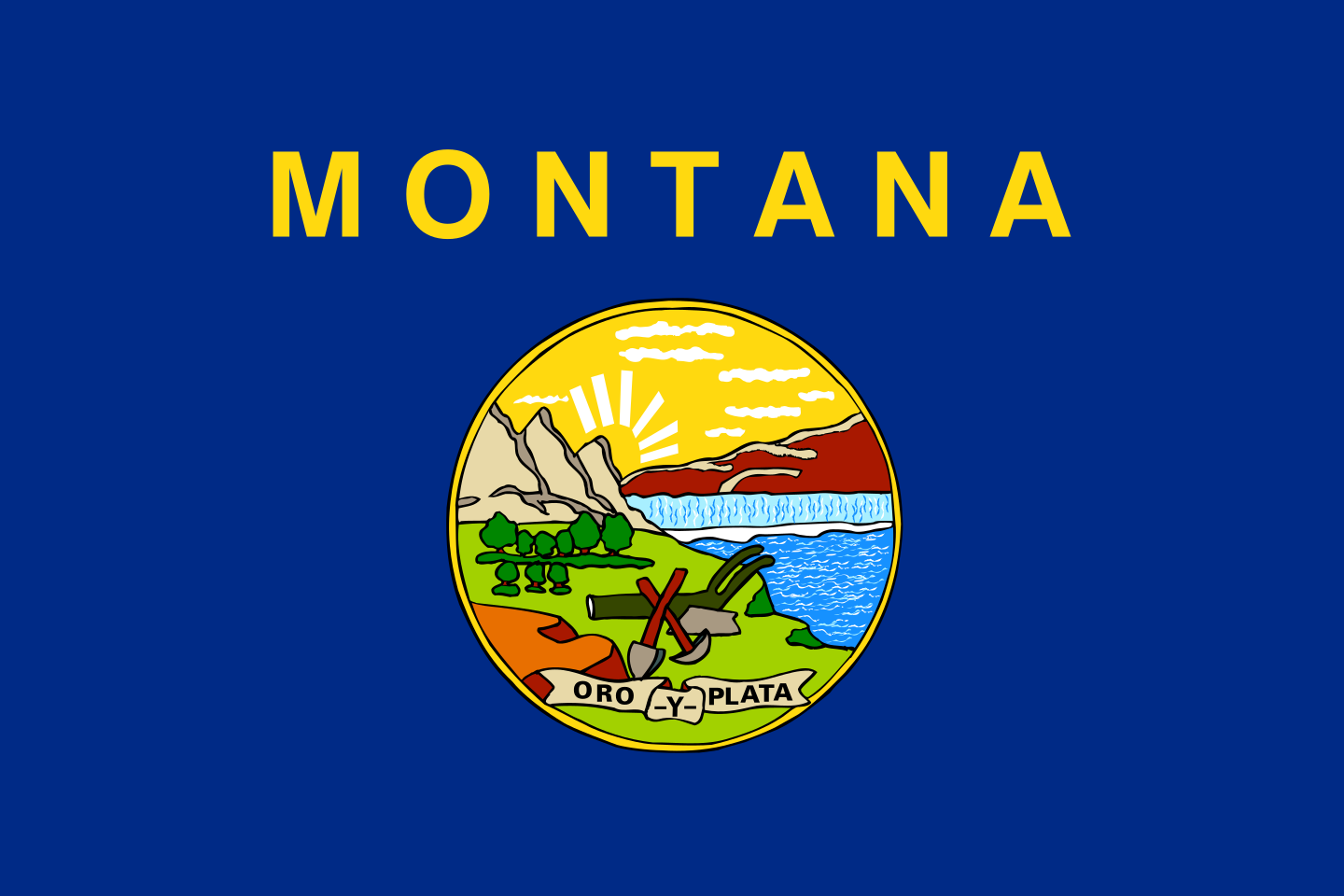
Montana is a large, landlocked state in the Mountain West region of the United States. It shares borders with Idaho, North Dakota, South Dakota, Wyoming, and three Canadian provinces. Despite being the fourth-largest state by area, it has a small population and low population density. Helena is the capital, while Billings is its largest city. The western part of Montana is dominated by the Rocky Mountains, while the eastern part features prairies and badlands.
5 hours ago : Montana Ranch Linked to 'Yellowstone' Universe Listed for $16.3M, Inspired Ranches Available.
A Montana ranch associated with the 'Yellowstone' universe is on the market for $16.3M. Inspired ranches mirroring the show's aesthetic are also being offered for sale, presenting an opportunity to own a piece of the 'Yellowstone' lifestyle.


1900: Decline in Montana's Asian Population by 1900
By 1900, nearly half of Montana's Asian population had left the state due to increasingly negative public opinion.
1900: Temperature Increase Since 1900
Since 1900, the average temperature in Montana has risen by almost 2.5 °F (1.3 °C), a rate higher than the continental U.S. average.
1902: Mary MacLane publishes her memoir
In 1902, pioneering feminist author Mary MacLane gained international fame with her memoir, The Story of Mary MacLane, detailing three months of her life in Butte.

1902: Reclamation Act Passed
In 1902, the Reclamation Act was passed, which enabled the construction of irrigation projects in Montana's eastern river valleys.
1907: Charles Nelson Pray served in the U.S. House
Charles Nelson Pray served in the U.S. House of Representatives from 1907 to 1913.
1909: Judicial elections became nonpartisan
Beginning in 1909, elections for judicial office in Montana became nonpartisan.
1909: Enlarged Homestead Act Passed
In 1909, Congress passed the Enlarged Homestead Act, increasing the amount of free land from 160 to 320 acres per family.
1910: Homestead Claims Surge
By 1910, homesteaders had filed claims on over five million acres of land in Montana.
1910: Census and reapportionment
Following the 1910 census and reapportionment, Montana received a second representative in the United States House of Representatives in 1913.
1911: Nonpartisan law struck down
In 1911, the Montana Supreme Court struck down the nonpartisan law on technical grounds.
1912: Homestead Claim Time Reduced
In 1912, the time required to 'prove up' on a homestead claim was reduced to three years.
1913: End of Charles Nelson Pray's service in the U.S. House
Charles Nelson Pray served in the U.S. House of Representatives from 1907 to 1913.
1913: Montana received a second representative
In 1913, Montana received a second representative in the United States House of Representatives, following the 1910 census and reapportionment.
1913: Thomas J. Walsh began serving as senator
Thomas J. Walsh served as a Montana senator from 1913 to 1933.
1914: Women granted the right to vote in Montana
In 1914, Montana granted women the right to vote.
1916: Jeannette Rankin elected to U.S. House
In 1916, Jeannette Rankin was elected to the U.S. House of Representatives, becoming the first woman to hold national office in the United States.
1916: Rocky Boy's Indian Reservation
In 1916, the Chippewa-Cree established the Rocky Boy's Indian Reservation near Box Elder.
1916: Stock-Raising Homestead Act
In 1916, the Stock-Raising Homestead Act permitted homesteads of 640 acres in areas unsuitable for irrigation.
June 1917: Speculator Mine Disaster
In June 1917, ramped-up mine production and the Speculator Mine disaster occurred.
June 1917: Espionage Act Passed
In June 1917, the U.S. Congress passed the Espionage Act of 1917.
August 1, 1917: Frank Little Lynched
On August 1, 1917, Industrial Workers of the World organizer Frank Little was lynched in Butte, leading to increased anti-labor sentiment and deployment of the National Guard.
1917: Homestead Filings Peak
At the peak of 1917, the Great Falls land office recorded 14,000 new homestead filings each year.
1917: Rankin Voted Against War Declaration
In 1917, Jeannette Rankin voted against the United States' declaration of war.
1917: Start of Devastating Droughts
In 1917, Montana began experiencing devastating droughts that lasted until 1921.
February 1918: Montana Sedition Act Passed
In February 1918, the Montana legislature passed the Montana Sedition Act, which criminalized criticism of the government or military and became a model for the federal version.
1918: Homestead Filings Peak
At the peak of 1918, the Great Falls land office recorded 14,000 new homestead filings each year.
1918: High Montanan Enlistment
In 1917-1918, Montana contributed a disproportionately high number of volunteers and draftees to the armed forces, with about 40,000 Montanans participating in the war effort.
1918: Wartime Emotions and Influenza Epidemic
In 1918, emotions rose amidst legislative action, resulting in criticism of officials, burnings of German-language books, and near-hangings. The 1918 influenza epidemic also claimed over 5,000 Montanan lives.
1919: Montana moved to district elections
Beginning in 1919, Montana moved to district, rather than at-large, elections for its two House members, creating Montana's 1st and 2nd congressional districts.
1919: Significant Drop Occurred
Following the drought in 1919, there was a significant drop in homestead filings.
1919: Number of Supreme Court justices increased
In 1919, the Montana legislature increased the number of Supreme Court justices to five.
1921: End of Devastating Droughts
The devastating droughts that began in 1917 ended in 1921, leading to widespread bank failures and migration out of the state.
1923: Burton K. Wheeler began serving as senator
Burton K. Wheeler served as a Montana senator from 1923 to 1947.
1923: Acres Farmed
By 1923, over 93 million acres were being farmed in Montana.
1933: End of Thomas J. Walsh's senate service
Thomas J. Walsh served as a Montana senator from 1913 to 1933.
1934: Indian Reorganization Act
The Indian Reorganization Act of 1934 enabled the creation of seven Indian reservations, encompassing 11 federally recognized tribal nations, in Montana.
1935: New nonpartisan law enacted
In 1935, a new law was enacted in Montana which barred political parties from endorsing, making contributions to, or making expenditures on behalf of or against judicial candidates.
July 5, 1937: High Temperature at Medicine Lake
On July 5, 1937, Medicine Lake recorded a high temperature of 117 °F or 47.2 °C.
1940: Jeannette Rankin Reelected to Congress
In 1940, Jeannette Rankin was reelected to Congress.
December 8, 1941: U.S. Enters World War II
On December 8, 1941, the U.S. entered World War II, leading to a significant number of Montanans enlisting in the military.
1941: Rankin Voted Against War Declaration
In 1941, Jeannette Rankin voted against the United States' declaration of war after the attack on Pearl Harbor, facing public outcry.
1942: Camp Rimini Established
In 1942, the U.S. Army established Camp Rimini near Helena for training sled dogs in winter weather.
1947: End of Burton K. Wheeler's senate service
Burton K. Wheeler served as a Montana senator from 1923 to 1947.
1947: Military Air Transport Service
In 1947, Montana became host to U.S. Air Force Military Air Transport Service for airlift training.
1948: Last Republican senator
In 1988, Montana sent a Republican to the U.S. Senate for the first time since 1948.
1952: Beginning of Republican presidential dominance
Montana has voted for the Republican nominee in all but two presidential elections since 1952.
1953: Strategic Air Command Air and Missile Forces
In 1953, Strategic Air Command air and missile forces were based at Malmstrom Air Force Base in Great Falls. The base also hosted the 29th Fighter Interceptor Squadron, Air Defense Command from 1953 to 1968.
January 20, 1954: Coldest temperature recorded in Montana
On January 20, 1954, a temperature of −70 °F or −56.7 °C was recorded at a gold mining camp near Rogers Pass. This temperature is also the coldest temperature on record for the contiguous United States.
December 1959: Minuteman I Missile Base Selected
In December 1959, Malmstrom AFB was selected as the home of the new Minuteman I intercontinental ballistic missile.
1959: Lee Enterprises buys Montana newspapers
In 1959, Lee Enterprises bought several Montana newspapers, changing the landscape from the Copper Kings era when each company had its own newspaper.
1961: James F. Battin served in the U.S. House
James F. Battin served in the U.S. House of Representatives from 1961 to 1969.
1961: Lee Metcalf began serving as senator
Lee Metcalf served as a Montana senator from 1961 to 1978.
1962: Minuteman I Missiles Ready and Cuban Missile Crisis
In early 1962, the first operational Minuteman I missiles were in place and ready. Later that year, the missiles assigned to the 341st Strategic Missile Wing played a major role in the Cuban Missile Crisis.
1964: Publication of 'Montana, High, Wide, and Handsome'
In 1964, Joseph Kinsey Howard's book, "Montana, High, Wide, and Handsome", was published.
1964: Wilderness Act of 1964
In 1964, the Wilderness Act established the National Wilderness Preservation System, which includes approximately 3,300,000 acres of wilderness in 12 separate areas within Montana.
1964: Last Republican governor
In 1988, Montana elected a Republican governor for the first time since 1964.
1964: Democratic presidential candidate
The neighboring states of Idaho, Wyoming, South Dakota, and North Dakota last supported a Democratic presidential candidate in 1964.
1968: Fighter Interceptor Squadron Ends
From 1953 to 1968, Malmstrom Air Force Base hosted the 29th Fighter Interceptor Squadron, Air Defense Command.
1968: Start of Democratic Party domination
From 1968 through 1988, the state was dominated by the Democratic Party, with Democratic governors for a 20-year period, and a Democratic majority of both the national congressional delegation and during many sessions of the state legislature.
1969: End of James F. Battin's service in the U.S. House
James F. Battin served in the U.S. House of Representatives from 1961 to 1969.
1971: Montana voters approve state constitutional convention
In 1971, Montana voters approved the call for a state constitutional convention.
January 15, 1972: Temperature Change in Loma
On January 15, 1972, Loma experienced the most extreme recorded temperature change in a 24-hour period in the United States, with a chinook wind causing the temperature to rise from −54 to 49 °F (−47.8 to 9.4 °C), a 103 °F (57.2 °C) degree difference.
June 20, 1972: New constitution ratified
Montana's new constitution was declared ratified on June 20, 1972.
1972: Term of office for justices lengthened
In 1972, the Montana constitution lengthened the term of office for Supreme Court justices to eight years and established the minimum number of justices at five.
1972: Montana voters amended the 1889 constitution
Montana voters amended the 1889 constitution 37 times between 1889 and 1972.
1973: Montana Water Use Act
The Montana Water Use Act of 1973 gave the Montana Water Court the power to adjudicate water rights claims.
1974: Montana Youth Courts established
In 1974, Montana Youth Courts were established by the Montana Youth Court Act, overseen by District Court judges and consisting of probation officers and support staff.
1974: State severance tax on coal in Montana
In 1974, a state severance tax on coal, varying from 20 to 30%, was implemented in Montana.
1974: Amendments including reclamation trust and sovereign immunity
In 1974, major amendments to the 1972 constitution included the establishment of a reclamation trust, funded by taxes on natural resource extraction, to restore mined land and the restoration of sovereign immunity when approved by a two-thirds vote in each house.
1975: Montana Worker's Compensation Court established
In 1975, the Montana Worker's Compensation Court was established by the Montana Workers' Compensation Act, with a single judge appointed by the governor.
1976: Establishment of a coal tax trust fund
In 1976, the Montana constitution was amended to establish a coal tax trust fund, which was funded by a tax on coal extraction.
1976: Missouri River Designated a National Wild and Scenic River
In 1976, the stretch of the Missouri River between Fort Benton and the Fred Robinson Bridge was designated a National Wild and Scenic River.
1978: Paul G. Hatfield served as U.S. Senator
In 1978, Paul G. Hatfield served as an appointed U.S. Senator.
1978: Conversion of county government review to voluntary
In 1978, an amendment converted the mandatory decennial review of county government into a voluntary one, needing approval or disallowance by residents in each county.
1978: Max Baucus began serving as senator
Max Baucus served as a Montana senator from 1978 to 2014.
1979: Montana Water Court established
In 1979, the Montana Water Court was established by the Montana Water Court Act, consisting of a chief water judge and four district water judges.
1979: Legislature increases number of justices
In 1979, the Montana legislature increased the number of Supreme Court justices by two, as allowed by the 1972 constitution.
1980: Growth of Native American Population Between 1980 and 1990
Between 1980 and 1990, Montana's Native American population grew by 27.9%.
1981: Supreme Court upholds Montana's coal severance tax
In 1981, the Supreme Court of the United States upheld Montana's 1974 state severance tax on coal in the case Commonwealth Edison Co. v. Montana, 453 U.S. 609.
1985: Montana Legislature passes law allowing resort tax
In 1985, the Montana Legislature passed a law allowing towns with fewer than 5,500 residents and unincorporated communities with fewer than 2,500 to levy a resort tax if more than half the community's income came from tourism.
1988: Republican governor elected
In 1988, Montana elected a Republican governor for the first time since 1964 and sent a Republican to the U.S. Senate for the first time since 1948.
1988: Public assistance changed from mandatory civil right
In 1988, an amendment changed the provision of public assistance from a mandatory civil right to a non-fundamental legislative prerogative.
1990: Diversity of Tribes in Montana in 1990
1990 census data indicated that people from as many as 275 different tribes lived in Montana.
1990: Voters turn down new constitutional convention
In 1990, Montana voters rejected holding a new constitutional convention with 84 percent voting no.
1990: Montana lost its second district
Montana lost its second district in the U.S. House after the 1990 census reapportionment.
1990: Native American Population Growth 1980-1990
The state's Native American population grew by 27.9% between 1980 and 1990, while Montana's entire population rose 1.6%.
1992: Last Democrat supported for president
In 1992, Montana last supported a Democrat for president when Bill Clinton won a plurality victory.
1992: Term limits implemented for certain statewide elected executive branch offices
In 1992, Montana voters approved a constitutional amendment implementing term limits for certain statewide elected executive branch offices, including the governor, lieutenant governor, secretary of state, state auditor, attorney general, superintendent of public instruction, and members of the Montana Legislature.
1992: Release of the film A River Runs Through It
In 1992, Robert Redford's film adaptation of Norman Maclean's novel, A River Runs Through It, was filmed in Montana and brought national attention to fly fishing and the state.
1994: Republican party took control
In 1994, the Republican Party took control of both chambers of the state legislature, consolidating a Republican party dominance.
1996: Republican congressional seats
Since 1996, the state's congressional seats have been Republican.
1999: Indian Education for All Act
In 1999, the Indian Education for All Act was passed to provide funding for and ensure implementation of the state's constitutional mandate to preserve the cultural integrity of American Indians.
2000: Language Spoken at Home in 2000
According to the 2000 census, 94.8% of the population aged five and older in Montana spoke English at home.
2000: Growth of Native American Population Between 2000 and 2010
Between 2000 and 2010, Montana's Native American population grew by 18.5 percent.
2002: Release of the film The Slaughter Rule
In 2002, the independent film The Slaughter Rule, which dramatized six-man football teams in Montana's Class C high schools, was released.
2004: Split party control
From 2004 to 2010, the two chambers of the state's legislature had split party control.
2004: New right to hunt and fish and prohibition on same-sex marriage
In 2004, the Montana constitution was amended to include a new constitutional right to hunt and fish and a now-defunct prohibition on same-sex marriage.
2004: Lawsuit Due to Lack of Funding
In 2004, the state was sued because of a lack of funding for the Indian Education for All Act, leading to increased state support of the program.
2004: Republican dominance
The state consolidated a Republican party dominance that lasted until the 2004 reapportionment produced more swing districts and a brief period of Democratic legislative majorities in the mid-2000s.
2005: Brian Morris served as associate justice
From 2005 to 2013, Brian Morris served as an associate justice of the Montana Supreme Court.
May 2006: Pardons Issued for Sedition Act Convictions
In May 2006, Governor Brian Schweitzer posthumously issued full pardons for all those convicted of violating the Montana Sedition Act.
2006: Shift in voting patterns
Through the mid-20th century, the state had a tradition of "sending the liberals to Washington and the conservatives to Helena". Between 1988 and 2006, the pattern flipped, with voters more likely to elect conservatives to federal offices.
July 2007: Hottest Month on Record
During July 2007, Montana experienced its hottest month ever recorded, with many cities setting heat records.
August 2007: Senator Tester Requests USS Montana Submarine
In August 2007, Senator Jon Tester requested that a submarine be christened USS Montana.
2007: South Dakota Passed Similar Legislation
In 2007, South Dakota passed similar legislation to Montana's Indian Education for All Act.
2008: Won by Republican John McCain
In the 2008 presidential election, Montana was considered a swing state and was ultimately won by Republican John McCain by a narrow margin of two percent.
2009: Native Americans in Urban Areas
As of 2009, almost two-thirds of Native Americans in the state live in urban areas.
2009: Language use by students in Montana
In 2009, the United States Department of Education estimated that 5,274 students in Montana spoke a language other than English at home, including Native American languages, German, Spanish, Russian, and Chinese.
2010: 2010 U.S. Census
According to the 2010 U.S. census, Billings, Missoula, Great Falls, Bozeman, Butte, Helena and Kalispell are the seven largest communities in Montana. These communities are informally known as the "big seven".
2010: Native American Population in 2010
According to the 2010 census, Montana is ranked 19th in native people and 6.5% of the state's population are Native American.
2010: Media market rankings in Montana
As of 2010, Missoula was the 166th largest media market in the United States, while Billings was 170th, Great Falls was 190th, the Butte/Bozeman area was 191st, and Helena was 206th according to Nielsen Media Research.
2010: Largest Christian denominations in Montana
As of 2010, the largest Christian denominations in Montana were the Catholic Church, the Church of Jesus Christ of Latter-day Saints, the Evangelical Lutheran Church in America, and non-denominational evangelical Protestants.
2010: Largest European Ancestry Groups in 2010
As of 2010, the largest European ancestry groups in Montana were German (27.0%), Irish (14.8%), English (12.6%), Norwegian (10.9%), French (4.7%), and Italian (3.4%).
2010: Population growth in Montana's largest counties.
During the first decade of the new century, growth was mainly concentrated in Montana's seven largest counties, with the highest percentage growth in Gallatin County, which had a 32.9% increase in its population from 2010 to 2020.
2010: Voters turn down new constitutional convention again
In 2010, Montana voters again turned down a new constitutional convention, with 58.6 percent voting no.
2010: Patient Protection and Affordable Care Act
In 2010, Senator Max Baucus shepherded the Patient Protection and Affordable Care Act through the Senate.
2010: Prohibition on new taxes on real property
In 2010, a constitutional amendment prohibited new taxes on the sale or transfer of real property.
2010: Native American residents in Montana cities in 2010.
In 2010, of Montana's 20 largest cities, Polson (15.7%), Havre (13.0%), Great Falls (5.0%), Billings (4.4%), and Anaconda (3.1%) had the greatest percentages of Native American residents.
2010: Dakota language speakers in Montana
In 2010, of the 17,800 Dakota language speakers, 700 lived in Montana.
2010: Republican control
In 2010, the midterm elections returned both branches of the state's legislature to Republican control.
2010: Tribal Affiliations Reported in 2010 Census
In the 2010 census, many Montanans reported belonging to various Native American tribes, the largest of which were the Blackfeet, the Crow, the Cheyenne, the Assiniboine Sioux, the Chippewa Cree, the Confederated Salish and Kootenai Tribes, the Ojibwe, the Sioux, the Assiniboine, the Gros Ventre and the Salish tribal grouping.
2010: Failed to regain its second seat
Montana's population grew at about the national average during the 2000s, but it had failed to regain its second seat in 2010.
December 2011: Estimated time Montana's population reached one million.
Sometime between November and December 2011, Montana had hit the one million population mark according to the Census and Economic Information Center.
2011: Spanish Language Speakers in 2011
In 2011, there were about 13,040 Spanish-language speakers in Montana, representing 1.4% of the population.
January 3, 2012: Montana Reaches One Million Population
On January 3, 2012, the Census and Economic Information Center (CEIC) at the Montana Department of Commerce estimated that Montana had hit the one million population mark sometime between November and December 2011.
2012: U.S. Supreme Court strikes down Montana's judicial nonpartisan election law
In 2012, the U.S. Supreme Court struck down Montana's judicial nonpartisan election law in American Tradition Partnership, Inc. v. Bullock, 567 U.S. ____ (Sup.Ct. 2012).
August 2013: Radio stations in Montana
As of August 2013, there were 527 FCC-licensed FM radio stations and 114 AM stations broadcasting in Montana.
2013: Other languages spoken in Montana
As of 2013, Montana had speakers of Assiniboine, Blackfoot, Cheyenne, Plains Cree, Crow, Dakota, German Hutterite, Gros Ventre, Kalispel-Pend d'Oreille, Kutenai, and Lakota.
2013: Population Statistics Based on 2013 Census Numbers
Based on 2013 census numbers, the "big seven" cities contain 35 percent of Montana's population, and the counties in which they are located are home to 62 percent of the state's population.
2013: End of Brian Morris's service as associate justice
From 2005 to 2013, Brian Morris served as an associate justice of the Montana Supreme Court.
2013: Billings Clinic named one of the safest hospitals in the U.S.
In 2013, AARP The Magazine named the Billings Clinic one of the safest hospitals in the United States.
2013: Bozeman Yellowstone International Airport becomes busiest
In the spring of 2013, Bozeman Yellowstone International Airport became the busiest airport in the state of Montana, surpassing Billings Logan International Airport.
2014: Religious affiliations in Montana
According to a 2014 Pew Research Center study, Christianity was the predominant religion in Montana, accounting for 65% of the adult population.
2014: Montana ranked as the least obese state in the U.S.
According to the 2014 Gallup Poll, Montana was ranked as the least obese state in the U.S., with an obesity rate of 19.6%.
2014: Steve Daines first elected as U.S. Senator
In 2014, Steve Daines was first elected as one of Montana's U.S. Senators.
2014: Spending on state supreme court races increases
In 2014, spending on state supreme court races in Montana exponentially increased to $1.6 million.
2014: End of Max Baucus's senate service
Max Baucus served as a Montana senator from 1978 to 2014.
September 3, 2015: USS Montana Submarine Announced
On September 3, 2015, Secretary of the Navy Ray Mabus announced that Virginia Class attack submarine SSN-794 would be named USS Montana.
2015: Percentage of Military Veterans in Montana
In the 2015 United States census estimates, Montana had the second-highest percentage of U.S. military veterans living there, with roughly 12 percent of its population over 18 being veterans.
2015: Senator seats held by Steve Daines
Steve Daines has held one of the Montana Senate seats since 2015.
2016: New constitutional rights for victims of crime approved
In 2016, extensive new constitutional rights for victims of crime were approved in Montana.
2016: Spending on state supreme court races increases further
In 2016, spending on state supreme court races in Montana increased to more than $1.6 million, a new record.
2017: Economic output from nonresident fishing in Montana
In 2017, nonresidents generated $4.7 billion in economic output in Montana, with $1.3 billion generated by visitor groups participating in guided fishing experiences.
2018: Non-resident visitors in Montana
In 2018, approximately 12.2 million non-residents visited Montana, while the population was estimated to be 1.06 million.
December 2019: Federal Recognition of the Little Shell Tribe
In December 2019, the Little Shell Tribe of Chippewa Indians of Great Falls was recognized by the federal government.
2019: Tourism in Montana
In 2019, Montana's tourism sector was rapidly growing, with 12.6 million tourists visiting the state that year.
April 2020: Highest unemployment rate in Montana
The highest unemployment rate in Montana was 11.9% in April 2020.
2020: Irreligious population in Montana
A separate study in 2020 found that 34% of the population in Montana were irreligious.
2020: 2020 Census
According to the 2020 census, 88.9% of Montana's population was White, 6.7% American Indian and Alaska Native, 4.1% Hispanics and Latinos of any race, 0.9% Asian, 0.6% Black or African American, 0.1% Native Hawaiian and other Pacific Islander, and 2.8% from two or more races.
2020: Montana self-identified as Native American in 2020.
In 2020, 67,612 people in Montana self-identified as Native American.
2020: Greg Gianforte elected as Governor
In 2020, Greg Gianforte, a Republican, was elected as the Governor of Montana.
2020: Steve Daines reelected as U.S. Senator
In 2020, Steve Daines was reelected as one of Montana's U.S. Senators.
2020: Largest Christian denominations in Montana
In 2020, the largest Christian denominations by adherents in Montana were the Catholic Church, non-denominational Protestantism, and the Church of Jesus Christ of Latter-day Saints.
2020: Montana ranked as 21st easiest state to vote in
In a 2020 study, Montana was ranked as the 21st easiest state for citizens to vote in.
2020: Montana regained a House seat
In the reapportionment following the 2020 census, Montana regained a House seat, increasing the state's number of representatives in the House to two.
2020: 2020 Census Results for Montana
The 2020 census put Montana's population at 1,084,225. From 2010 to 2020, Gallatin County had the highest percentage population growth at 32.9%, Kalispell had the largest percentage city growth at 40.1%, and Billings had the largest increase in residents with 12,946 new residents.
June 25, 2022: USS Montana Commissioned
The USS Montana submarine was commissioned on June 25, 2022.
2022: Homeless Population in Montana in 2022
According to HUD's 2022 Annual Homeless Assessment Report, there were an estimated 1,585 homeless people in Montana.
2022: Religious affiliations in Montana
According to a 2022 survey by the Public Religion Research Institute, Christianity grew to 62% of the population in Montana, comprising Protestant, Catholic, and Restorationist denominations.
2022: Montana's Gross Domestic Product
As of 2022, the U.S. Bureau of Economic Analysis estimated Montana's Gross Domestic Product was $67.072 billion, ranking 47th in the nation, and per capita personal income was $60,984, ranking 28th in the nation.
2022: Non-Christian population in Montana
In 2022, a PRRI study reported that the unaffiliated made up 32% of Montana's population among its non-Christian population, with New Age spirituality, Judaism, and Buddhism also represented.
February 2023: Lowest historical unemployment rate in Montana
The lowest historical unemployment rate in Montana was 2.4% in February 2023.
May 2023: Montana bans TikTok and Temu
In May 2023, Montana became the first US state to ban the social media app TikTok and online marketplace Temu.
July 1, 2023: Montana Population on July 1, 2023
On July 1, 2023, the United States Census Bureau stated that the population of Montana was 1,132,812, a 4.5% increase since the 2020 census.
2023: Billings Clinic unites with Logan Health Medical Center
In 2023, Billings Clinic united with Kalispell-based Logan Health Medical Center to form the largest Montana-based health system in the state, with coverage in all corners of the state and into Wyoming.
2023: Suicide rate in Montana
In 2023, Montana had a suicide rate of 26.6 per 100,000, the second highest in the U.S.
2023: Outdoor recreation contribution to Montana's GDP
In 2023, outdoor recreation accounted for 4.6% of Montana's gross domestic product, the third highest percentage of any state.
2023: Start of two representatives
Starting in 2023, Montana has two representatives in the House after a thirty-year break.
2023: House seats (now two districts
The state's congressional seats were two districts since 2023.
September 2024: New business formations in Montana
According to a report from Montana's Secretary of State Christi Jacobsen, new business formations increased from 4,900 in September 2024, to more than 6,000 in September 2025.
December 2024: USS Montana Stationed at Pearl Harbor
In December 2024, the USS Montana was stationed at Joint Base Pearl Harbor-Hickam.
2024: Republican majority
Following the 2024 Montana elections, the Montana Senate is controlled by Republicans 32 to 18, and the Montana House of Representatives also holds a 57 to 43 Republican majority.
2024: Jon Tester lost reelection
In 2024, Democratic U.S. Senator Jon Tester lost reelection, subsequently ceding his seat on January 3, 2025, thereby leaving Montana with no Democratic statewide officeholders.
2024: St. Vincent Regional Hospital receives verification as a Trauma I hospital
In 2024, Intermountain Health's St. Vincent Regional Hospital also received verification as a Trauma I hospital.
2024: Craft breweries in Montana
In 2024, Montana ranked third in the nation in number of craft breweries per capita.
2024: Tim Sheehy elected as U.S. Senator
In 2024, Tim Sheehy was elected as one of Montana's U.S. Senators.
2024: Constitutional provision codifying abortion rights
In 2024, a constitutional provision codifying abortion rights was added to the Montana Constitution.
January 3, 2025: Loss of Tester's seat
On January 3, 2025, Democratic U.S. Senator Jon Tester ceding his seat left Montana with no Democratic statewide officeholders.
August 2025: Unemployment rate in Montana
As of August 2025, the unemployment rate in Montana was 2.9%.
September 2025: Record number of new businesses registered in Montana
As of September 2025, Montana experienced a record number of new businesses registered for four consecutive years.
2025: Montana's corporate and personal income tax rates
As of 2025, Montana's corporate income tax is 6.75 percent, and the state's personal income tax contains seven brackets ranging from 1.0 to 6.75 percent.
2025: Senator seats held by Tim Sheehy
Tim Sheehy has held one of the Montana Senate seats since 2025.
Mentioned in this timeline

TikTok also known as Douyin in China is a social...

Bill Clinton served as the nd U S President from...

The Affordable Care Act ACA also known as Obamacare is...

A submarine is a watercraft capable of independent operation underwater...

Germany officially the Federal Republic of Germany is located in...

The Catholic Church the largest Christian church globally with over...
Trending

15 minutes ago Jennie Garth reveals struggles with depression, divorce, and self-love journey.

15 minutes ago Arthur Rinderknech faces Alex Michelsen at ATP Munich; Betting odds previewed.
16 minutes ago Bollywood legend Asha Bhosle passes away at 92; tributes pour in from celebrities.
1 hour ago OpenText expands European cloud offerings with AWS, Google Cloud, and sovereign AI.

1 hour ago Real Madrid faces boardroom turmoil, denies sporting director rumors, soul searching at Bernabéu.
11 days ago Alaska Airlines reveals new International Business Class Suites for long-haul flights.
Popular

Paula White-Cain is a prominent American televangelist and key figure...

Melania Trump is a Slovenian-American former model who served as...

William Franklin Graham III commonly known as Franklin Graham is...

Eric Swalwell is an American lawyer and politician currently serving...

J D Vance is an American politician and author He...

Viktor Orb n is a prominent Hungarian politician and lawyer...