


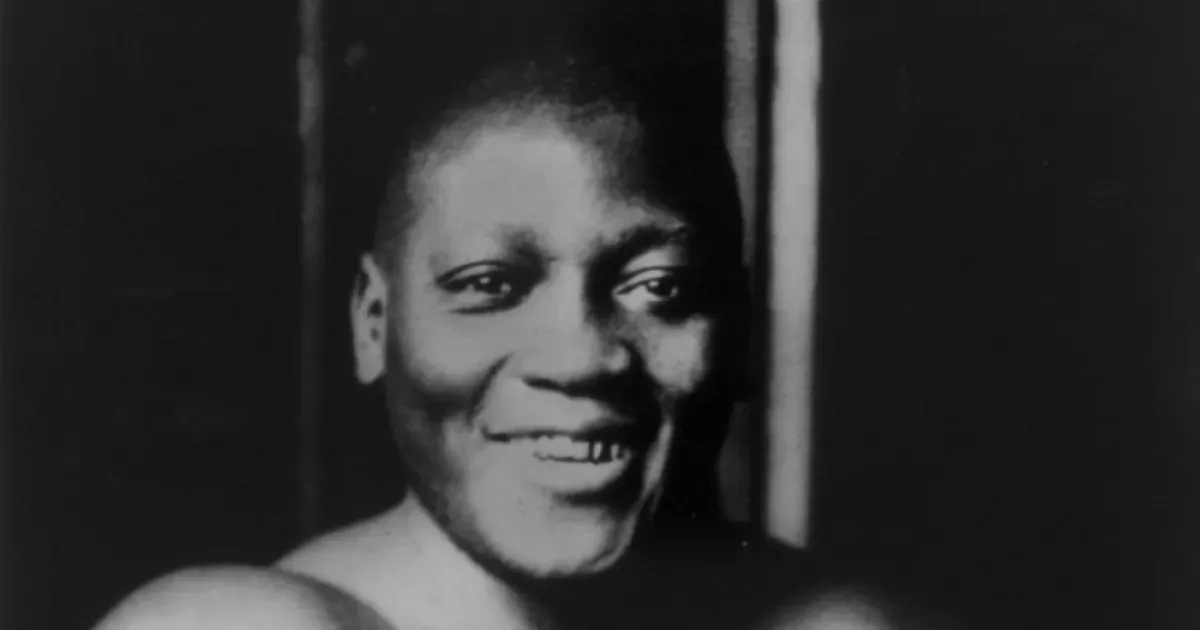
Jack Johnson, nicknamed the "Galveston Giant", was an American boxer and the first African American world heavyweight boxing champion (1908–1915) during the Jim Crow era. His victory over James J. Jeffries in 1910, a fight dubbed the "fight of the century", triggered race riots across the U.S. Johnson was a prominent and controversial figure, considered by Ken Burns as "the most famous and the most notorious African American on Earth" for over a decade. He is remembered as one of boxing's most influential figures.
1900: Setting of "The Big Blow"
In 1900, the events of Joe R. Lansdale's short story "The Big Blow" take place during the Galveston Hurricane, where Johnson fights a white boxer.


January 1901: Rematch Against Klondike
In January 1901, Carroll organized a rematch between Johnson and Klondike in Memphis. Johnson won after Klondike quit in the 14th round.
February 25, 1901: Fight and Arrest with Joe Choynski
On February 25, 1901, Johnson fought Joe Choynski at Harmony Hall in Galveston, Texas. Both fighters were arrested for participating in an illegal prizefight and spent 23 days in jail.
February 5, 1903: Wins World Colored Heavyweight Championship
On February 5, 1903, at Hazard's Pavilion in Los Angeles, Johnson won a 20-round decision over Denver Ed Martin for the World Colored Heavyweight Championship.
1903: Met Clara Kerr in Philadelphia
In 1903 while in Philadelphia, Johnson met Clara Kerr, a black prostitute. Kerr later left Johnson and stole his belongings, leading to her arrest and a brief reconciliation.
1904: Challenge to James J. Jeffries
In 1904, Johnson issued a challenge to James J. Jeffries, who held the world heavyweight title at the time. However, Jeffries refused to fight an African American and retired instead.
1905: Frequent Fights with Joe Jeanette
Between 1905 and 1908, Johnson and Joe Jeanette fought frequently, with Johnson dominating their official matchups before winning the world heavyweight title.
April 26, 1906: Fight Against Sam Langford
On April 26, 1906, Johnson fought Sam Langford at the Lincoln Athletic Club in Chelsea, Massachusetts, winning easily. However, after winning the heavyweight championship, he refused to give Langford a chance at the title.
July 1907: Knocks Out Bob Fitzsimmons
In July 1907, Johnson fought former champion Bob Fitzsimmons and knocked him out in two rounds.
1907: Affair with Alma "Lola" Toy
During a tour of Australia in 1907, Johnson had an affair with Alma "Lola" Toy, a white woman from Sydney, and expressed his intention to marry her, causing controversy.
December 26, 1908: Wins World Heavyweight Title
On December 26, 1908, Johnson won the world heavyweight title by defeating Tommy Burns at the Sydney Stadium in Australia. The police stopped the fight in the 14th round, and the championship was awarded to Johnson.
1908: Wins Heavyweight Title and Refuses to Fight Jeanette
After winning the heavyweight title in 1908, Johnson refused to fight Joe Jeanette again, despite numerous challenges.
1908: Becomes First Black Heavyweight Champion
In 1908, Jack Johnson became the first black world heavyweight boxing champion during the Jim Crow era.
1908: Filmed fight with Tommy Burns
In 1908, Johnson's bout with Tommy Burns was filmed and turned into a documentary, The Burns-Johnson Fight.
October 16, 1909: Knocks Out Stanley Ketchel
On October 16, 1909, Johnson knocked out Stanley Ketchel in the 12th round with a devastating right to the jaw during a fight.
October 29, 1909: Agreement Signed for Johnson-Jeffries Fight
On October 29, 1909, Johnson and Jeffries signed an agreement to box for the heavyweight championship of the world and called promoters to bid for the right to orchestrate the event.
December 1909: Selection of Promoters for Johnson-Jeffries Fight
In early December 1909, Johnson and Jeffries selected a bid from the nation's top boxing promoters—Tex Rickard and John Gleason for their fight. The bid guaranteed a purse of $101,000.
1909: Met Etta Terry Duryea
In 1909, Johnson met Etta Terry Duryea, a Brooklyn socialite, at a car race.
1909: Involvement with Belle Schreiber
In 1909, Johnson was involved with Belle Schreiber, an alleged prostitute.
July 4, 1910: "Fight of the Century" Against Jeffries
On July 4, 1910, the fight between Johnson and Jeffries took place in Reno, Nevada. Johnson dominated and Jeffries' corner threw in the towel in the 15th round.
1910: Langford lost to Battling Jim Johnson
In 1910, Battling Jim Johnson had a draw and loss via KO to Sam McVey, the former colored champ.
1910: "Fight of the Century" Against James J. Jeffries
In 1910, Johnson fought James J. Jeffries in a match dubbed the "fight of the century". Johnson defeated Jeffries, triggering race riots across the U.S.
1910: Hired a private investigator and Confronted Etta Duryea
In 1910, Johnson hired a private investigator to follow Duryea and confronted her on Christmas Day, beating her to the point of hospitalization.
1910: Involvement with Belle Schreiber
In 1910, Johnson was involved with Belle Schreiber, an alleged prostitute.
1910: Jeffries Agrees to Fight Johnson
In 1910, former heavyweight champion James J. Jeffries came out of retirement to challenge Johnson. Jeffries stated that he was fighting to prove that "a white man is better than a Negro".
1910: Johnson-Jeffries fight filmed
In 1910, the film of the Johnson-Jeffries fight happened.
January 18, 1911: Married Etta Terry Duryea
On January 18, 1911, Johnson married Etta Terry Duryea.
1911: Attempted to become a Freemason
In 1911, Johnson attempted to become a Freemason in Dundee, Scotland, and was initiated as an Entered Apprentice. However, his admission was ruled illegal, and the Forfarshire Lodge was suspended.
July 1912: Opened Café de Champion
In July 1912, Johnson opened an interracial nightclub in Chicago called Café de Champion.
July 19, 1912: Battling Jim Johnson vs Joe Jeanette
On July 19, 1912, Battling Jim fought former colored champ Joe Jeanette four times between July 19, 1912, and January 21, 1913, and lost all four fights.
September 11, 1912: Etta Duryea's death
On September 11, 1912, Etta Duryea, Johnson's wife, died from a self-inflicted gunshot wound, worsened by Johnson's abuse, infidelity, and the hostile reaction to their interracial relationship.
October 18, 1912: Arrested for violating the Mann Act
On October 18, 1912, Johnson was arrested on the grounds that his relationship with Lucille Cameron violated the Mann Act due to her being an alleged prostitute. The case fell apart because Cameron refused to cooperate.
December 3, 1912: Married Lucille Cameron
On December 3, 1912, Johnson married Lucille Cameron, an 18-year-old prostitute, at 3:00 p.m.
1912: Suicide of Etta Duryea Johnson
In 1912, Jack Johnson's first wife, Etta Duryea Johnson, committed suicide.
1912: Opens "Black and Tan" Restaurant and Nightclub
In 1912, Johnson opened a successful and luxurious "black and tan" restaurant and nightclub in Chicago, which was partly run by his wife. He was later arrested on charges of violating the Mann Act.
January 21, 1913: Battling Jim Johnson vs Joe Jeanette
On January 21, 1913, Battling Jim fought former colored champ Joe Jeanette four times between July 19, 1912, and January 21, 1913, and lost all four fights.
June 1913: Convicted of violating the Mann Act
In June 1913, Johnson was convicted by an all-white jury in the courtroom of Kenesaw Mountain Landis for violating the Mann Act. He was sentenced to a year and a day in prison.
August 1913: Rumors of Fight with Langford in Paris
In August 1913, there were rumors that Johnson had agreed to fight Sam Langford in Paris for the title, but it did not happen because Langford was allegedly unable to raise the $30,000 guarantee.
November 1913: IBU Declares Title Vacant
In November 1913, the International Boxing Union had declared the world heavyweight title held by Jack Johnson to be vacant.
December 19, 1913: Fight Against Battling Jim Johnson in Paris
On December 19, 1913, Johnson fought Battling Jim Johnson in Paris. It was the first time in history that two black people had fought for the world heavyweight championship.
1913: Conviction
In 1913 Jack Johnson faced a racially motivated felony conviction, for which Mike Tyson, Harry Reid, and John McCain supported a Change.org petition asking President Obama to posthumously pardon him.
1914: Published "Mes combats"
In 1914, Johnson wrote "Mes combats", a memoir of his life.
1914: Arranging the Fight with Jess Willard
In late 1914, Jack Curley and Harry Frazee began working to arrange a title fight between Johnson and Jess Willard.
April 5, 1915: Loses Title to Jess Willard
On April 5, 1915, Johnson lost his world heavyweight championship to Jess Willard in Havana, Cuba. He was knocked out in the 26th round.
October 1915: Mentioned in letters from WW1
In October 1915, Johnson's name was used to describe the impact of a shell during World War One, as mentioned in a letter from Rupert Edward Inglis.
1915: End of Championship Reign
In 1915, Jack Johnson's reign as the world heavyweight boxing champion came to an end.
1916: Mentioned in letters from WW1
In 1916, British troops in the trenches of World War One used Johnson's name to describe the impact of German 150 mm heavy artillery shells.
July 20, 1920: Returned to the U.S.
On July 20, 1920, Johnson returned to the U.S. after living in exile and surrendered to federal agents at the Mexican border.
September 1920: Sent to Leavenworth Penitentiary
In September 1920, Johnson was sent to the United States Penitentiary, Leavenworth, to serve his sentence.
1920: Opened Club Deluxe
In 1920, Johnson opened the Club Deluxe, a Black and Tan night club in Harlem.
1920: Serves Prison Sentence
In 1920, after fleeing the country for seven years and fighting boxing matches abroad, Johnson served his sentence at the federal penitentiary at Leavenworth.
July 9, 1921: Released from Leavenworth Penitentiary
On July 9, 1921, Johnson was released from the United States Penitentiary, Leavenworth.
1924: Lucille Cameron filed for divorce
In 1924, Lucille Cameron filed for divorce from Johnson due to his infidelity.
August 1925: Married Irene Pineau
In August 1925, Johnson married Irene Pineau in Waukegan, after she divorced her husband.
1927: Reported marriage to Mary Austin
According to Johnson's 1927 autobiography, he married Mary Austin, a black woman from Galveston, Texas, though no record exists of this marriage.
1927: Autobiography Published
In 1927, Johnson mentioned in his autobiography that he did not engage in fights before the age of 12.
1927: Published "Jack Johnson in the Ring and Out"
In 1927, Johnson wrote "Jack Johnson in the Ring and Out", a memoir of his life.
1931: End of boxing career
In 1931 Jack Johnson finished his boxing career.
1938: Final Professional Fight
In 1938, Johnson had his final professional fight at age 60, losing to Walter Price by a 7th-round TKO.
1943: Professed faith to Christ
In 1943, Johnson attended a service at the Angelus Temple in Los Angeles and professed his faith to Christ, during a service led by evangelist Aimee Semple McPherson.
June 10, 1946: Jack Johnson's Death
On June 10, 1946, Jack Johnson, nicknamed the "Galveston Giant", passed away. He was the first black world heavyweight boxing champion (1908–1915).
1946: Death in Car Crash
In 1946, Jack Johnson died in a car crash at the age of 68.
1954: Inducted into The Ring magazine's Boxing Hall of Fame
In 1954, Johnson was an inaugural inductee to The Ring magazine's Boxing Hall of Fame.
1970: Release of "Jack Johnson" film
In 1970, Jimmy Jacobs and Bill Cayton released the film "Jack Johnson", featuring restored archive footage of Johnson with his words voiced by Brock Peters and music by Miles Davis.
1970: Film Adaptation of The Great White Hope
In 1970, the play The Great White Hope was adapted into a film, starring James Earl Jones as "Jack Jefferson" and Jane Alexander as his love interest.
1971: Release of "Jack Johnson" album by Miles Davis
In 1971, Miles Davis released the album "Jack Johnson", which was the score for the film about Jack Johnson.
1976: Trevor Von Eeden published graphic novel about Jack Johnson
In 1976, Trevor Von Eeden, the first black artist ever hired by DC Comics, wrote and drew the graphic novel "The Original Johnson", detailing Jack Johnson's life from childhood up to his death.
1987: The Ring magazine's Boxing Hall of Fame disbanded
In 1987, The Ring magazine's Boxing Hall of Fame was disbanded.
1989: Start of Roy Jones Jr.'s boxing career
In 1989, Roy Jones Jr. started his boxing career.
1990: Inducted into International Boxing Hall of Fame
In 1990, Johnson was inducted into the International Boxing Hall of Fame.
1997: Joe R. Lansdale's short story featuring Jack Johnson
In 1997, Joe R. Lansdale's short story "The Big Blow", which featured Jack Johnson fighting a white boxer, was published.
2000: Publication of novelized "The Big Blow"
In 2000, Joe R. Lansdale's short story "The Big Blow" was expanded into a novel.
2002: Named one of 100 Greatest African Americans
In 2002, scholar Molefi Kete Asante listed Jack Johnson on his list of 100 Greatest African Americans.
2004: Publication of "Unforgivable Blackness: The Rise and Fall of Jack Johnson"
In 2004, Geoffrey C. Ward's nonfiction book "Unforgivable Blackness: The Rise and Fall of Jack Johnson" was published, which served as the basis for the 2005 Ken Burns documentary.
2005: Ken Burns produced documentary about Jack Johnson
In 2005, Ken Burns produced a two-part documentary about Johnson's life, "Unforgivable Blackness: The Rise and Fall of Jack Johnson", based on the 2004 nonfiction book of the same name by Geoffrey C. Ward, and with music by Wynton Marsalis.
2005: Addition of marker to Johnson's grave
In 2005, after filmmaker Ken Burns released a film about Johnson's life, an additional marker was added to Johnson's grave.
2005: Film of Johnson-Jeffries fight added to National Film Registry
In 2005, the United States National Film Preservation Board deemed the film of the 1910 Johnson-Jeffries fight "historically significant" and put it in the National Film Registry.
2005: Film Added to National Film Registry
In 2005, the film of the Jeffries–Johnson "Fight of the Century" was entered into the United States National Film Registry as being worthy of preservation.
2006: "Unforgivable Blackness" wins award
In 2006, Geoffrey C. Ward's book, "Unforgivable Blackness: The Rise and Fall of Jack Johnson" won the William Hill Sports Book of the Year award.
2008: Bill requesting pardon passed the House
In 2008, a bill which requested that President George W. Bush pardon Johnson passed the House, but failed to pass in the Senate.
April 2009: Request for a presidential pardon
In April 2009, Senator John McCain, along with Representative Peter King, film maker Ken Burns, and Johnson's great-niece, Linda Haywood, requested a presidential pardon for Johnson from President Barack Obama.
2012: Park dedicated in Johnson's memory
In 2012, the City of Galveston dedicated a park in Johnson's memory, called Jack Johnson Park, which includes a life-size bronze statue of Johnson.
2013: "The Big Smoke" nominated for National Book Award
In 2013, Adrian Matejka's book of poetry, "The Big Smoke", inspired by Jack Johnson's life, was a finalist for the National Book Award for Poetry.
December 2015: Mention in the Every Student Succeeds Act
In December 2015, Congress expressed in the Every Student Succeeds Act that Johnson should receive a posthumous pardon.
March 2016: Premiere of "The Royale"
In March 2016, "The Royale", a play by Marco Ramirez inspired by Jack Johnson, premiered at Lincoln Center Theater.
June 2016: Petition for pardon
In June 2016, another petition for Johnson's pardon was issued to President Obama, marking the 70th anniversary of his death.
April 2018: Trump considered a full pardon
In April 2018, President Donald Trump announced that he was considering granting a full pardon to Johnson on the advice of actor Sylvester Stallone.
May 24, 2018: Posthumous Presidential Pardon
On May 24, 2018, President Donald Trump granted Johnson a posthumous presidential pardon, 105 years after his conviction.
2018: Posthumous Pardon by President Trump
In 2018, Johnson was posthumously pardoned by U.S. President Donald Trump.
2021: Release of "Crossing the Color Line"
In 2021, the book "Crossing the Color Line: Stanley Ketchel's Challenge for Jack Johnson's Heavyweight Crown" by Vernon Gravely, detailing Johnson's fight with Stanley Ketchel, was released.
2023: Roy Jones Jr. beat boxing career record.
In 2023 Roy Jones Jr. beat the longest professional career of any world heavyweight boxing champion
2023: Release of "Last On His Feet: Jack Johnson and the Battle of the Century" graphic novel
In 2023, the graphic novel "Last On His Feet: Jack Johnson and the Battle of the Century" by Adrian Matejka and Youssef Daoudi was released, chronicling the Johnson vs. Jeffries fight.
2025: Equivalent Value of the Purse in 2025
In December 1909, the bid guaranteed a purse of $101,000, equivalent to $3,619,000 in 2025.
2025: Earnings from "Fight of the Century" in 2025 Dollars
The "Fight of the Century" earned Johnson $65,000, which is over $2.2 million in 2025 dollars.
Mentioned in this timeline

Donald John Trump is an American politician media personality and...
Barack Obama the th U S President - was the...
George W Bush the rd U S President - is...
Mike Tyson nicknamed 'Iron Mike ' is a legendary heavyweight...

Sylvester Stallone is an iconic American actor screenwriter and filmmaker...
The United States of America is a federal republic primarily...
Trending
3 hours ago Multiple Earthquakes Reported Across California Regions

22 hours ago New Netflix Docuseries Explores Life and Legacy of Matthew Perry
4 hours ago Leylah Fernandez Secures New Position in Updated WTA World Rankings

4 hours ago Katie Volynets Set For WTA Guangzhou Clash Against Dayana Yastremska

3 hours ago Zeynep Sönmez Featured in Tennis Prediction Markets

4 hours ago Sadie Sink and Maya Hawke Star in New Whimsical Prada Fantasy Holiday Campaign
Popular

Ilhan Omar is a prominent American politician currently serving as...

Ken Paxton is an American politician and lawyer serving as...

Elon Musk is a visionary entrepreneur and engineer known for...
William Franklin Graham III known as Franklin Graham is an...
Barack Obama the th U S President - was the...

Kathy Hochul is an American politician and lawyer who has...