History of Moldova in Timeline


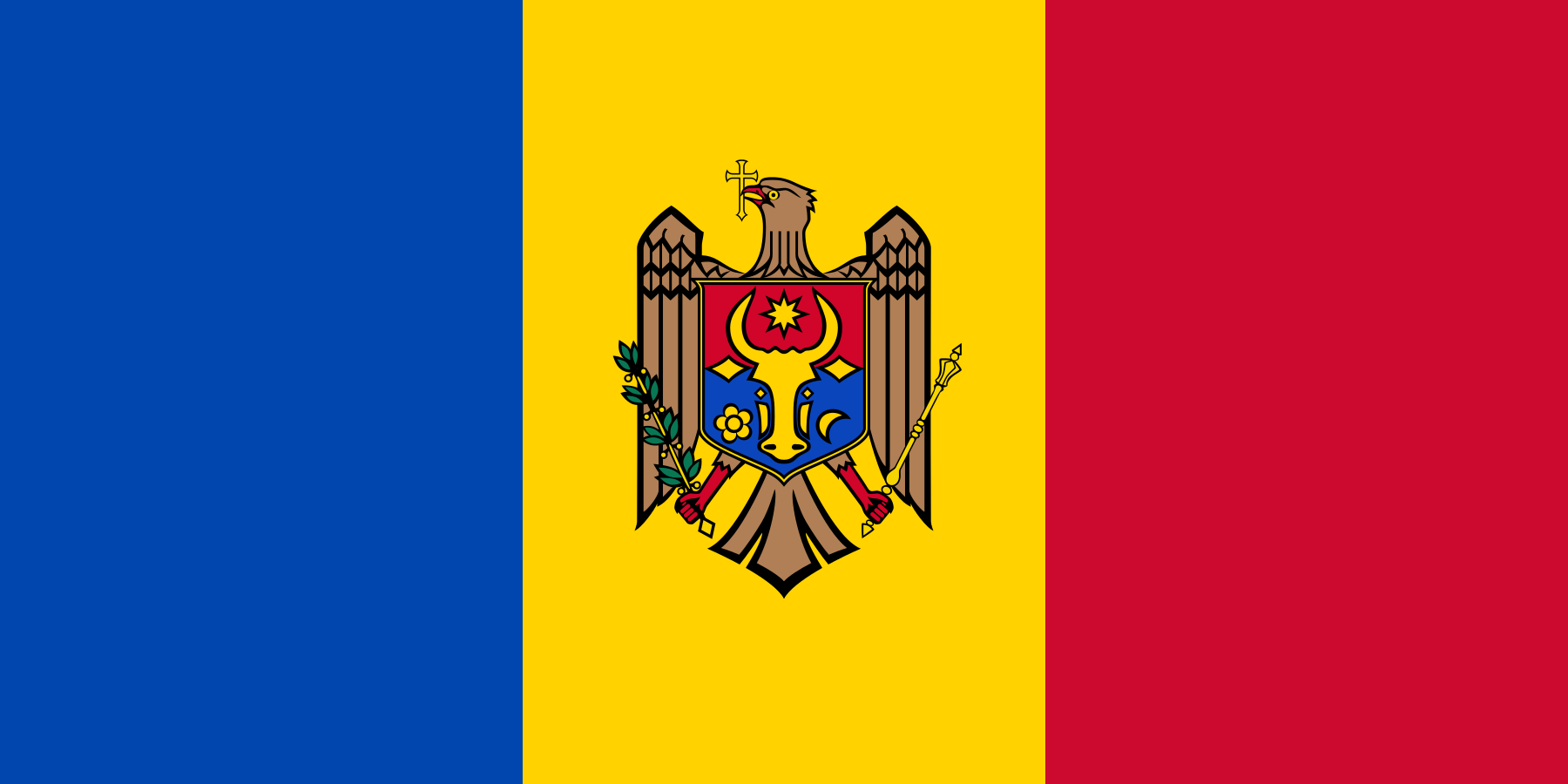
Moldova is a landlocked country in Eastern Europe bordered by Romania and Ukraine, with a population of approximately 2.38 million. A breakaway state, Transnistria, lies on its eastern border with Ukraine. Chișinău is the capital and largest city. Moldova operates as a parliamentary representative democratic republic.
3 hours ago : Moldova's Veterinary Education to modernize through the EDUVET European Project for enhancement.
Moldova's veterinary education system will be modernized through the European Union's EDUVET project. Authorities plan improvements for the Republic of Moldova's veterinary studies for enhancement.


1917: Bessarabia becomes an autonomous state
During the Russian Revolution in 1917, Bessarabia briefly became an autonomous state within the Russian Republic.
1917: Influence of Russian and Soviet administrative control
During the period of 1917, Moldovans were influenced by Russian and Soviet administrative control and by ethnic Russian immigration.
February 1918: Bessarabia declares independence
In February 1918, during the Russian Revolution, Bessarabia declared its independence from the Russian Republic.
1918: Bessarabia unites with Romania
In 1918, Bessarabia briefly became independent as the Moldavian Democratic Republic and, following the decision of the Parliament (Sfatul Țării), united with Romania.
1924: Establishment of Moldavian autonomous republic
In 1924, Soviet Russia established the Moldavian Autonomous Republic within the Ukrainian SSR on territories partially inhabited by Moldovans, located to the east of Bessarabia.
1939: Radio Moldova begins broadcasting
In 1939, Radio Moldova, the first publicly funded national radio broadcaster, began broadcasting from Chişinău.
1940: Soviet Union reclaims Bessarabia from Romania
During the Second World War, in 1940 the Soviet Union occupied Bessarabia and reclaimed it from Romania. It joined the Union as the Moldavian SSR.
1940: Romania cedes Bessarabia and Northern Bukovina to the Soviet Union
In 1940, as a consequence of the Molotov-Ribbentrop Pact, Romania was compelled to cede Bessarabia and Northern Bukovina to the Soviet Union, leading to the creation of the Moldavian Soviet Socialist Republic.
1940: Ion Creangă State Pedagogical University of Chișinău Established
In 1940, the Ion Creangă State Pedagogical University of Chișinău was established.
1945: Nicolae Testemițanu State University of Medicine and Pharmacy Established
In 1945, the Nicolae Testemițanu State University of Medicine and Pharmacy was established.
1946: Moldova State University Established
In 1946, the Moldova State University was established in Chișinău.
1961: Academy of Sciences of Moldova Established
In 1961, the Academy of Sciences of Moldova was established in Chișinău.
January 1963: Lowest temperature recorded in Moldova
On 20 January 1963, the lowest temperature ever recorded in Moldova was −35.5 °C (−31.9 °F) in Brătușeni, Edineț county.
1964: Technical University of Moldova Established
In 1964, the Technical University of Moldova was established.
1969: Earliest Wines
In 1969, the earliest wines in Mileștii Mici's collection date to this year.
1972: Release of Lăutarii
In 1972, the film Lăutarii, written and directed by Emil Loteanu, was released.
1988: Nicolae Juravschi at the Seoul Games
In 1988, Nicolae Juravschi represented the Soviet Union at the Seoul Games, winning two medals.
1990: Population Decline
According to Balkan Insight, the population of Moldova has fallen by almost 33% since 1990.
1990: War of Transnistria Begins
After the 1990–1992 War of Transnistria, Moldova sought a peaceful resolution to the conflict in the Transnistria region.
1990: Ecological Movement of Moldova founded
In 1990, the Ecological Movement of Moldova was founded to restore Moldova's damaged natural environment.
1990: Transnistria under breakaway government control
Since 1990, the strip of Moldovan territory on the east bank of the Dniester has been under the de facto control of the breakaway government of Transnistria.
August 1991: Moldavian SSR declares independence as Moldova
On 27 August 1991, as the dissolution of the Soviet Union was underway, the Moldavian SSR declared independence and took the name Moldova.
1991: Academy of Economic Studies of Moldova Established
In 1991, the Academy of Economic Studies of Moldova was established.
1991: Moldova declares independence
In 1991, the dissolution of the USSR led to Moldova's declared independence.
October 1992: Moldova ratified Treaty on Conventional Armed Forces in Europe
In October 1992, Moldova ratified the Treaty on Conventional Armed Forces in Europe.
1992: War of Transnistria Ends
After the 1990–1992 War of Transnistria, Moldova sought a peaceful resolution to the conflict in the Transnistria region.
1992: Moldova joins international organizations
In 1992, Moldova became a member state of the United Nations, the Organization for Security and Co-operation in Europe (OSCE), the North Atlantic Cooperation Council, the World Bank, the International Monetary Fund and the European Bank for Reconstruction and Development.
1992: Independence from the Soviet Union
In 1992, Moldova gained independence from the Soviet Union and began its transition to a market economy.
1992: Transnistria ties with Russia
Since 1992, Transnistria has pursued close diplomatic, military, and economic ties with Russia.
March 1994: Moldova joined the North Atlantic Treaty Organisation's Partnership for Peace
On 16 March 1994, Moldova joined the North Atlantic Treaty Organisation's Partnership for Peace.
October 1994: Moldova acceded to the provisions of the nuclear Non-Proliferation Treaty
In October 1994, Moldova acceded to the provisions of the nuclear Non-Proliferation Treaty in Washington, D.C.
1994: Moldova participates in NATO's Partnership for Peace programme
In 1994, Moldova became a participant in NATO's Partnership for Peace programme.
1994: Constitution of Moldova established
In 1994, the Constitution of Moldova set the framework for the government of the country, outlining amendment processes, referendum requirements, and the establishment of an independent Constitutional Court.
1994: First match of the Moldova national football team
In 1994, the Moldova national football team played its first match.
1994: Moldova's Olympic debut
Moldova made its Olympic debut at the 1994 Winter Olympics in Lillehammer.
May 1995: Moldova signs CIS Interparliamentary Assembly Convention
In May 1995, Moldova signed the CIS Interparliamentary Assembly Convention to become a member.
July 1995: Moldova admitted to the Council of Europe
In July 1995, Moldova was admitted to the Council of Europe.
1996: Moldova joins the Francophonie
In 1996, Moldova joined the Francophonie.
1999: Moldova acquires Danube river frontage
In 1999, Moldova acquired a 0.45 kilometer river frontage to the Danube from Ukraine, transforming Giurgiulești into a river port with access to international waters.
2000: Constitutional change adopted regarding presidential election
The Constitutional Court ruled on 4 March 2016 that this constitutional change adopted in 2000 regarding the presidential election was unconstitutional, thus reverting the election method of the president to a two-round system direct election.
2001: President elected by Parliament
Between 2001 and 2015 the President was elected by the Moldovan Parliament
2001: Moldova joins the World Trade Organization
In 2001, Moldova joined the World Trade Organization.
2002: Casa Mariorei founded
Casa Mariorei, a domestic violence shelter in Chișinău which provides shelter, healthcare, legal advice, and psychosocial support for native Moldovan, immigrant, and refugee women, was founded in 2002.
2002: Moldova joins the International Criminal Court
In 2002, Moldova joined the International Criminal Court.
2002: Moldovan diaspora in Ukraine
In 2002, the Moldovan diaspora population in Ukraine was estimated to be 258,600.
2003: O-Zone's "Dragostea Din Tei" tops charts
In 2003, the Moldovan band O-Zone rose to prominence with their hit song "Dragostea Din Tei", which topped multiple notable single charts.
2004: First run of the Moldova President's Cup
In 2004, the Moldova President's Cup cycling race was first run. Also in 2004, rugby union playing numbers at all levels have more than doubled.
August 2005: Reintroduction of European bison to Moldova
Several days before Moldova's Independence Day on 27 August 2005, three European bison from Białowieża Forest in Poland were reintroduced to Moldova, after being extinct since the 18th century.
2005: Guinness World Record
In 2005, Mileștii Mici retained the Guinness World Record for the largest wine cellar by number of bottles.
2005: Moldova participates in Eurovision
In 2005, Moldova began participating in the Eurovision Song Contest. Also in 2005, the band Zdob și Zdub represented the country and finished sixth.
2005: Establishment of EU Border Assistance Mission
In 2005, the European Union Border Assistance Mission to Moldova and Ukraine (EUBAM) was established at the joint request of the presidents of Moldova and Ukraine to improve cooperation, approximate border and customs procedures to EU standards, and support the fight against cross-border crime.
May 2007: Natalia Barbu represents Moldova at Eurovision
In May 2007, Natalia Barbu represented Moldova in Helsinki at the Eurovision Song Contest with her entry "Fight", finishing tenth.
July 2007: Highest temperature recorded in Moldova
On 21 July 2007, the highest temperature ever recorded in Moldova was 41.5 °C (106.7 °F) in Camenca.
2009: Joining Budapest Convention
In 2009, Moldova joined the Budapest Convention on Cybercrime of the Council of Europe.
2009: Release of Wedding in Bessarabia
In 2009, Wedding in Bessarabia, a co-production by Romania, Moldova, and Luxembourg, was released.
February 2010: Poland provides financial support for European integration
According to a lending agreement signed in February 2010, Poland provided US$15 million as a component of its support for Moldova in its European integration efforts.
April 2010: Romania offers development aid to Moldova
In April 2010, Romania offered Moldova development aid worth €100 million and doubled the number of scholarships for Moldovan students to 5,000.
September 2010: European Parliament approves grant to Moldova
In September 2010, the European Parliament approved a grant of €90 million to Moldova to supplement existing financial support.
2010: Moldovan diaspora in Russia
In 2010, the Moldovan diaspora population in Russia was estimated to be 156,400.
2010: SunStroke Project at Eurovision
In 2010, the SunStroke Project with Olia Tira represented Moldova in the Eurovision Song Contest with their hit song "Run Away".
2011: Islamic League of Moldova
In 2011, the Moldovan Ministry of Justice recognised the Islamic League of Moldova as an NGO representing Moldovan Muslims.
2011: Zdob și Zdub at Eurovision
In the 2011 Eurovision Song Contest, Zdob și Zdub represented Moldova, finishing 12th.
March 2012: Joint meeting of Romanian and Moldovan governments
The first joint meeting of the Governments of Romania and Moldova, held in March 2012, concluded with several bilateral agreements in various fields.
2012: Decree underpinning Moldova's sovereignty
In 2012, a decree underpinning Moldova's sovereignty was established.
2012: Security zone incident raises tensions with Russia
In 2012, a security zone incident resulted in the death of a civilian, raising tensions between Moldova and Russia.
2012: Border Police put under the control of the Ministry of Internal Affairs
The Moldovan Border Police was a military branch until 2012 when it was put under the control of the Ministry of Internal Affairs.
August 2013: Pipeline Construction Begins
In August 2013, construction commenced on a pipeline between Moldova and Romania to break Russia's monopoly on Moldova's gas supply.
November 2013: Accord drafted in Vilnius
In November 2013, the Association Agreement with the European Union was drafted in Vilnius.
November 2013: Moldova signs association agreement with the EU
On 29 November 2013, at a summit in Vilnius, Moldova signed an association agreement with the European Union, dedicated to the European Union's 'Eastern Partnership' with ex-Soviet countries.
June 2014: Moldova signed the Association Agreement with the European Union
In June 2014, Moldova signed the Association Agreement with the European Union in Brussels.
November 2014: US donated Humvees and trailers to Moldovan Armed Forces
On 12 November 2014, the US donated to Moldovan Armed Forces 39 Humvees and 10 trailers, with a value of US$700,000, to the 22nd Peacekeeping Battalion of the Moldovan National Army to "increase the capability of Moldovan peacekeeping contingents."
2014: Eastern Orthodox Christian faith
According to the 2014 Moldovan census, 90% of the country reported to be of the Eastern Orthodox Christian faith.
2014: Census results
According to the 2014 census, 38.5% of Moldova's population was urban.
2014: Referendum in Gagauzia
In 2014, nearly 99% of Gagauzians voted in a referendum to reject closer links with Europe in favor of joining the Russian-led Eurasian Economic Union.
2014: Languages spoken in Moldova
In 2014, the Moldovan census for the first time collected information about the languages spoken by residents in Moldova.
2015: Scholarships in high schools and universities for Moldovan students
As of 2015, Romania allocates 5,000 scholarships in high schools and universities for Moldovan students.
2015: President elected by Parliament
Between 2001 and 2015 the President was elected by the Moldovan Parliament
2015: Doubling agricultural production
Between 2015 and 2022, agricultural production in Moldova has almost doubled, particularly in vegetable and fruit production.
2015: Moldova signed a military agreement with Romania
In 2015, Moldova signed a military agreement with Romania to strengthen regional security.
2015: Radu Albot wins ATP doubles title
In 2015, Radu Albot won the ATP doubles title at the Istanbul Open.
2015: Rise of Carla's Dreams
In 2015, a new musical project by the name of Carla's Dreams rose in popularity around Moldova.
2015: Governor election in Gagauzia
In 2015, just over half of Gagauzians voted for the Russian-backed socialist candidate Irina Vlakh as governor.
March 2016: Constitutional Court reverts presidential election method
On 4 March 2016, the Constitutional Court ruled that the constitutional change adopted in 2000 regarding the presidential election was unconstitutional, thus reverting the election method of the president to a two-round system direct election.
December 2016: Retirement age reform approved
On December 19, 2016, the Moldovan parliament approved raising the retirement age to 63 years, from 57 for women and 62 for men.
2016: Carla's Dreams' "Sub Pielea Mea" reaches top charts
In 2016, Carla's Dreams reached the top charts in multiple countries in Europe with the release of their song "Sub Pielea Mea".
2016: National Cyber Security Programme
In 2016, Moldova adopted the National Cyber Security Programme for 2016–2020 to establish a safer digital environment.
2016: High Alcohol Consumption Per Capita
In 2016, Moldova had among the highest alcohol consumption per capita in the world, at 15.2 litres of pure alcohol imbibed.
2016: Office for Democratic Institutions and Human Rights' recommendations on hate crimes
The Office for Democratic Institutions and Human Rights published recommendations on hate crimes in 2016.
2017: Carla's Dreams releases latest album
In 2017, Carla's Dreams, the musical group known for their anonymity, released their latest album.
2017: SunStroke Project at Eurovision with "Hey Mama"
In 2017, SunStroke Project featured again in the Eurovision entry "Hey Mama", which got third place.
2018: Primary energy supply
In 2018, Moldova's primary energy supply consisted of approximately half natural gas, a quarter oil, and one-fifth solid biomass.
2018: Deaths exceed live births
Since 2018, the number of deaths has exceeded the levels of live-births in Moldova, though the gap has been reduced since 2021.
2019: Children per women
As of 2019, the average number of children per women of childbearing age was 1.78.
2019: Ilan Shor flees to Israel
In 2019 Ilan Șhor, a pro-Russian politician and businessman, fled to Israel after being convicted of fraud and money-laundering.
2019: Talks for bison exchange program with Belarus
In 2019, Moldova began talks with Belarus regarding a bison exchange program between the two countries.
2019: Foreign Visitors
In 2019, Moldova had 31,000 non-resident tourists.
2019: Forest Landscape Integrity Index score
In 2019, Moldova had a Forest Landscape Integrity Index mean score of 2.2/10, ranking it 158th globally out of 172 countries.
2019: Health Care Spending
In 2019, Moldova spent 4.9% of its annual GDP on health care.
2019: Radu Albot wins ATP singles title
In 2019, Radu Albot won the ATP singles title at the Delray Beach Open.
2019: Moldovan diaspora in Italy and France
In 2019, the Moldovan diaspora population in Italy was estimated to be 188,923 and in France was estimated to be 26,300.
2019: Leading causes of death
In 2019, the leading causes of death in Moldova were Ischaemic heart disease, strokes, hypertensive heart disease, cirrhosis of the liver, and trachea, bronchus, and lung cancers.
2019: Fertility rate and live births
In 2019, the total fertility rate was 1.78, and there were 12.2 live births per 1,000 inhabitants in Moldova.
2019: 5G consideration
Moldova is considering bidding to begin rolling out 5G in 2024, with testing beginning in 2019.
November 2020: Maia Sandu elected president of Moldova
In the November 2020 presidential election, the pro-European opposition candidate Maia Sandu was elected as the new president of the republic, becoming the first female elected president of Moldova.
2020: Corruption Perceptions Index and Press Freedom Index
According to Transparency International, Moldova's Corruption Perceptions Index was 34 points in 2020. Reporters Without Borders improved Moldova's Press Freedom Index ranking from 89th in 2020 to 40th in 2022.
2020: National Cyber Security Programme
In 2016, Moldova adopted the National Cyber Security Programme for 2016–2020 to establish a safer digital environment.
2020: Government Resignation
In 2020, After the prime minister and government resigned and the president and parliament failed to form a new government, early parliamentary elections were called
2020: Maia Sandu elected president
In 2020, Maia Sandu was elected president of Moldova on a pro-Western and anti-corruption platform.
2020: Moldova's Press Freedom Index ranking
In 2020, Reporters Without Borders ranked Moldova's Press Freedom Index at 89th.
2020: Net emigration falls to a low
In 2020, net emigration in Moldova fell to a low of 7,000 people.
2020: Moldovan diaspora in Romania
In 2020, the Moldovan diaspora population in Romania was estimated to be 285,000.
2020: Infant mortality rate
In 2020, the infant mortality rate in Moldova was 8.7 per 1,000 live-births.
July 2021: Early parliamentary elections held
Early parliamentary elections were held in Moldova in July 2021, resulting in the Party of Action and Solidarity winning a single-party majority.
2021: Recorded hate crimes
In 2021, 8 hate crimes were recorded, 7 of which reached a successful conviction, with one going to prosecution but without a conviction.
2021: Wine Exports
In 2021, Moldova exported $140 million in wine, becoming the 21st largest exporter of wine globally and the EU became the main purchaser of Moldovan wines.
2021: GDP growth rebound
In 2021, Moldova's annual GDP growth rebounded to 13.9% following the COVID-19 pandemic and lockdowns.
2021: Shift in Wine Export Destinations
In 2021, Russia accounted for only 10 percent of Moldovan wine exports, a significant decrease from 80 percent in the early 2000s, while exports to European countries exceeded 120 million liters.
2021: Zdob și Zdub in Eurovision
In 2021, Zdob și Zdub represented Moldova in the Eurovision Song Contest, achieving a similar result to their 2005 performance.
2021: Russia's plan to destabilise Moldova
In 2021, a document written by Russia's FSB's Directorate for Cross-Border Cooperation, titled "Strategic objectives of the Russian Federation in the Republic of Moldova" sets out a 10-year plan to destabilise Moldova.
2021: Agriculture Exports and Employment
In 2021, agriculture constituted 12% of Moldova's overall exports and 21% of overall employment.
2021: Net emigration and parliamentary election
In 2021, net emigration was 45,000, and the Moldovan diaspora voted for Maia Sandu's Party of Action and Solidarity in the parliamentary election.
2021: Moldovan diaspora in Canada
In 2021, the Moldovan diaspora population in Canada was estimated to be 20,470.
2021: Digitization laboratory equipped
In 2021, the United States assisted by equipping a digitisation laboratory to restore and preserve Moldovan feature and documentary films.
2021: Comparison of death statistics
In 2021, the overall number of deaths was higher than 2022.
2021: Reducing gap between deaths and births
Since 2018, the number of deaths has exceeded the levels of live-births in Moldova, though the gap has been reduced since 2021.
March 2022: Moldova signed the membership application to join the EU
On 3 March 2022, Moldova signed the membership application to join the EU.
May 2022: Incitement to religious and ethnic hatred made illegal
In May 2022, incitement to religious and ethnic hatred was made illegal in Moldova.
June 2022: Moldova granted EU candidate status
In June 2022, under the presidency of Maia Sandu, Moldova was granted candidate status for membership in the European Union.
June 2022: Moldova was granted candidate status by EU leaders
On 23 June 2022, Moldova was officially granted candidate status by EU leaders.
June 2022: Amendments to the Criminal Code adopted by the Moldovan Parliament
The Office for Democratic Institutions and Human Rights' 2016 recommendations on hate crimes were "largely reflected in amendments to the Criminal Code adopted by the Moldovan Parliament and published on 3 June 2022".
July 2022: Internet Users in Moldova
By July 2022, Moldova had 3 million internet users, approximately 76% of the population, with well-developed digital infrastructure.
July 2022: UNDP to transfer films from Moldova-Film archive
In July 2022, the United Nations Development Programme announced it would be using equipment to transfer more than 1,600 films from the Moldova-Film archive for preservation.
August 2022: Starlink Launch
In August 2022, Starlink launched its services in Moldova.
October 2022: Defense Minister claimed most military equipment is outdated
In October 2022, Defense Minister Anatolie Nosatii claimed that 90 percent of the country's military equipment is outdated and of Soviet origin, dating back to the 1960s and 1980s.
October 2022: Meeting with the European Union
In a meeting with the European Union in October 2022, EU representatives welcomed positive developments in Moldova such as the ratification of the Istanbul Convention on preventing and combating violence against women, the adoption of legislation on hate crime, and the ongoing work to reform the Electoral Code.
2022: Public support for union
A 2022 survey during the Russian invasion of Ukraine indicated that only 11% of Romania's population supports an immediate union between Moldova and Romania.
2022: Healthcare Data
According to 2022 data, there are 48.4 doctors and 91 units of average medical staff per 10,000 inhabitants in Moldova.
2022: Amnesty International's report on Moldova
According to Amnesty International's 2022/23 report, "No visible progress was made in reducing instances of torture and other ill-treatment in detention. Impunity continued for past human rights violations by law enforcement agencies. New "temporary" restrictions on public assemblies were introduced.
2022: Human Rights Report of the United States Department of State
According to Human Rights Report of the United States Department of State, released in 2022, "While authorities investigated reports of human rights abuses and corruption committed by officials, the process was slow and burdensome. During the year, authorities indicted and detained several former high-level officials including former President Igor Dodon, former member of parliament Vladimir Andronachi, Shor Party member of parliament Marina Tauber and former director of Moldovan Railways Anatolie Topala.
2022: Moldova's Corruption Perceptions Index and Press Freedom Index ranking improved
According to Transparency International, Moldova's Corruption Perceptions Index improved to 39 points in 2022. Reporters Without Borders improved Moldova's Press Freedom Index ranking from 89th in 2020 to 40th in 2022.
2022: Population Density
As of 2022, the population density in Moldova is 82.8 inhabitants per 1 square kilometer, and the average life expectancy was 71.5 years.
2022: Doubling agricultural production
Between 2015 and 2022, agricultural production in Moldova has almost doubled, particularly in vegetable and fruit production.
2022: Increase in net emigration
By 2022, 43,000 more people left Moldova than came into the country.
2022: Electricity Imports from Romania
In 2022, Moldova began importing electricity from Romania, eliminating the need to buy electricity generated from Russian gas in Transnistria.
2022: Population decline and low fertility
In 2022, Moldova experienced a population decline with 43,000 more people leaving the country than arriving, and the average number of children per woman was 1.69.
2022: Moldova submits EU membership application
In 2022, Moldova pursued closer ties with the European Union, submitting a formal membership application.
2022: Moldovan diaspora in Germany
In 2022, the Moldovan diaspora population in Germany was estimated to be 122,000.
2022: Broadcasting licenses removed from television stations
In 2022, the Moldovan government removed the broadcasting licenses from six television stations for broadcasting pro-Russian propaganda.
2022: Life expectancy and fertility rate
In 2022, the average life expectancy in Moldova was 71.5 years, and the total fertility rate per woman was 1.69.
2022: Overall number of deaths
In 2022, the overall number of deaths in Moldova fell by 20.5% compared to 2021.
2022: Increase in foreign visitors
In the first quarter of 2022, Moldova experienced an increase in foreign visitors compared to pre-pandemic levels, with numbers rising from 31,000 in 2019 to 36,100.
February 2023: Russia canceled decree underpinning Moldova's sovereignty
In February 2023, Russia canceled a 2012 decree that underpinned Moldova's sovereignty.
February 2023: Moldova passed a law introducing criminal penalties for separatism
On 2 February 2023 Moldova passed a law introducing criminal penalties for separatism, including prison terms. The law continues with penalties for financing and inciting separatism, plotting against Moldova, and collecting and stealing information that could harm the country's sovereignty, independence and integrity.
March 2023: Aims of Partnership Mission in Moldova stated
A memorandum dated 29 March 2023 stated that the Partnership Mission in Moldova aims at enhancing the resilience of Moldova's security sector in the area of crisis management as well as enhancing resilience to hybrid threats, including cybersecurity, and countering foreign information manipulation and interference.
March 2023: Romanian is the only official language
As of March 2023, Romanian is the only official language of Moldova, with all references to the Moldovan language in the constitution and legal bills amended to refer to Romanian.
April 2023: Moldova needed funding to modernize its armed forces
In April 2023, Valeriu Mija, Secretary of State for Defence Policy and National Army Reform in the Defence Ministry, claimed that Moldova needed $275 million to modernise its armed forces.
April 2023: European Union created a Partnership Mission in Moldova
On 24 April 2023, the European Union created a Partnership Mission in Moldova through its Common Security and Defence Policy to support the government in countering hybrid threats.
May 2023: Moldova suspended participation in the Commonwealth of Independent States
In May 2023, the Moldovan government announced the immediate suspension of its participation in the Commonwealth of Independent States and its intentions to ultimately withdraw from the organisation entirely.
June 2023: EU support and investment programme for Moldova
In June 2023, Moldova signed a comprehensive free trade agreement with the European Free Trade Association. On 28 June 2023, the European Union announced a €1.6 billion support and investment programme for Moldova, as well as confirming reductions in the price of mobile data and voice roaming charges in Moldova by European and Moldovan telecoms operators, as well as Moldova joining the EU's joint gas purchase platform.
June 2023: Poland sent military equipment to the Moldovan police
In June 2023, Poland sent a transport of military equipment worth €8 million (including drones, laptops, explosive ordnance disposal equipment, and ultrasound equipment) to the Moldovan police.
June 2023: Pride parade in Chișinău needed no heavy police cordons
On 18 June 2023, some 500 LGBT activists and supporters held a Pride parade in the capital city of Chișinău which for the first time needed no heavy police cordons to protect them from protesters largely linked to the Orthodox church.
June 2023: No longer imports from Russia
As of June 2023, Moldova stopped importing oil and natural gas from Russia and gained access to the European Union's joint gas purchasing platform.
July 2023: Gagauzia leader thanks Ilan Shor
In July 2023, Evghenia Guțul, the leader in Gagauzia, thanked Ilan Shor for his personal and financial support.
July 2023: Moldova passed legislation removing it from membership in the CIS Interparliamentary Assembly
In July 2023, Moldova passed legislation removing it from membership in the CIS Interparliamentary Assembly.
July 2023: Seed Libraries Network
In July 2023, a network of 20 seed libraries was established across Moldova to improve agricultural biodiversity and climate resilience.
July 2023: Government summoned Russian ambassador and expelled diplomats
In July 2023, the Moldovan government summoned the Russian ambassador Oleg Vasnetsov to Moldova, following media reports of alleged spying devices on the rooftop of their embassy in Chişinău. Also in July 2023, the Moldovan government expelled 45 Russian diplomats and embassy staff due to "hostile actions" intended to destabilise the Republic of Moldova.
October 2023: Banning of media outlets
In October 2023 Orizont TV, ITV, Prime, Publika TV, Canal 2 and Canal 3 were banned for undermining the local elections as well as blocking a number of Russian media outlets which includes the news agencies TASS and Interfax.
December 2023: EU accession talks begin
Accession talks between Moldova and the EU began on 13 December 2023.
2023: Fast and inexpensive internet
As of 2023, Internet in Moldova is among the fastest and least expensive in the world.
2023: Freedom House ranked Moldova as a "partly free" country
Freedom House ranked Moldova as a "partly free" country with a score of 62/100 in 2023.
2023: Moldova's Human Development Index ranking
In 2023, Moldova ranked 86th in the world in terms of the Human Development Index.
2023: Moldova's Press Freedom Index improves
In 2023, Reporters Without Borders improved Moldova's Press Freedom Index ranking to 28th, partly due to government legal reforms.
2023: IMF prediction of economic improvement
In 2023, the IMF predicted that Moldova's economy would improve from a 1.5% contraction to a growth of 1.5%.
January 2024: Estimated population
As of 1 January 2024, Moldova has an estimated population of approximately 2,423,300.
November 2024: Referendum and Presidential Election
In Moldova's referendum on joining the EU, 50.17% voted "yes," with Maia Sandu alleging "unprecedented" outside interference. Sandu received 42% in the simultaneous presidential election, leading to a run-off on 3 November 2024.
November 2024: Maia Sandu re-elected as president
In the November 2024 presidential election, President Maia Sandu was re-elected with 55% of the vote in the run-off.
2024: Referendum on joining the EU planned
A referendum on joining the EU is planned for autumn 2024, there will be no voting stations in Transnistria, however residents there will be free to travel into other areas of Moldova to vote, should they wish to.
2024: Ethnic Composition
According to the 2024 national census, ethnic Moldovans constituted almost 77% of the country's population, with Romanians, Ukrainians, Gagauzians, and Russians making up the most substantial ethnic minorities.
2024: National Census
In 2024, the most recent national census of Moldova was carried out (not including Transnistria).
2024: 5G consideration
Moldova is considering bidding to begin rolling out 5G in 2024, with testing beginning in 2019.
2024: Census language results
The 2024 census results for languages spoken were: Moldovan (49.2%), Romanian (31.3%), Russian (11.1%), Gagauz (3.8%), Ukrainian (2.9%), Bulgarian (1.2%), Romani (0.3), and others (0.2%).
January 2025: New Legislation Effective
New cybersecurity legislation, partially drafted by the Moldova Cybersecurity Rapid Assistance Unit, will go into effect in Moldova on 1 January 2025.
September 2025: BBC investigation revealed a secret Russian-backed network trying to disrupt the election in Moldova
In September 2025, a BBC investigation revealed a secret Russian-backed network trying to disrupt the election in Moldova. The investigation linked the operation to fugitive oligarch Ilan Shor and the banned NGO Evrazia. Recruits used ChatGPT to create false content after filming opposition supporters.
2025: Moldova's Global Innovation Index ranking
As of 2025, Moldova ranks 74th in the world on the Global Innovation Index.
2025: Religious demography
As of 2025, the non-Orthodox religious demography includes: 5.76% non-Orthodox Christian, 2.45% irreligious, 0.46% Muslim, and 0.09% religious Jews.
2025: Connectivity Improvements
Improved connectivity between Moldova and Romania is expected to be completed by 2025.
2030: Target date for EU Accession
Moldova has set 2030 as the target date for EU Accession.
2035: Projected Population Decline
By 2035, the total population of Moldova may be half of what it was in 1990.
Mentioned in this timeline
Starlink is a satellite internet constellation operated by Starlink Services...
Ukraine is a country in Eastern Europe the second-largest on...
The Union of Soviet Socialist Republics USSR existed from to...

Washington D C is the capital city and federal district...
Germany officially the Federal Republic of Germany is a nation...
Inflation in economics signifies an increase in the average price...
Trending
7 minutes ago Gervonta Davis targeted for world title fight amidst controversy and hit list mentions.
7 minutes ago Terence Crawford's son triumphs, securing Nebraska state wrestling title: A proud moment.

4 months ago Pacquiao hints at Mayweather Rematch, Talks Underway for a Spring Bout

1 hour ago Jaden Ivey sidelined for weeks with knee soreness; Bulls confident on recovery.
1 hour ago Shaq Reveals Phil Jackson's Motivation Tactics; ESPN Changes 'Inside the NBA' Lineup.

1 hour ago AJ Dybantsa: Potential $100 Million NBA Prospect, 2026 Mock Draft Predictions Emerge
Popular
Jesse Jackson is an American civil rights activist politician and...
Barack Obama the th U S President - was the...
Bernie Sanders is a prominent American politician currently serving as...

Ken Paxton is an American politician and lawyer serving as...

Michael Joseph Jackson the King of Pop was a highly...
WWE Raw a professional wrestling television program by WWE airs...