


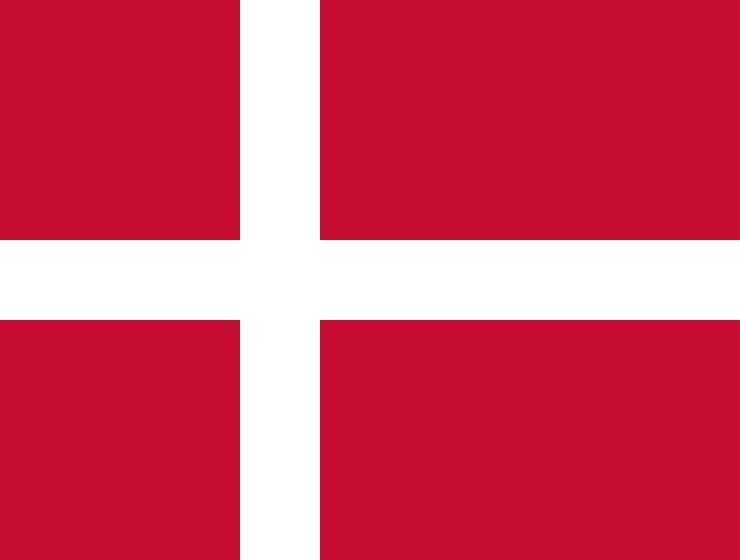
Denmark is a Nordic country located in Northern Europe, comprising the Jutland peninsula and an archipelago of islands. It's the main constituent of the Kingdom of Denmark, which also includes the Faroe Islands and Greenland. Situated south of Norway and Sweden and north of Germany, Denmark lies between the North Sea and the Baltic Sea. It's the southernmost of the Scandinavian countries.
1909: De Tretten art collective
The De Tretten art collective was active from 1909–1912.


1912: De Tretten art collective
The De Tretten art collective was active from 1909–1912.
1917: Danish West Indies
Denmark continued to rule over Danish West Indies from 1671 to 1917.
March 1920: Schleswig Plebiscites
In March 1920, the second Schleswig Plebiscite took place.
July 1920: Northern Schleswig Recovered
On 10 July 1920, Northern Schleswig was recovered by Denmark, adding approximately 163,600 inhabitants and 3,984 square kilometers.
1920: North Schleswig Becomes Danish Again
In 1920, North Schleswig became Danish again.
1924: First Social Democratic Government
In 1924, the country's first social democratic government took office.
1931: Carl Nielsen's death
Carl Nielsen (1865–1931), Denmark's most famous classical composer, died in 1931. He is remembered for his six symphonies and his Wind Quintet.
1939: Nonaggression Pact with Nazi Germany
In 1939, Denmark signed a 10-year nonaggression pact with Nazi Germany.
April 1940: German Invasion of Denmark
In April 1940, during World War II, Danish neutrality was violated by a rapid German invasion.
April 1940: German Invasion and Danish Surrender
On 9 April 1940, Germany invaded Denmark, and the Danish government quickly surrendered.
1943: Resistance movement emerged
In 1943, a resistance movement emerged during the occupation of Denmark.
1944: Iceland Retains Danish Monarchy Until 1944
Denmark kept the possessions of Iceland (which retained the Danish monarchy until 1944).
1944: Iceland Declared Independence
In 1944, Iceland declared independence during World War II.
1944: Iceland Severed Ties and Became Independent
In 1944, Iceland severed ties with Denmark and became an independent republic.
May 1945: Liberation of Denmark
In May 1945, Denmark was liberated after the end of World War II.
May 1945: German Surrender
In May 1945, Germany surrendered, marking the end of World War II for Denmark.
1945: Expansion of Industrial Base and Service Sector
Since 1945, Denmark has greatly expanded its industrial base and service sector, moving away from a predominantly agricultural economy.
1948: Home Rule Granted to Faroe Islands
In 1948, Home rule was granted to the Faroe Islands, each having previously had the status of counties.
1948: Faroe Islands Gained Home Rule
In 1948, the Faroe Islands gained home rule.
1948: COBRA art collective
The COBRA art collective was active from 1948–1951.
1949: Denmark Became Founding Member of NATO
In 1949, Denmark became a founding member of NATO.
1949: Founding Member of NATO
In 1949, Denmark became a founding member of the North Atlantic Treaty Organization (NATO).
1951: FIBA membership
Denmark joined the international governing body FIBA in 1951.
1951: COBRA art collective
The COBRA art collective was active from 1948–1951.
1953: Constitutional Change
Constitutional change in 1953 led to a single-chamber parliament elected by proportional representation, female accession to the Danish throne, and Greenland becoming an integral part of Denmark.
1957: Eurovision Song Contest participation
Denmark has participated in the Eurovision Song Contest since 1957.
1962: Silver medal for women's handball
In 1962, the Denmark women's national handball team won a silver medal.
1963: Eurovision Song Contest win
Denmark won the Eurovision Song Contest in 1963.
1967: Silver medal for men's handball
In 1967, the Danish men's national handball team won a silver medal.
1969: Legalization of pornography
In 1969, Denmark was the first country to legalize pornography.
1970: Gourmet cooking introduction
Since around 1970, chefs and restaurants across Denmark have introduced gourmet cooking, largely influenced by French cuisine.
1971: Ministry of Environment Established
In 1971, Denmark established a Ministry of Environment.
1971: Roskilde Festival start
Since 1971, Roskilde Festival near Copenhagen has been the largest music festival in Northern Europe.
1973: Environmental Law Implemented
In 1973, Denmark was the first country in the world to implement an environmental law.
1973: Denmark Joined the European Economic Community
In 1973, Denmark, along with Britain and Ireland, joined the European Economic Community (now the European Union) after a public referendum.
1973: Denmark Joins the European Union
In 1973, Denmark, along with Greenland, became a member of what is now the European Union, though it negotiated certain opt-outs.
1975: Record High Temperature
In 1975, the most extreme temperature recorded in Denmark was 36.4 °C.
1979: Home Rule in Greenland
In 1979, Greenland achieved home rule, devolving powers to handle their internal affairs.
1982: Record Low Temperature
In 1982, the most extreme low temperature recorded in Denmark was −31.2 °C.
1984: European Championships qualification
In 1984, Denmark qualified for the European Championships.
1986: Greenland Withdraws from EEC
In 1986, Greenland withdrew from the EEC because of fisheries policies.
1987: Babette's Feast Oscar win
In 1987, Gabriel Axel's film 'Babette's Feast' won an Oscar.
1987: Establishment of the Danish Centre of Human Rights
In 1987, the Kingdom Parliament (Folketinget) established a national human rights institution, the Danish Centre of Human Rights, now the Danish Institute for Human Rights.
1988: Pelle the Conqueror awards
In 1988, Bille August's film 'Pelle the Conqueror' won an Oscar, Palme d'Or, and Golden Globe award.
1989: Legal recognition to same-sex unions
In 1989, Denmark became the first country in the world to grant legal recognition to same-sex unions in the form of registered partnerships.
1989: Introduction of registered partnership laws
In 1989, Denmark was the first country to introduce "registered partnership" laws.
1992: European champions
In 1992, Denmark were crowned European champions in football.
1992: Rejection of the Maastricht Treaty
In 1992, the Maastricht Treaty, which involved further European integration, was rejected by the Danish people.
1993: Silver medal for women's handball
In 1993, the Denmark women's national handball team won a silver medal.
1993: Acceptance of the Maastricht Treaty
In 1993, the Maastricht Treaty was accepted by the Danish people after a second referendum, which provided for four opt-outs from policies.
1993: Superflex founded
The art collective Superflex was founded in 1993.
1994: Gold medal for women's handball
In 1994, the Denmark women's national handball team won a gold medal.
1994: Government initiatives for integration and urban decay
In 1994, the government of Poul Nyrup Rasmussen presented major plans to further integration and counter urban decay in vulnerable residential areas.
1995: Confederations Cup win and bronze medal
In 1995, Denmark won the Confederations Cup in football and the Denmark women's national handball team won a bronze medal.
1996: Ratification of ILO-convention 169
In 1996, Denmark ratified ILO-convention 169 on Indigenous people recommended by the UN.
1996: Gold medals for women's handball
In 1996, the Denmark women's national handball team won 2 gold medals.
1997: Gold medal for women's handball
In 1997, the Denmark women's national handball team won a gold medal.
1998: World Cup quarter-final and silver medal
In 1998, Denmark reached the quarter-final of the World Cup and the Denmark women's national handball team won a silver medal.
1999: NATO Bombing of Yugoslavia
In 1999, Denmark participated in the NATO bombing of Yugoslavia, marking a shift towards a more active role in international conflicts.
September 2000: Referendum on Adopting the Euro
In September 2000, a referendum rejected adopting the euro in Denmark.
2000: Eurovision Song Contest win
Denmark won the Eurovision Song Contest in 2000.
2000: Rejection of the Euro
In 2000, the Danes rejected the euro as the national currency in a referendum.
2000: Gold medal for women's handball
In 2000, the Denmark women's national handball team won a gold medal.
2000: Government initiatives for integration and urban decay
In 2000, the government of Poul Nyrup Rasmussen presented major plans to further integration and counter urban decay in vulnerable residential areas.
2000: Pioneering Development of Enzymes for Bioethanol
Since 2000, the Danish biotech company Novozymes has pioneered development of enzymes for converting waste to cellulosic ethanol.
2001: War in Afghanistan
In 2001, Denmark participated in the War in Afghanistan, marking a shift towards a more active role in international conflicts.
2002: Gold and bronze medals
In 2002, the Denmark women's national handball team won a gold medal and the Danish men's national handball team won a bronze medal.
2003: Engagement in Iraq
Between 2003 and 2007, approximately 450 Danish soldiers were stationed in Iraq.
2004: European Championships qualification, silver and bronze medals
In 2004, Denmark qualified for the European Championships and the Denmark women's national handball team won a gold and silver medal, while the Danish men's national handball team won a bronze medal.
2004: Government initiatives for integration and urban decay
In 2004, the Anders Fogh Rasmussen I Cabinet presented major plans to further integration and counter urban decay in vulnerable residential areas.
2005: King of the Mountains status
In 2005, Michael Rasmussen reached King of the Mountains status in the Tour de France.
2006: King of the Mountains status
In 2006, Michael Rasmussen reached King of the Mountains status in the Tour de France.
2006: Bronze medal for men's handball
In 2006, the Danish men's national handball team won a bronze medal.
January 2007: Regions Created
On 1 January 2007, the regions were created to replace the 16 former counties.
2007: Health care expenditure
As of 2007, Denmark spent 9.8% of its GDP on health care (US$3,512 per capita).
2007: Withdrawal from Iraq
Between 2003 and 2007, approximately 450 Danish soldiers were stationed in Iraq.
2007: Native speakers of German
In 2007, Denmark had 25,900 native speakers of German, mostly in the South Jutland area.
2007: Regional Reforms
In 2007, reforms led to the incorporation of sui generis municipalities like Copenhagen Municipality and Frederiksberg into the new regions.
2007: Government attempt to favour environmentally friendly cars
In 2007, the Danish government attempted to favor environmentally friendly cars by slightly reducing taxes on high mileage vehicles.
2007: Bronze medal for men's handball
In 2007, the Danish men's national handball team won a bronze medal.
2008: Increase in the import of fuel inefficient old cars
In 2008, Denmark experienced an increase in the import of fuel inefficient old cars, as the cost for older cars, including taxes, kept them within the budget of many Danes.
2008: Gold medal for men's handball
In 2008, the Danish men's national handball team won a gold medal.
2009: Poll about religion
According to a 2009 poll, 25% of Danes believe Jesus is the son of God.
2009: Crude Oil Production
In 2009, Denmark was producing 259,980 barrels of crude oil a day.
2009: Further Autonomy for Greenland
In 2009, Greenland achieved further autonomy, devolving powers to handle their internal affairs.
2009: Greenland Awarded Self-Determination
In 2009, Greenland was awarded self-determination.
2009: Referendum on the Danish Act of Succession
In 2009, a referendum was held on changing the Danish Act of Succession to grant absolute primogeniture to the Danish throne.
2010: Eurobarometer poll about religion
According to a 2010 Eurobarometer poll, 28% of Danish nationals polled responded that they "believe there is a God".
2010: Official use of the term "ghetto"
During the years 2010, the term "ghetto" was used officially to designate some or all of the vulnerable areas.
2010: Ecological Footprint
In 2010, Denmark's national ecological footprint was 8.26 global hectares per person.
2010: Government initiatives for integration and urban decay
In 2010, the Lars Løkke Rasmussen I Cabinet presented major plans to further integration and counter urban decay in vulnerable residential areas.
2010: Opinion Polls Against Adopting the Euro
Since 2010, opinion polls have consistently shown a clear majority against adopting the euro in Denmark.
May 2011: GDP from Renewable Energy Technology
In May 2011 Denmark derived 3.1% of its gross domestic product from renewable energy technology and energy efficiency.
2011: Average car age
As of 2011, the average car age in Denmark was 9.2 years.
2011: Silver medal for men's handball
In 2011, the Danish men's national handball team won a silver medal.
June 2012: Presidency of the Council of the European Union
From January to June 2012, Denmark held the Presidency of the Council of the European Union.
June 2012: New same-sex marriage law
On 7 June 2012, a new same-sex marriage law was introduced replacing the registered partnership law. The new law came into effect on 15 June 2012.
2012: Health care expenditure
As of 2012, Denmark spends 11.2% of its GDP on health care
2012: Gender-neutral marriage
In 2012, Denmark replaced its "registered partnership" laws with gender-neutral marriage.
2012: Initiatives to Simplify Business Rules
In 2012, the Danish government launched a series of initiatives aiming to simplify business rules through the "Danish Business Authority".
2012: Gold medal for men's handball
In 2012, the Danish men's national handball team won a gold medal.
2012: Cancer rate in Denmark
In a 2012 study, Denmark had the highest cancer rate of all countries listed by the World Cancer Research Fund International.
2013: Eurovision Song Contest win
Denmark won the Eurovision Song Contest in 2013.
2013: Silver and bronze medal
In 2013, the Danish men's national handball team won a silver medal, and the Denmark women's national handball team won a bronze medal.
2013: Government initiatives for integration and urban decay
In 2013, the Helle Thorning-Schmidt I Cabinet presented major plans to further integration and counter urban decay in vulnerable residential areas.
2014: Silver medal for men's handball
In 2014, the Danish men's national handball team won a silver medal.
2015: Life expectancy in Denmark
As of 2015, Denmark had a life expectancy of 80.6 years at birth.
2015: Wind Power Consumption
In 2015 wind turbines provided 42.1% of the total electricity consumption in Denmark.
2015: Contribution to Foreign Aid
In 2015, Denmark contributed 0.85% of its gross national income (GNI) to foreign aid, meeting the UN target of 0.7% of GNI.
2015: Climate Change Performance Index
In 2015, Denmark topped the list of the Climate Change Performance Index due to its implementation effective climate protection policies.
2015: Tax Structure Characteristics
In 2015, the Danish tax system was characterized by substantially higher revenues from taxes on personal income and a lower proportion of revenues from taxes on corporate income and gains and property taxes than in OECD generally.
January 2016: Transgender identity resolution
In January 2016, the Danish parliament implemented a resolution preventing transgender identity from being classified as a mental health condition, going against the World Health Organization standards.
April 2016: Greenland legalises same-sex marriage
In April 2016, Greenland legalised same-sex marriage.
2016: Net Replacement Rates for Unemployed Persons
According to OECD, initial as well as long-term net replacement rates for unemployed persons were 65% of previous net income in 2016, against an OECD average of 53%.
2016: Gold medal for men's handball
In 2016, the Danish men's national handball team won a gold medal.
2016: Public Opinion on Globalisation
In a 2016 poll, 57% of the Danish public saw globalisation as an opportunity, whereas 18% viewed it as a threat.
2016: Empathy scores of countries study
In a 2016 study comparing empathy scores of 63 countries, Denmark ranked 4th world-wide having the highest empathy among surveyed European countries.
July 2017: Faroe Islands legalises same-sex marriage
In July 2017, the Faroe Islands legalised same-sex marriage.
2017: Gini Coefficient Ranking
According to Eurostat, Denmark's Gini coefficient for disposable income was the 7th-lowest among EU countries in 2017.
2017: Largest Export Partners
As of 2017, Denmark's largest export partners are Germany, Sweden, the United Kingdom and the United States.
2017: Most Widespread Tree
As of 2017, Norway spruce is the most widespread tree in Denmark.
2017: Contribution of Services to GDP
By 2017, services contributed circa 75% of Denmark's GDP.
2017: Immigration Statistics
In 2017, 54% of all non-Scandinavian immigrants were from other EU countries. The net migration rate in 2017 was 2.1 migrants per 1,000 population.
2017: Overall Level of Taxation
In 2017, the overall level of taxation in Denmark (sum of all taxes, as a percentage of GDP) was 46%.
2017: Employment Rate
With an employment rate in 2017 of 74.2% for people aged 15–64-years, Denmark ranks 9th highest among the OECD countries.
March 2018: Eurobarometer Opinion Poll on the Euro
In March 2018, a Eurobarometer opinion poll showed that 29% of respondents from Denmark were in favor of the EMU and the euro, whereas 65% were against it.
June 2018: WHO standards
Until June 2018, the World Health Organization (WHO) classified transgender identity as being a mental health issue.
July 2018: Net International Investment Position
By 1 July 2018, the net international investment position (or net foreign assets) of Denmark was equal to 64.6% of GDP.
2018: Energy Export
Denmark exported roughly 460 million GJ of energy in 2018.
2018: Government initiatives for integration and urban decay
In 2018, the Lars Løkke Rasmussen III Cabinet presented major plans to further integration and counter urban decay in vulnerable residential areas.
2018: Education statistics
In 2018, the government recorded upper secondary school completion rates of 83% and tertiary enrolment and completion rates of 45%.
2018: National Health Service Financed by a National Health Care Contribution
Until 2018 the health service is partly financed by a national health care contribution.
January 2019: Abolishment of National Health Care Contribution
From 1 January 2019 the national health care contribution will be abolished, as it is being replaced by higher income tax instead.
2019: Global Competitiveness Report Ranking
According to the World Economic Forum in its Global Competitiveness Report 2019, Denmark is the 10th most competitive economy in the world, and 7th in Europe and North America.
2019: World Championship title
In 2019, the Danish men's national handball team won their first World Championship title.
December 2020: Stopped Issuing New Licenses for Oil and Gas Extraction
In December 2020, the Danish government stopped issuing new licences for oil and gas extraction.
2020: Statistics on ethnic groups
According to 2020 figures from Statistics Denmark, 86.1% of the population in Denmark was of Danish descent. The remaining 13.89% were of foreign background.
2020: Light rail systems planned to be in operation
Around 2020, light rail systems were planned to be in operation in Copenhagen, Aarhus, Odense, and Aalborg.
2021: Beyond Oil and Gas Alliance
In 2021, Denmark joined Costa Rica to launch the "Beyond Oil and Gas alliance" for stopping use fossil fuels.
2021: Construction of the Fehmarn Belt Fixed Link Started
In 2021, construction started on the Fehmarn Belt Fixed Link, which will connect Denmark and Germany with a second link.
2021: Government initiatives for integration and urban decay
In 2021, the Mette Frederiksen I Cabinet presented major plans to further integration and counter urban decay in vulnerable residential areas.
2021: Removal of the term "ghetto"
In 2021, the term "ghetto" was removed officially and four different lists are published.
November 2022: Danish General Election
Following the 2022 Danish general election in November 2022, incumbent prime minister and Social Democratic leader Mette Frederiksen formed a cabinet.
December 2022: Frederiksen II Cabinet Formed
In December 2022, incumbent prime minister and Social Democratic leader Mette Frederiksen formed the current Frederiksen II Cabinet, a coalition government with the until then leading opposition party Venstre and the recently founded Moderate party.
2022: Poverty Rate
As of 2022, 6.5% of the population was reported to live below the poverty line, when adjusted for taxes and transfers.
2022: Life expectancy in Denmark
As of 2022, Denmark had a life expectancy of 81.3 years at birth (79.5 for men, 83.2 for women).
2022: GDP Per Hour Worked Ranking
In 2022, Denmark's GDP per hour worked was the 16th highest in the world.
November 2023: Eurobarometer Opinion Poll on the Euro
In November 2023, a Eurobarometer opinion poll showed that 31% of respondents from Denmark were in favor of the EMU and the euro, whereas 63% were against it.
2023: Focus on Increasing Energy Taxes
In 2023, the Danish government focused on methods to increase taxes on energy dealers.
2023: Vulnerable residential areas in Denmark
In 2023, there were 19 vulnerable residential areas in Denmark.
January 2024: King Frederik X Became Head of State
Hereditary monarch King Frederik X has been head of state since 14 January 2024.
2024: Global Peace Index Ranking
According to the 2024 Global Peace Index, Denmark is the 8th most peaceful country in the world.
2024: Church of Denmark Membership
As of 2024, 71.2% of the population of Denmark were members of the Church of Denmark (Den Danske Folkekirke).
2024: Copenhagen Airport passenger volume
In 2024, Copenhagen Airport handled almost 30 million passengers, making it Scandinavia's busiest passenger airport.
2024: Freedom House Report
In its 2024 Freedom in the World report, Freedom House rated Denmark 4 out of 4 for religious freedom.
May 2025: Denmark's Population
In May 2025, Denmark's population is over 6 million, with roughly 40% living in Zealand, the largest and most populated island.
May 2025: Population of Denmark reaches 6 million
In May 2025, the population of Denmark, as registered by Statistics Denmark, was 6 million, with an average age of 42.2 years.
June 2025: Elimination of Mailboxes
Since June 2025, approximately 1,500 mailboxes have been eliminated in Denmark.
November 2025: Danish Local Elections
The most recent Danish local elections were held on 18 November 2025.
December 2025: End of Paper Letter Delivery by PostNord Danmark
After 31 December 2025, PostNord Danmark ceased all delivery of paper letter envelopes to encourage electronic mailing.
2025: Global Innovation Index Ranking
Denmark was ranked 9th in the Global Innovation Index in 2025.
2025: US Hybrid Warfare Targetting Greenland
Since 2025 the Danish territory of Greenland has been the target of US hybrid warfare under Donald Trump. Mette Frederiksen urged the United States to cease its threats against a historically close ally.
2026: Layoffs at PostNord Danmark
In 2026, a third of employees working for PostNord Danmark, or 1,500 workers, will be unemployed.
Mentioned in this timeline

Donald John Trump is an American politician media personality and...
Basketball is a team sport played on a rectangular court...
The United States of America is a federal republic primarily...
Christmas is an annual festival celebrated on December th commemorating...
Germany officially the Federal Republic of Germany is located in...
Iraq officially the Republic of Iraq is a country in...
Trending

4 hours ago Michael Strahan Updates on Daughter Isabella's Brain Cancer Recovery Journey

4 hours ago Rob Gronkowski Discusses NFL Analysis and Reflects on Chad O'Shea's Impact
4 hours ago Marvin Harrison Jr. Faces Uncertain Future Amidst Cardinals Trade Rumors and Career Struggles

22 days ago UNC Shooter Found Not Guilty by Reason of Insanity and Local Car Accident Reported

5 hours ago Enzo Fernández and Mac Allister Ahead of Liverpool vs Manchester City Clash

5 hours ago Erling Haaland Urges Manchester City Positivity Amid Ongoing Premier League Legal Charges
Popular

Ken Paxton is an American politician and lawyer serving as...

Cristiano Ronaldo widely considered one of the greatest footballers captains...

Michael Joseph Jackson the King of Pop was a highly...
Elon Musk is a visionary entrepreneur and engineer known for...

Shakira Isabel Mebarak Ripoll the Queen of Latin Music is...
Bernie Sanders is a prominent American politician and the senior...