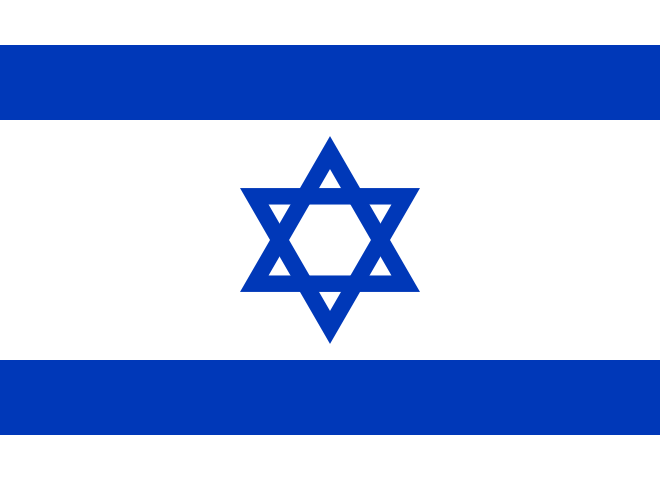
Israel is a country in the Southern Levant region of West Asia, bordered by Lebanon, Syria, Jordan, and Egypt. It has a Mediterranean coastline to the west and reaches the Red Sea in the south. Jerusalem is the proclaimed capital and government seat, while Tel Aviv is the largest urban area and economic center. The Dead Sea, Earth's lowest point, lies to its east.
The Second Aliyah began in 1904 after the Kishinev pogrom, leading to approximately 40,000 Jews settling in Palestine, though nearly half eventually left.
In 1907, Jewish armed militias emerged, with the first being Bar-Giora.
Between 1882 and 1914, antisemitism, pogroms, and official policies in tsarist Russia led to the emigration of three million Jews, only 1% of whom went to Palestine.
The Second Aliyah ended in 1914. This wave of migration included Zionist socialist groups who established the kibbutz movement, based on a Jewish economy using only Jewish labor.
In 1917, the Balfour Declaration was secured by Chaim Weizmann's efforts, stating Britain's support for the creation of a Jewish 'national home' in Palestine.
Founded in 1918, Habima Theatre in Tel Aviv is Israel's oldest repertory theatre company and national theatre.
In 1918, the Jewish Legion, primarily Zionist volunteers, assisted in the British conquest of Palestine.
The Third Aliyah took place from 1919 to 1923, bringing an additional 100,000 Jews to Palestine.
In 1920, the territory was divided between Britain and France under the mandate system, and the British-administered area (including modern Israel) was named Mandatory Palestine. The 1920 Palestine riots also took place.
Under the British Mandate, from 1920 to 1948, the entire region was known as Palestine.
In 1922, the League of Nations granted Britain the Mandate for Palestine, which included the Balfour Declaration and similar provisions regarding the Arab Palestinians.
The Third Aliyah lasted from 1919 to 1923, bringing an additional 100,000 Jews to Palestine.
The Fourth Aliyah took place from 1924 to 1929, bringing an additional 100,000 Jews to Palestine.
The Fourth Aliyah lasted from 1924 to 1929, bringing an additional 100,000 Jews to Palestine.
In 1936, the Arab revolt of 1936–39 started as a result of the increasing persecution of Jews and the rise of Nazism in Europe, leading to the Fifth Aliyah.
In 1939, the British introduced restrictions on Jewish immigration to Palestine with the White Paper of 1939.
The highest temperature of 54 °C (129 °F) was recorded in 1942 in the Tirat Zvi kibbutz.
From 1944, the UK faced a Jewish insurgency over immigration restrictions, which intensified following the end of the war, and continued conflict with the Arab community over limit levels.
On July 22, 1946, Irgun bombed the British administrative headquarters for Palestine, killing 91 people in response to Operation Agatha.
In February 1947, the British referred the Palestine issue to the newly formed United Nations after failing to mediate between Jewish and Arab representatives.
On May 15, 1947, the UN General Assembly resolved that a Special Committee be created "to prepare ... a report on the question of Palestine".
In July 1947, the Jewish insurgency peaked, culminating in the Sergeants affair, where the Irgun took two British sergeants hostage and killed them after executions of Irgun operatives were carried out.
In September 1947, the British cabinet decided to evacuate Palestine as the Mandate was no longer tenable.
On November 29, 1947, the General Assembly adopted Resolution 181 (II) which was essentially the partition plan proposed in the report of September 3. The Jewish Agency accepted the plan.
On December 1, 1947, the Arab Higher Committee proclaimed a three-day strike, and riots broke out in Jerusalem as the Arab League and Arab Higher Committee of Palestine rejected the UN partition plan.
In 1947, the Jewish insurgency continued despite efforts by the British military and Palestine Police Force to suppress it.
In 1947, the United Nations (UN) Partition Plan was created which caused the Arab-Jewish tensions to escalate into a civil war.
In April 1948, the Haganah moved onto the offensive against Arab militias and gangs attacking Jewish areas.
Colonial Secretary Arthur Creech Jones announced that the British Mandate would end on May 15, 1948, at which point the British would evacuate.
On May 14, 1948, Israel declared its independence as the British Mandate ended, which was followed by an invasion by Arab states.
On May 14, 1948, the day before the expiration of the British Mandate, David Ben-Gurion declared the establishment of a Jewish state in Eretz-Israel, leading to the 1948 Arab-Israeli War.
In 1948, forests accounted for 2% of the area in Israel.
Israel remains formally in a state of war with Syria, dating back uninterrupted to 1948.
Prior to 1948, opposition to Yiddish was common among supporters of the Zionist movement who sought to promote Hebrew's revival as a unifying national language. In 1948, these sentiments were reflected in the early policies of the Israeli government, which largely banned Yiddish theatre and publications.
Retention of Israel's population since 1948 is about even or greater, when compared to other countries with mass immigration.
Starting in 1948, approximately 1,150,000 Jewish refugees relocated to Israel over the next two decades.
The Israel Defence Forces (IDF) was founded during the 1948 Arab–Israeli War by consolidating paramilitary organisations, chiefly the Haganah.
Upon establishment in 1948, the country formally adopted the name State of Israel, after considering and rejecting other proposed names.
In May 1949, Israel was admitted as a member of the UN by United Nations General Assembly Resolution 273.
According to the demarcation lines of the 1949 Armistice Agreements, the sovereign territory of Israel is approximately 20,770 square kilometers.
In the aftermath of the Six-Day War, the 1949 Green Line became the administrative boundary between Israel and the occupied territories.
Turkey has cooperated with Israel since its recognition of Israel in 1949.
In 1950, Israel passed the Law of Return, granting Jews the unrestricted right to immigrate to Israel and obtain Israeli citizenship.
By 1952, over 200,000 people were living in temporary camps known as ma'abarot in Israel.
The State Education Law was established in Israel in 1953, establishing five types of schools: state secular, state religious, ultra orthodox, communal settlement schools, and Arab schools.
In 1955 Israel began its foreign aid programme in Burma and then shifted to Africa.
In 1956, Israel joined a secret alliance with the UK and France and overran the Sinai Peninsula during the Suez Crisis after the continued blockade of the Suez Canal and Straits of Tiran to Israeli shipping, together with increasing fedayeen attacks against Israel's southern population and recent Arab threatening statements. They were later pressured to withdraw by the UN.
Israel's humanitarian efforts officially began in 1957 with the establishment of Mashav, the Israel's Agency for International Development Cooperation.
Since 1957, UN peacekeepers were stationed in the Sinai Peninsula until they were expelled by Egypt in May 1967.
By 1958, the population of Israel had risen to two million due to the influx of Holocaust survivors and Jews from Arab and Muslim countries.
The United States has provided military assistance and grants to Israel since 1967, under the Foreign Assistance Act, period beginning 1962.
In 1963, Israel was engaged in a diplomatic standoff with the United States in relation to the Israeli nuclear programme.
In 1964, the Palestine Liberation Organisation (PLO) was established, committing itself to "armed struggle as the only way to liberate the homeland".
Israel hosted and won the 1964 AFC Asian Cup.
Since 1964 Arab countries, concerned over Israeli plans to divert waters of the Jordan River into the coastal plain, had been trying to divert the headwaters to deprive Israel of water resources, provoking tensions between Israel on the one hand, and Syria and Lebanon on the other.
By 1966, Israeli-Arab relations had deteriorated to the point of battles taking place between Israeli and Arab forces.
In 1966, Shmuel Yosef Agnon shared the Nobel Prize in Literature with German Jewish author Nelly Sachs.
In May 1967, Egypt massed its army near the border with Israel, expelled UN peacekeepers stationed in the Sinai Peninsula since 1957, and blocked Israel's access to the Red Sea.
After the 1967 Six-Day War, Israel occupied the West Bank, Gaza and Egyptian Sinai, and annexed East Jerusalem and the Syrian Golan Heights.
Diplomatic relations between Israel and the Soviet Union were broken in 1967 following the Six-Day War.
Following the 1967 war and the "Three Nos" resolution of the Arab League, Israel faced attacks from the Egyptians in the Sinai Peninsula during the 1967–1970 War of Attrition.
Following the 1967 war relations soured, and Israel's foreign aid programme subsequently shifted its focus to Latin America.
From their occupation in 1967, Palestinians living in these territories were under Israeli military administration.
In 1967, Israel captured and occupied the West Bank, the Gaza Strip, and the Golan Heights as a result of the Six-Day War.
The 1980 Jerusalem Law was believed by some to reaffirm Israel's 1967 annexation of Jerusalem by government decree and reignited international controversy over the status of the city.
The 1968 Summer Paralympics were hosted by Israel.
Between 1948 and 1970, approximately 1,150,000 Jewish refugees relocated to Israel.
Following the 1967 war, Israel faced attacks from the Egyptians in the Sinai Peninsula during the 1967–1970 War of Attrition.
In 1970 the Israel national football team qualified for the FIFA World Cup, the only time it participated.
In 1972, Palestinian groups launched attacks against Israeli and Jewish targets around the world, including a massacre of Israeli athletes at the Summer Olympics in Munich.
On 6 October 1973, the Egyptian and Syrian armies launched a surprise attack against Israeli forces in the Sinai Peninsula and Golan Heights, opening the Yom Kippur War.
Israel has participated in the Eurovision Song Contest nearly every year since 1973, winning it four times and hosting three times.
Since the Yom Kippur War in 1973, the Gaza-Israel conflict of 2023 has been the most significant military engagement in the region.
Since 1974, the United States has been a particularly notable contributor of military aid to Israel.
The 1974 Asian Games, held in Tehran, were the last Asian Games in which Israel participated, due to other Arab countries refusing to compete with Israel.
Since Israel's establishment, military expenditure constituted a significant portion of the country's gross domestic product, with a peak of 30.3% of GDP in 1975.
On 27 June 1976, Air France Flight 139 was hijacked in flight from Israel to France by Palestinian guerrillas; Israeli commandos rescued 102 of 106 Israeli hostages days later.
The 1977 Knesset elections marked a major turning point in Israeli political history as Menachem Begin's Likud party took control from the Labor Party. Later that year, Egyptian President Anwar El Sadat made a trip to Israel and spoke before the Knesset in what was the first recognition of Israel by an Arab head of state.
On 11 March 1978, a PLO guerilla raid from Lebanon led to the Coastal Road massacre. Israel responded by launching an invasion of southern Lebanon to destroy PLO bases.
Israel was excluded from the 1978 Asian Games and since then has not competed in Asian sport events.
In 1979, Israel returned the Sinai Peninsula to Egypt as part of the Egypt–Israel peace treaty.
In 1979, a peace treaty was signed with Egypt, leading to the return of the Sinai in 1982.
The 1980 Jerusalem Law was believed by some to reaffirm Israel's 1967 annexation of Jerusalem by government decree and reignited international controversy over the status of the city.
In 1981 Israel effectively annexed the Golan Heights. The international community largely rejected these moves.
Between 1982 and 2000, Israel occupied part of southern Lebanon, in what was known as the Security Belt.
Following a series of PLO attacks in 1982, Israel invaded Lebanon to destroy the PLO bases.
In 1982, as part of the 1979 peace treaty, the Sinai was returned to Egypt.
Between 1985 and 2015, Israel sent 24 delegations of their search and rescue unit the Home Front Command to 22 countries.
Israel withdrew from most of Lebanon in 1986 but continued to occupy a borderland buffer zone in southern Lebanon until 2000, from where Israeli forces engaged in conflict with Hezbollah.
In 1987, The First Intifada, a Palestinian uprising against Israeli rule, broke out, with waves of uncoordinated demonstrations and violence in the occupied West Bank and Gaza.
Since 1987, Eilat has hosted its own international music festival, the Red Sea Jazz Festival, every summer.
In 1988, Shavit was first launched, making Israel the eighth nation to have a space launch capability.
Between 1990 and 1994, immigration from the post-Soviet states increased Israel's population by twelve per cent.
Between 1990 and 2004, over one million Russian-speaking immigrants arrived in Israel due to mass immigration from the former Soviet Union. Because of this, Russian became a widely spoken language.
In 1990, the number of train passengers per year was 2.5 million in Israel.
During the 1991 Gulf War, the PLO supported Saddam Hussein and Iraqi missile attacks against Israel. Despite public outrage, Israel heeded American calls to refrain from hitting back.
In 1991, diplomatic relations between Israel and the Soviet Union were renewed.
Since the Gulf War in 1991, all homes in Israel are required to have a reinforced security room, Merkhav Mugan, impermeable to chemical and biological substances.
Turkey and Israel established full diplomatic relations in 1991.
In 1992, India established full diplomatic ties with Israel, fostering a strong partnership since then.
In 1992, Yitzhak Rabin became prime minister following an election in which his party called for compromise with Israel's neighbours.
Since its first win in 1992, Israel has won 20 Olympic medals.
In 1993, the Oslo Accords introduced limited Palestinian self-rule in the West Bank and Gaza.
Israel is widely believed to possess nuclear weapons and per a 1993 report, chemical and biological weapons of mass destruction.
Since the Israel-PLO letters of recognition in 1993, most of the Palestinian population and cities have been under the internal jurisdiction of the Palestinian Authority.
Between 1990 and 1994, immigration from the post-Soviet states increased Israel's population by twelve per cent.
In 1994, UEFA agreed to admit Israel, and its football teams now compete in Europe.
In 1994, the Israel–Jordan peace treaty was signed, making Jordan the second Arab country to normalise relations with Israel.
In November 1995, Rabin was assassinated by Yigal Amir, a far-right Jew who opposed the Accords.
Relations between Greece and Israel have improved since 1995 after decline of Israeli–Turkish relations.
Ehud Barak was elected prime minister in 1999. He later withdrew forces from southern Lebanon and conducted negotiations with PNA Chairman Yasser Arafat and U.S. President Bill Clinton at the 2000 Camp David Summit.
Around 2000 BCE, early references to "Canaan" and "Canaanites" appear in ancient Near Eastern and Egyptian texts, indicating that these populations were structured as politically independent city-states.
Between 1982 and 2000, Israel occupied part of southern Lebanon, in what was known as the Security Belt.
In 2000, Ehud Barak conducted negotiations with PNA Chairman Yasser Arafat and U.S. President Bill Clinton at the Camp David Summit. Each side blamed the other for the failure of the talks.
In late 2000, after a controversial visit by Sharon to the Temple Mount, the Second Intifada began. Between 2000 and 2008, 1,063 Israelis, 5,517 Palestinians and 64 foreign citizens were killed.
Israel withdrew from most of Lebanon in 1986 but continued to occupy a borderland buffer zone in southern Lebanon until 2000, from where Israeli forces engaged in conflict with Hezbollah.
Sharon became prime minister in a 2001 election; he carried out his plan to unilaterally withdraw from the Gaza Strip and spearheaded the construction of the West Bank barrier, ending the intifada.
Palestinian Israeli filmmakers have made films dealing with the Arab-Israeli conflict and status of Palestinians within Israel, such as Mohammad Bakri's 2002 film Jenin, Jenin and The Syrian Bride.
In 2003, Ilan Ramon became Israel's first astronaut, serving on the fatal mission of Space Shuttle Columbia.
In 2003, the Knesset began drafting an official constitution based on the Basic Laws of Israel.
The United States has provided military assistance and grants to Israel since 1967, under the Foreign Assistance Act (period beginning 1962), more than any other country for that period until 2003.
Between 1990 and 2004, over one million Russian-speaking immigrants arrived in Israel due to mass immigration from the former Soviet Union. Because of this, Russian became a widely spoken language.
In 2004, the International Court of Justice (ICJ) issued an advisory opinion stating that lands captured by Israel in the Six-Day War, including East Jerusalem, are occupied territory. The ICJ also found that the construction of the West Bank barrier within the occupied Palestinian territory violates international law.
Israel began producing natural gas from its own offshore gas fields in 2004.
Israel won a gold medal in windsurfing at the 2004 Summer Olympics.
Since 2004, Israel has produced six Nobel Prize-winning scientists, mostly in chemistry.
In 2005, Israel removed its settlers and forces from the Gaza Strip as part of a unilateral disengagement plan.
In 2005, approximately 7,800 Israelis lived in settlements in the Gaza Strip, known as Gush Katif, until they were evacuated by the government as part of its disengagement plan.
Israeli forces mostly withdrew from Lebanon by October 2006 but continued to occupy the Lebanese portion of Ghajar village.
As of 2007, many public and residential buildings did not meet new earthquake resistant standards.
By 2007, Germany had paid 25 billion euros in reparations to Israel and individual Israeli Holocaust survivors.
Following the 2007 Battle of Gaza, when Hamas assumed power in the Gaza Strip, Israel tightened control of the Gaza crossings.
In 2007 the Israeli Air Force destroyed a nuclear reactor in Syria.
Between 2000 and 2008, 1,063 Israelis, 5,517 Palestinians and 64 foreign citizens were killed.
Since 2008, this marked the fifth war of the Gaza-Israel conflict.
In 2009, the Tamar gas field was discovered near the coast of Israel.
In 2010, Israel joined the OECD.
In 2010, the Israeli Air Force hosted Greece's Hellenic Air Force in a joint exercise.
In 2010, the Leviathan gas field was discovered in Israel.
In 2011, Israel's water technology industry was worth around $2 billion per year with annual exports of products and services in the tens of millions of dollars.
In 2011, Ketura Sun, Israel's first commercial solar field, was built by the Arava Power Company.
By June 2012, approximately 60,000 African migrants had entered Israel.
In 2012, Israel commenced an operation in the Gaza Strip, which lasted for eight days, described as a response to Palestinian rocket attacks.
In 2012, Israel ranked third in the number of academic degrees per capita, with 20 per cent of the population holding such degrees.
In 2012, Israel was ranked ninth in the world by the Futron's Space Competitiveness Index.
Commercial production of natural gas from the Tamar field began in 2013, with over 7.5 billion cubic metres (bcm) produced annually.
In 2013, the electric car company Better Place shut down in Israel.
In July 2014, Israel initiated another operation in Gaza in response to an escalation of rocket attacks by Hamas.
By 2014, desalination programmes provided roughly 35% of the drinking water in Israel.
As of 2015, kosher restaurants make up around a quarter of the total restaurants in Israel.
As of 2015, over 50 per cent of the water for households, agriculture and industry is artificially produced in Israel.
Between 1985 and 2015, Israel sent 24 delegations of their search and rescue unit the Home Front Command to 22 countries.
Following the 2015 election, 10 of the 120 members of the Knesset were settlers.
In 2015, Israel ranked third among OECD members for the percentage of 25–64-year-olds that have attained tertiary education with 49% compared with the OECD average of 35%.
In 2015, Israel's net external debt stood at a surplus of $69 billion.
In 2015, the number of train passengers per year grew to 53 million in Israel.
A 2016 survey by Pew Research indicated that 49% of Israeli Jews self-identify as Hiloni (secular), 29% as Masorti (traditional), 13% as Dati (religious) and 9% as Haredi (ultra-Orthodox).
As of 2016, Israel had 199 billion bcm of proven reserves of natural gas.
As of 2016, Israel has 19,224 kilometres of paved roads and 3 million motor vehicles.
In 2016, 399,300 Israelis lived in West Bank settlements, including those that predated the establishment of the State of Israel and which were re-established after the Six-Day War. Additionally there were more than 200,000 Jews living in East Jerusalem and 22,000 in the Golan Heights.
In 2016, 89 percent of the 7,300 books transferred to the National Library of Israel were in Hebrew.
In 2016, United Nations Security Council Resolution 2334 was passed, stating that Israel's settlement activity constitutes a "flagrant violation" of international law. The resolution demands that Israel stop such activity and fulfill its obligations as an occupying power under the Fourth Geneva Convention.
In 2016, forests accounted for 8.5% of the area in Israel.
In 2016, the OECD estimated the average life expectancy in Israel at 82.5 years, the 6th-highest in the world.
Tourism in Israel experienced a 25 percent growth since 2016.
Under a memorandum of understanding signed in 2016, the U.S. is expected to provide Israel with $3.8 billion per year from 2018 to 2028.
In 2017, a record 3.6 million tourists visited Israel, yielding a 25 per cent growth since 2016 and contributed NIS 20 billion to the economy.
In a 2017 poll, 40% of Arab citizens of Israel identified as "Arab in Israel" or "Arab citizen of Israel".
On 19 July 2018, the Knesset passed a Basic Law that characterizes Israel as principally a "Nation State of the Jewish People" and Hebrew as its official language.
As of 2018 there are 77 localities granted "municipalities" status by the Ministry of the Interior in Israel, four of which are in the West Bank.
In 2018, Israel ranked 38th in the World Giving Index.
Under a memorandum of understanding signed in 2016, the U.S. is expected to provide Israel with $3.8 billion per year from 2018 to 2028.
Until 2018, Arabic was an official language of Israel. In 2018 it was downgraded to having a "special status in the state".
In 2019, Israel was ranked 5th in the Bloomberg Innovation Index.
In 2019, the Leviathan gas field started production.
In 2020, 68.7% of 12th graders in Israel earned a matriculation certificate.
In 2020, 96% of police investigations into settler violence in the West Bank ended without an indictment.
In 2020, imports totalled $96.5 billion and exports reached $114 billion.
In 2020, the Abraham Accords normalized ties with more Arab states.
In 2021 Israelis took a record of NIS 116.1 billion in mortgages, an increase of 50% from 2020.
Israel ranked 8th globally for arms exports in 2020–2024.
In May 2021, another round of fighting occurred in Gaza and Israel, lasting eleven days.
By 2021 housing prices in Israel rose by 5.6%, and Israelis took a record of NIS 116.1 billion in mortgages, an increase of 50% from 2020.
In 2021, Israel ranked 15th in the world by total military expenditure, with $24.3 billion, and 6th by defence spending as a percentage of GDP, with 5.2%.
In 2021, a Washington Post survey of scholars and academic experts on the Middle East found an increase from 59% to 65% describing Israel as a "one-state reality akin to apartheid".
As of 2022, Arab-led parties held about 10% of seats in the Knesset.
As of 2022, the estimated religious affiliation in Israel was 73.5% Jewish, 18.1% Muslim, 1.9% Christian, 1.6% Druze, and 4.9% other.
As of 2022, there are about 2.7 million properties in Israel, with an annual increase of over 50,000.
In 2022, Michael Lynk, a Canadian law professor appointed by the U.N. Human Rights Council, stated that the situation met the legal definition of apartheid, concluding that "Israel has imposed upon Palestine an apartheid reality in a post-apartheid world".
In 2022, The Economist ranked Israel as the fourth most successful economy among the developed countries.
Israel consistently rated low in the Global Peace Index, ranking 134th out of 163 nations in 2022.
On 7 October 2023, Palestinian militant groups led by Hamas launched coordinated attacks on Israel, marking the beginning of the Gaza war. Approximately 1,300 Israelis were killed, and over 200 hostages were taken to the Gaza Strip.
Since October 2023, Israel has been in conflict with Hezbollah due to Hezbollah shooting rockets at Israel to support Hamas in Gaza.
As of October 2023, the IMF estimated Israel's GDP at 521.7 billion dollars and GDP per capita at 53.2 thousand, ranking 13th worldwide.
During the 2023 Gaza war, Israel has been alleged to be "trying to suppress the reporting coming out of the besieged enclave while disinformation infiltrates its own media ecosystem".
In 2023, Ben Gurion Airport handled over 21.1 million passengers.
In 2023, East Jerusalem and West Bank areas had a total population of 617,580 inhabitants.
In February 2024, the ICJ held public hearings regarding the legal consequences of Israeli policies and practices in the occupied Palestinian territory including East Jerusalem. In its 2024 advisory opinion, the ICJ found that Israel's occupation constitutes systemic discrimination and is in breach of Article 3 of the International Convention on the Elimination of All Forms of Racial Discrimination.
In April 2024, Israel initiated a wave of airstrikes on Iran after Iranian strikes targeted Israel, marking the first direct exchange of fire between the two countries.
In May 2024, Israel shut down the local offices of Al Jazeera. In 2024, according to the Committee to Protect Journalists, Israel was the second leading country in jailing journalists, and responsible for the majority of journalists killed in the world.
In September 2024, Israel assassinated Hezbollah secretary general Hassan Nasrallah.
In October 2024, Israel invaded Lebanon and exchanged missile barrages with Iran three weeks later in response to Iranian strikes earlier that month.
In November 2024, a ceasefire agreement instructed Israel to withdraw from Lebanon.
In 2024, the International Court of Justice issued an advisory opinion stating that Israel's occupation of the Palestinian territories violated international law. The ICJ stated that Israel should end its occupation as quickly as possible and pay reparations. The court also found Israel in breach of Article 3 of the International Convention on the Elimination of All Forms of Racial Discrimination.
Israel has won seven medals at the 2024 Paris Olympics.
Israel ranked 8th globally for arms exports in 2020–2024.
The 2024 Freedom House report found Israeli media is "vibrant and free to criticize government policy". Also in the 2024 Press Freedom Index by Reporters Without Borders, Israel was placed 112th of 180 countries, second in the Middle East and North Africa.
By February 2025, Israel mostly withdrew from Lebanon, but Israeli forces stayed in five military outposts on highlands in Southern Lebanon, against the agreement.
As of April 2025, the population of Israel was an estimated 10,094,000.
In June 2025, Israel launched a renewed series of airstrikes on Iran, targeting Iran's air defence systems, missile launchers, their military leadership, and their nuclear programme, escalating into a full-scale war.
96% of police investigations into settler violence in the West Bank from 2020 to 2025 ended without an indictment.
As of 2025, Israel is the only UN member state to recognise the Republic of Somaliland.
In 2025, Israel was ranked 14th in the Global Innovation Index.
In February 2026, Israel and the United States launched extensive airstrikes on Iran, assassinating Iranian Supreme Leader Ali Khamenei and sparking the 2026 Iran war and the 2026 Lebanon war.
It is expected that by 2028, Haredi Jews will represent over 20% of the Jewish population in Israel.
Under a memorandum of understanding signed in 2016, the U.S. is expected to provide Israel with $3.8 billion per year from 2018 to 2028.
By 2030, the country aims to have 30% of vehicles on its roads powered by electricity.
It is expected that by 2050, desalination programmes will supply 70% of Israel's drinking water.
Bill Clinton served as the nd U S President from...

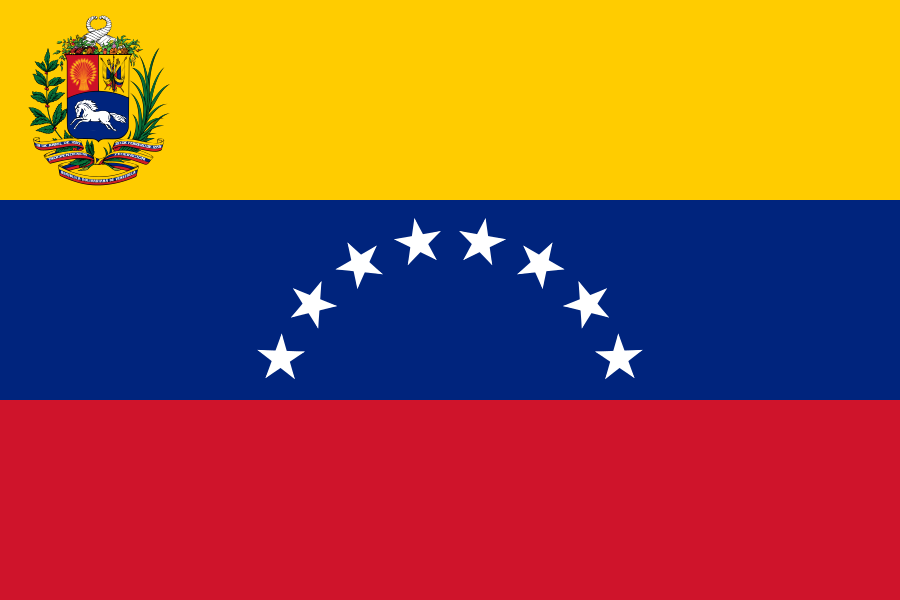
Venezuela officially the Bolivarian Republic of Venezuela is a country...
Qatar is a country located on the Qatar Peninsula in...
The Union of Soviet Socialist Republics USSR existed from to...
India officially the Republic of India is a South Asian...
Cornell Iral Haynes Jr known as Nelly is an American...
2 months ago Gas prices fluctuate, affected by state taxes, global factors, and Supreme Court rulings.
1 month ago Cowboys' Draft: 7-Round Mock, Picks Analysis, and 2026 Draft Buzz with Clinton.
Scott Cameron Pelley is a highly accomplished American journalist who has dedicated over three decades to CBS News He gained...
6 months ago OnlyFans Model Bonnie Blue Detained in Bali for 'Bangbus' Tour Stunt.
16 days ago Israeli strike kills top Hamas leader in Gaza; commander confirmed dead.
6 months ago Sky Bet Moves Headquarters to Malta, Evading UK Taxes, Sparks Political Backlash.
Ken Paxton is an American politician and lawyer serving as...

Graham Cunningham Platner is an American oyster farmer and Marine...
Michael Joseph Jackson the King of Pop was a highly...

William Franklin Graham III known as Franklin Graham is an...
Blackpink is a South Korean girl group formed by YG...
E Jean Carroll is an American journalist author and advice...