


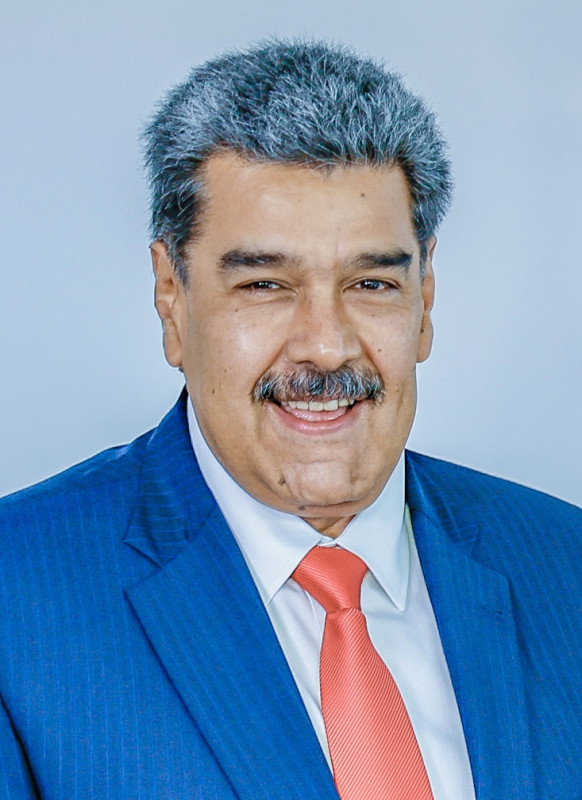
Nicolás Maduro is a Venezuelan politician who assumed the presidency in 2013. Formerly the vice president and minister of foreign affairs under Hugo Chávez, his presidency has been marked by economic crisis and political turmoil. In 2026, he and his wife were captured by US forces and charged with drug trafficking, leading to his de facto removal from power. However, the Venezuelan government considers him the de jure president with Delcy Rodríguez as interim president.
4 hours ago : Maduro-Linked Fugitive Arrested for Alleged Money Laundering and Bribery Scheme
A fugitive linked to the Nicolás Maduro government has been arrested on charges related to money laundering and schemes to profit from Venezuelans' basic necessities. The suspect is expected to appear in a U.S. court to face bribery and laundering allegations.


November 1962: Maduro's Alleged Birth Date
According to a 2016 Supreme Tribunal of Justice ruling, Nicolás Maduro was born in Caracas on 23 November 1962.
November 1962: Birth in Caracas
In November 1962, Nicolás Maduro Moros was born in Caracas into a working-class family.
November 23, 1962: Nicolás Maduro Born
On November 23, 1962, Nicolás Maduro Moros was born. He later became the 53rd president of Venezuela in 2013.
1983: Bodyguard for José Vicente Rangel
In 1983, Nicolás Maduro was employed as a bodyguard for José Vicente Rangel during Rangel's unsuccessful presidential campaign.
April 1989: Death of Father
In April 1989, Nicolás Maduro's father, Nicolás Maduro García, died in a motor vehicle accident.
1992: Chavez lawyer
In 1992, Cilia Flores was Hugo Chávez's lawyer following the Venezuelan coup d'état attempts.
1992: Accusations linked to coup
In 1992, Maduro was accused of links to the Venezuelan failed coup in 1992, a charge that President Chávez denied.
1992: Joined MBR-200 and Campaigned for Chávez's Release
In the early 1990s, Nicolás Maduro joined MBR-200 and campaigned for the release of Chávez when he was jailed for his role in the 1992 Venezuelan coup d'état attempts.
1998: Elected to Chamber of Deputies
In 1998, Nicolás Maduro was elected on the MVR ticket to the Venezuelan Chamber of Deputies, representing the Capital District.
1998: Founding of the Movement of the Fifth Republic
In the late 1990s, Nicolás Maduro was instrumental in founding the Movement of the Fifth Republic, which supported Chávez in his run for president in 1998.
1999: Elected to National Constituent Assembly
In 1999, Nicolás Maduro was elected to the National Constituent Assembly, representing the Capital District.
2000: Elected to National Assembly
In 2000, Nicolás Maduro was elected to the National Assembly, representing the Capital District.
2002: Tenth anniversary of the 2002 Venezuelan coup d'état attempt
In 2002, during a tenth anniversary gathering commemorating the 2002 Venezuelan coup d'état attempt going into the 2012 Venezuelan presidential election, Maduro called opposition members "snobs" and "little faggots".
2005: Visit to Sathya Sai Baba in India
In 2005, Nicolás Maduro visited Indian Hindu guru Sathya Sai Baba in India.
2005: Elected President of the National Assembly
In 2005, Nicolás Maduro was elected as president of the National Assembly of Venezuela.
August 2006: Flores replaced Maduro as president of National Assembly
In August 2006, Cilia Flores replaced Nicolás Maduro as president of the National Assembly when he resigned to become Minister of Foreign Affairs.
September 2006: Brief detention in New York
In September 2006, Nicolás Maduro was briefly detained by United States Department of Homeland Security officers at the John F. Kennedy International Airport in New York City after paying for three airline tickets in cash.
2006: Became Minister of Foreign Affairs
In 2006, Nicolás Maduro became the Minister of Foreign Affairs.
2006: President of the National Assembly until 2006
Nicolás Maduro remained as president of the National Assembly of Venezuela until 2006.
2007: Luisa Ortega Díaz becomes Chief Prosecutor of Venezuela
In 2007, Luisa Ortega Díaz became the Chief Prosecutor of Venezuela, a position she held until her sacking in August 2017.
2010: Turnaround in relations with Colombia
In 2010, Nicolás Maduro oversaw a turnaround in relations with Colombia.
2011: Chosen as Successor
In 2011, Nicolás Maduro had been chosen by Chávez to succeed him in the presidency if he were to die from cancer.
October 2012: Appointed Vice President of Venezuela
In October 2012, Nicolás Maduro was appointed Vice President of Venezuela, after the presidential elections.
October 2012: Appointed Vice President
On 13 October 2012, Chávez appointed Maduro Vice President of Venezuela.
December 2012: Chávez Endorses Maduro
In December 2012, Chávez announced that his recurring cancer had returned and endorsed Maduro as his successor should a new presidential election be called.
2012: Maduro calls opposition members "snobs" and "little faggots"
During a tenth anniversary gathering commemorating the 2002 Venezuelan coup d'état attempt going into the 2012 Venezuelan presidential election, Maduro called opposition members "snobs" and "little faggots".
2012: Became Vice President of Venezuela
In 2012, Nicolás Maduro served as the Vice President of Venezuela under President Hugo Chávez.
2012: Reported Follower of Sathya Sai Baba
In 2012, it was reported by The New York Times that Nicolás Maduro was a follower of Indian Hindu guru Sathya Sai Baba.
March 2013: Assumed Presidential Powers
In March 2013, upon the death of Hugo Chávez, Nicolás Maduro assumed the powers and responsibilities of the president. He was chosen as the Socialist Party's candidate in the election.
April 2013: Elected President
In April 2013, Nicolás Maduro was elected president, narrowly defeating opposition candidate Henrique Capriles.
June 2013: Conflicting Birthplace Declarations
In June 2013, Nicolás Maduro gave conflicting statements about his birthplace. He claimed to be born in Caracas during a press conference in Rome and Elías Jaua claimed Maduro was born in El Valle parish in Caracas during an interview with a Spanish journalist.
July 2013: Marriage to Cilia Flores
In July 2013, Nicolás Maduro married Cilia Flores, a lawyer and politician.
October 2013: Maduro's Approval Rating Stands Between 45% and 50%
In October 2013, Maduro's approval rating stood between 45% and 50%, possibly due to Hugo Chávez's endorsement.
October 2013: Creation of Vice Ministry of Supreme Happiness
In October 2013, Nicolás Maduro announced the creation of a new agency, the Vice Ministry of Supreme Happiness, to coordinate social programmes.
October 2013: Tibisay Lucena Claims Maduro Born in La Candelaria
In October 2013, Tibisay Lucena, head of the National Electoral Council, claimed Maduro was born in La Candelaria Parish in Caracas, showing copies of the registry presentation book of all the newborns on the alleged date of Maduro's birth.
November 2013: Maduro granted decree powers
In November 2013, six months after being elected, Maduro was granted the power to rule by decree by the pre-2015 Venezuelan legislature to address the ongoing economic crisis.
2013: Maduro Uses Anti-Gay Attacks as a Political Weapon
During the 2013 presidential campaign, Maduro used anti-gay attacks as a political weapon, calling representatives of the opposition "faggots". Maduro used anti-gay speech toward his opponent Henrique Capriles calling him a "little princess" and saying "I do have a wife, you know? I do like women!"
2013: Evidence Presented on Maduro's Alleged Colombian Citizenship
In 2013 lawyer Enrique Aristeguieta Gramcko presented evidence about the presumed non-existence of ineligibility conditions of Maduro to be elected and to hold the office of the presidency, under Article 96, Section B, of the Political Constitution of Colombia, Nicolás Maduro Moros, even in the unproven case of having been born in Venezuela, is "Colombian by birth" because he is the son of a Colombian mother and by having resided in that territory during his youth.
2013: Odebrecht Paid $35 Million to Fund Maduro's Presidential Campaign
In 2013, Euzenando Prazeres de Azevedo, president of Constructora Odebrecht in Venezuela, revealed that Odebrecht paid $35 million to fund Maduro's 2013 presidential campaign if Odebrecht projects would be prioritized in Venezuela.
2013: Assumed Presidency and won Special Election
In 2013, Nicolás Maduro assumed the presidency after Chávez's death and won the special presidential election.
2013: Became President of Venezuela
In 2013, Nicolás Maduro became the 53rd president of Venezuela.
2013: Jewish Ancestry Claim
In 2013, Nicolás Maduro stated that his grandparents were Jewish, from a Sephardic Moorish background, and converted to Catholicism in Venezuela.
2013: Media Outlet Shutdowns
In 2013, during Nicolás Maduro's first tenure as president, 115 media outlets were shut down, which included 41 print outlets, 65 radio outlets, and 9 television channels.
2013: Succession to Presidency
In 2013, the succession to the presidency of Nicolás Maduro was due to multiple mechanisms established by Hugo Chávez, including high oil prices, foreign ties, and alignment of the PSUV.
2013: Drop in World Press Freedom Index
Since 2013, Venezuela's rank on the World Press Freedom Index of Reporters Without Borders has dropped 42 places.
2013: Accusations of Authoritarian Leadership Begin
Since Nicolás Maduro took office in 2013, he has faced accusations of authoritarian leadership.
February 2014: Situation in Venezuela referred to ICC
On 27 September 2018, six states parties to the Rome Statute referred the situation in Venezuela since 12 February 2014 to the International Criminal Court (ICC), requesting the Prosecutor Fatou Bensouda to initiate an investigation on alleged crimes against humanity.
March 2014: Venezuela breaks relations with Panama
On March 6, 2014, Maduro announced Venezuela was breaking diplomatic and commercial relations with Panama after President Ricardo Martinelli expressed support for demonstrators during protests. This was on the 1 year anniversary of Hugo Chavez's death.
October 2014: Maduro's Approval Rating Drops to 24.5%
In October 2014, Maduro's approval rating was at 24.5% according to pollster Datanálisis.
November 2014: Polls Indicate Venezuelans Believe Maduro Should Not Finish Term
In November 2014, Datanálisis polls indicated that more than 66% of Venezuelans believed that Maduro should not finish his six-year term, with government supporters representing more than 25% of those believing that Maduro should resign.
November 2014: End of first period ruling by decree
In November 2014, Maduro's first period of being given the power to rule by decree ended. The Venezuelan opposition strongly condemned the legislature's power that had been usurped by the court.
2014: Official Declarations Share Four Different Birthplaces of Maduro
By 2014, official declarations by the Venezuela government shared four different birthplaces of Maduro. Tachira state's governor José Vielma Mora assured that Maduro was born in El Palotal sector of San Antonio del Táchira
2014: Wave of Protests
In 2014, Nicolás Maduro faced a wave of protests due to shortages and declining living standards in Venezuela.
February 2015: Accusations of US Overthrow Attempt
In early 2015, the Maduro government accused the United States of attempting to overthrow him, leading to actions like the arrest of Antonio Ledezma. This was followed by travel restrictions on American tourists and military marches and public exercises "for the first time in Venezuela's democratic history".
March 2015: Maduro granted decree powers again
In March 2015, Maduro was given the power to rule by decree by the pre-2015 Venezuelan legislature again to address the ongoing economic crisis.
March 2015: Maduro Government Reports Psychological Attacks
In March 2015, Mario Silva of Venezolana de Televisión stated that Nicolás Maduro had received about 13 million psychological attacks.
April 2015: Maduro Sees Small Increase in Approval After Anti-US Rhetoric
In April 2015, Maduro saw a small increase in approval after initiating a campaign of anti-US rhetoric following the sanctioning of seven officials accused by the United States of participating in human rights violations.
November 2015: Arrest of Maduro's Nephews
In November 2015, after Maduro's nephews were apprehended by the US Drug Enforcement Administration for the illegal distribution of cocaine on 10 November 2015, carrying diplomatic passports, Maduro criticized "attacks and imperialist ambushes" on Twitter.
December 2015: End of second period ruling by decree
In December 2015, Maduro's second period of being given the power to rule by decree ended. The Venezuelan opposition strongly condemned the legislature's power that had been usurped by the court.
2015: Extrajudicial executions began
Beginning in 2015, Amnesty International reported that Nicolás Maduro's government committed some of the worst human rights violations in Venezuela's history, including 8,292 extrajudicial executions between 2015 and 2017.
2015: Ruled by Decree
From 2015, Nicolás Maduro ruled Venezuela by decree through powers granted to him by the ruling party legislature.
2015: Opposition-led National Assembly
In 2015, an opposition-led National Assembly was elected, but Maduro maintained power through the Supreme Tribunal, the National Electoral Council (CNE), and the military.
January 2016: Maduro's decree powers by Supreme Court
In January 2016, Maduro was given the power to rule by decree by the Supreme Tribunal to address the ongoing economic crisis. The Venezuelan opposition strongly condemned the legislature's power that had been usurped by the court.
January 2016: OAS Threatens to Invoke Democratic Charter
On 12 January 2016, the Secretary General of the Organization of American States (OAS), Luis Almagro, threatened to invoke the Inter-American Democratic Charter, after opposition National Assembly members were barred from taking their seats by the Maduro-aligned Supreme Court.
April 2016: Maduro Changes Birthplace Narrative Again
In April 2016, Nicolás Maduro changed his birthplace narrative once more, stating he was born in Los Chaguaramos, specifically in Valle Abajo, and was baptized in the San Pedro church.
May 2016: Continued Claims of US Coup Attempt and OAS Involvement
In May 2016, Nicolás Maduro again claimed that the United States was attempting to assist the opposition with a coup attempt. The government called for a meeting with the OAS, accusing the US and the OAS of attempting to overthrow Maduro. Maduro called OAS Secretary General Luis Almagro "a traitor" and stated that he worked for the CIA.
May 2016: Recall Referendum Petition
In May 2016, opposition leaders in Venezuela delivered a petition to the National Electoral Council (CNE) calling for a recall referendum to remove Maduro from office.
July 2016: Detention of Opposition Activists
In July 2016, the Venezuelan intelligence service detained five opposition activists involved with the recall referendum.
August 2016: Signatures Validated for Recall Process
In August 2016, the CNE announced that enough signatures had been validated for the recall process to continue.
October 2016: Supreme Tribunal Ruling on Maduro's Birthplace
On 28 October 2016, the Supreme Tribunal of Justice ruled that Nicolás Maduro was born in Caracas, in the parish of La Candelaria, on 23 November 1962, based on "incontrovertible evidence". The ruling cited a communique from the Colombian vice-minister of foreign affairs stating that no information was found to infer that Maduro is a Colombian national.
November 2016: Poll Finds Most Voters Would Oust Maduro in Recall
During a recall movement gathered from late-October through November 2016, a poll by Venebarómetro found that "88% of 'likely' voters in a recall would choose to oust Maduro."
November 2016: Maduro Nephews Found Guilty
In November 2016, Maduro's two nephews were found guilty.
2016: Request to Investigate Maduro's Nationality
In 2016, a group of Venezuelans requested the National Assembly to investigate whether Nicolás Maduro was Colombian, citing doubts about his origins and his refusal to show his birth certificate. Allegations arose that he might be Colombian by birth due to his mother's nationality and his childhood residence in Colombia.
2016: Growing Concerns of Dictatorship
In 2016, the Supreme Tribunal's refusal to acknowledge the National Assembly's attempts to recall Maduro led to increased concerns of dictatorship. Various sources, including Foreign Affairs and Americas Quarterly, highlighted Venezuela's transition towards a full dictatorship.
April 2017: ICC Prosecutor believed Crimes against Humanity were committed
On 14 December 2020, the Office of the Prosecutor released a report on the office's year activities, stating that it believed there was a "reasonable basis" to think that "since at least April 2017, civilian authorities, members of the armed forces and pro-government individuals have committed the crimes against humanity."
May 2017: Proposed Constituent Assembly Election
In May 2017, Nicolás Maduro proposed the 2017 Venezuelan Constituent Assembly election.
July 2017: Constituent Assembly Election and US Sanctions
In July 2017, the Venezuelan Constituent Assembly election was held despite wide international condemnation, and the United States sanctioned Maduro, labeling him as a "dictator".
July 2017: United States Sanctions Maduro
On 31 July 2017, after the Constituent Assembly election, the United States sanctioned Maduro, making him the fourth foreign head of state to be sanctioned by the United States. Secretary of the Treasury Steven Mnuchin stated "Maduro is a dictator who disregards the will of the Venezuelan people".
August 2017: Luisa Ortega Díaz accuses Maduro of profiting from shortages
In August 2017, Chief Prosecutor Luisa Ortega Díaz accused Maduro of profiting from shortages in Venezuela through the government-operated CLAP program, alleging contracts with Group Grand Limited, a company "presumably owned by Nicolás Maduro".
August 2017: Trump considers military option
On August 11, 2017, US President Donald Trump stated he would "not rule out a military option" to confront the government of Maduro.
November 2017: Maduro Eats Empanada During Live Broadcast
In November 2017, during a live broadcast, Maduro was caught on camera eating an empanada from his desk, sparking controversy due to the nationwide food shortage and his perceived weight gain.
December 2017: Maduro's Nephews Sentenced
On 14 December 2017, Maduro's two nephews were sentenced to 18 years of imprisonment.
2017: Extrajudicial executions continued
Ending in 2017, Amnesty International reported that Nicolás Maduro's government committed some of the worst human rights violations in Venezuela's history, including 8,292 extrajudicial executions between 2015 and 2017.
2017: Maduro expresses personal support for same-sex marriage.
In 2017, Maduro expressed his personal support for same-sex marriage.
2017: Government Vows Recall Would Not Occur Until 2017
In 2017, The government vowed a recall would not occur until 2017, ensuring the current vice president would potentially come to power.
2017: National Assembly investigates CLAP program
In 2017, the National Assembly conducted an investigation finding that the government paid US$42 for food that cost under US$13 and that "Maduro's inner circle kept the difference, which totaled more than $200 million dollars in at least one case", adding that food boxes were "distributed in exchange for votes".
2017: Constitutional Crisis and Protests
In 2017, the Supreme Tribunal stripped the elected National Assembly of power, leading to a constitutional crisis and another wave of protests. The Constituent Assembly of Venezuela was elected under irregular voting conditions.
2017: Constitutional Crisis and International Condemnation
In 2017, the Venezuelan constitutional crisis escalated when the Supreme Tribunal took over the legislative powers of the National Assembly. The United States Department of the Treasury sanctioned President Maduro, labeling him a dictator, and prevented him from entering the US. Other international figures and organizations also condemned Maduro's actions, describing Venezuela as a dictatorship.
2017: Government Officials Sanctioned by United States and Canada
In 2017, thirteen government officials were sanctioned by the United States Department of Treasury for their involvement with the 2017 Venezuelan Constituent Assembly election, and the Canadian government sanctioned members of the Maduro government, including Maduro, preventing Canadian nationals from participating in property and financial deals with him due to the rupture of Venezuela's constitutional order.
2017: Tareck El Aissami Served as Vice President
Tareck El Aissami served Maduro as Vice President from 2017 to 2018.
2017: Venezuela Downgraded to Authoritarian Regime
The Economist Intelligence Unit's 2017 report downgraded Venezuela from a hybrid regime to an authoritarian regime, reflecting the country's continued slide towards dictatorship, with an index of 3.87.
January 2018: Nullity of 2013 Presidential Elections Decreed
On 11 January 2018, the Supreme Tribunal of Justice of Venezuela in exile decreed the nullity of the 2013 presidential elections after lawyer Enrique Aristeguieta Gramcko presented evidence about the presumed non-existence of ineligibility conditions of Maduro.
February 2018: ICC Opens Preliminary Probes
In February 2018, the International Criminal Court (ICC) announced that it would open preliminary probes into the alleged crimes against humanity performed by Venezuelan authorities.
March 2018: Maduro Sanctioned by Panamanian Government
In March 2018, Maduro was sanctioned by the Panamanian government for his alleged involvement with "money laundering, financing of terrorism and financing the proliferation of weapons of mass destruction".
March 2018: Pastrana References Baptism Certificate
In March 2018, former Colombian president Andrés Pastrana made reference to the baptism certificate of Maduro's mother, noting that the disclosed document reiterates the Colombian origin of the mother of the president and that therefore Maduro has Colombian citizenship.
April 2018: End of diplomatic crisis with Panama
On April 26, 2018, President Maduro announced that he had called President Varela and agreed to the return of the ambassadors and the return of air communication between both countries, thus ending the diplomatic crisis.
May 2018: Presidential Elections and Dictatorship Accusations
In May 2018, Venezuelan presidential elections were held prematurely. Critics labeled Maduro a dictator and accused his regime of driving Venezuela to the brink of collapse.
May 2018: Sanctions Against Diosdado Cabello
On 18 May 2018, the United States Department of the Treasury's Office of Foreign Assets Control (OFAC) placed sanctions against Diosdado Cabello, alleging that he and others used their power to profit from extortion, money laundering, and embezzlement. Cabello was also accused of directing drug trafficking activities and dividing profits with President Maduro.
August 2018: Alleged assassination attempt on Maduro
On August 4, 2018, two drones detonated explosives near Avenida Bolívar, Caracas, during a speech by Maduro. The Venezuelan government claims it was a targeted assassination attempt, while others suggest it was a false flag operation.
September 2018: Polls Find Most Venezuelans Want Maduro Removed From Power
In September 2018, Meganálisis polls found that 84.6% of Venezuelans surveyed wanted Maduro and his government to be removed from power. Following the suspension of the recall movement, a Venebarómetro poll found that 61.4% found that Maduro had become a dictator, while in a poll taken by Keller and Associates 63% of those questioned thought that Maduro was a dictator.
September 2018: Situation in Venezuela referred to ICC
On 27 September 2018, six states parties to the Rome Statute referred the situation in Venezuela since 12 February 2014 to the International Criminal Court (ICC), requesting the Prosecutor Fatou Bensouda to initiate an investigation on alleged crimes against humanity.
October 2018: Mexican prosecutors accuse Venezuelan government of buying poor-quality food
On 18 October 2018, Mexican prosecutors accused the Venezuelan government and Mexican individuals of buying poor-quality food products for CLAP and exporting them to Venezuela to double their value for sale.
December 2018: Presidential Election Pulled Ahead
In December 2018, the original electoral date for the presidential elections was scheduled, but it was subsequently pulled ahead.
2018: Datanálisis Poll Indicates Low Voter Support for Maduro
Before the 2018 presidential elections, a Datanálisis poll indicated that 16.7% of voters would vote for Maduro as candidate, compared to 27.6% and 17.1% of voters that would choose rival candidates Henri Falcón and Javier Bertucci, respectively.
2018: Amnesty International report on human rights violations
In 2018, Amnesty International released a report accusing Nicolas Maduro's government of committing some of the worst human rights violations in Venezuela's history, including 8,292 extrajudicial executions carried out between 2015 and 2017.
2018: Reelection and Presidential Crisis
In 2018, Nicolás Maduro was reelected and sworn in, leading to a presidential crisis after Juan Guaidó, president of the National Assembly, declared himself interim president.
2018: OAS Report on Crimes Against Humanity
In 2018, a Board of Independent Experts designated by the Organization of American States (OAS) published a report alleging that crimes against humanity were committed in Venezuela during Maduro's presidency. The board suggested Maduro could be responsible for numerous murders, extra-judicial executions, arbitrary detentions, torture cases, and a 'state-sanctioned humanitarian crisis'.
2018: Maduro declared winner of presidential election
Maduro was declared as the winner of the 2018 election with 67.8% of the vote. The result was denounced as fraudulent by most neighboring countries and organizations but recognized as legitimate by others.
2018: Tareck El Aissami Served as Vice President
Tareck El Aissami served Maduro as Vice President from 2017 to 2018.
January 2019: Maduro Banned from Entering Colombia
As of January 2019, Maduro is banned from entering Colombia, as the Colombian government maintains a list of people banned from entering Colombia or subject to expulsion who have a "close relationship and support for the Nicolás Maduro regime".
January 2019: Maduro's Illegitimate Presidency and International Response
In January 2019, Nicolás Maduro's swearing-in as president was met with widespread condemnation. The Organization of American States (OAS) declared his presidency illegitimate and called for new elections. Juan Guaidó, president of the National Assembly, was declared interim president by some nations while Russia, China, and Cuba supported Maduro.
January 2019: Maduro calls Bolsonaro "a Hitler of the modern era"
On January 14, 2019, Maduro called Brazilian President Jair Bolsonaro "a Hitler of the modern era" after Brazil recognised Venezuelan opposition leader Juan Guaidó as the country's interim president.
January 2019: Venezuela breaks ties with the US
On January 23, 2019, Maduro announced that Venezuela was severing ties with the United States following Trump's recognition of Juan Guaidó as the interim President of Venezuela.
January 2019: Maduro's Second Inauguration and Consolidation of Power
The 10 January 2019 second inauguration of Nicolás Maduro was widely condemned and led to commentary that Maduro had consolidated power and become a dictator, from various international news sources.
February 2019: Conflicting Polls Show Differing Approval Ratings for Maduro and Guaidó
A poll from 21 January to 2 February 2019 by Hinterlaces found that 57% of Venezuelans recognized Maduro as the legitimate president of Venezuela, while a Datanálisis poll found that, among the poorest 20% of Venezuelans, Maduro's support had fallen to 18% in February 2019 from 40% two years earlier.
February 2019: Surveys Indicate Most Venezuelans Recognize Guaidó as Interim President
During the presidential crisis, surveys between 30 January and 1 February 2019 by Meganálisis recorded that 4.1% of Venezuelans recognized Maduro as president, 11.2% were undecided, and 84.6% of respondents recognized Guaidó as interim president.
March 2019: Datanálisis Poll Shows Guaidó's Approval Soaring While Maduro's Hits All-Time Low
By 4 March 2019, a Datanálisis poll found Guaidó's approval at 61%, and Maduro's at all-time low of 14%, with Guaidó winning 77% in a theoretical election with Maduro, who received 23% of support.
March 2019: Report on Maduro losing support
In March 2019, The Wall Street Journal reported that barrios are turning against Maduro, blaming government brutality for the shift. Foro Penal said that 50 people had been killed by security forces in the first two months of the year, and 653 had been arrested for protesting or speaking against the government.
April 2019: US Department of State Allegations
In April 2019, the US Department of State alleged that Venezuela, led by Nicolas Maduro, has consistently violated the human rights of its citizens. The State Department report highlighted abuse by the nation's security forces, including a number of deaths, the suspicious death of opposition politician Fernando Albán Salazar, the detention of Roberto Marrero, and repression of demonstrators during Venezuelan protests which left at least 40 dead in 2019.
April 2019: US Department of State highlights investigation into CLAP program
In April 2019, the United States Department of State highlighted a 2017 National Assembly investigation finding irregularities in the CLAP program, alleging that the government overpaid for food and that Maduro's inner circle pocketed the difference.
May 2019: Analyst Says Maduro Is Extremely Unpopular
In a May 2019 analysis, José Briceño-Ruiz said that, based on the Meganalisis poll and other trends, Maduro was "extremely unpopular".
June 2019: Journalists Denied Access to National Assembly
As of June 2019, journalists have been denied access to seven sessions of the National Assembly by the National Guard.
September 2019: Human Rights Watch Report on Extrajudicial Executions
In September 2019, Human Rights Watch reported that poor communities in Venezuela no longer supporting Maduro's government have witnessed arbitrary arrests and extrajudicial executions by Venezuelan police. Despite claims of confrontations with armed criminals, witnesses have challenged these claims, with victims last seen in police custody.
October 2019: Contract signed for overthrow attempt
In October 2019, Goudreau claimed that Juan Guaidó and two political advisers had signed a contract with him for US$213 million to overthrow Maduro, but this was not confirmed.
2019: Violations of Freedom of Expression
During the first seven months of 2019, the Press and Society Institute of Venezuela found at least 350 cases of violations of freedom of expression.
2019: Porras' criticism and economic policy changes
In 2019, Maduro's former chief of staff criticized his leadership, citing a lack of vision. Increased international sanctions in 2019 led the Maduro government to abandon socialist policies, resulting in a rebound from economic decline.
2019: Porras comments about Maduro
In 2019, Temir Porras described Nicolás Maduro as pragmatic and a skilled politician during the early days of Chavismo.
2019: UN Report on Human Rights Violations
In 2019, the Office of the United Nations High Commissioner for Human Rights addressed extrajudicial executions, torture, enforced disappearances, and other rights violations allegedly committed by Venezuelan security forces in recent years. The High Commissioner Michelle Bachelet expressed her concerns for the "shockingly high" number of extrajudicial killings and urged for the dissolution of the FAES.
March 2020: US Charges Maduro with Narco-Terrorism
On 26 March 2020, the United States Department of Justice charged Maduro and other Venezuelan officials and some Colombian former FARC members for "narco-terrorism," accusing them of shipping cocaine to the US. The US government offered $15 million for information leading to his arrest.
May 2020: Attempted overthrow of Maduro
In May 2020, Venezuelan security forces prevented an attempt to overthrow Maduro by armed Venezuelan dissidents organized by Silvercorp USA. The Venezuelan government claimed the United States and its DEA were responsible, while Juan Guaidó denied involvement.
October 2020: Maduro indicted by US federal court
In October 2020, Maduro was indicted by a US federal court, accused of narcoterrorism and conspiracy to import cocaine to the United States.
December 2020: ICC Prosecutor believed Crimes against Humanity were committed
In December 2020, the Office of the Prosecutor released a report stating that it believed there was a "reasonable basis" to think that since at least April 2017, civilian authorities, members of the armed forces and pro-government individuals have committed the crimes against humanity.
2020: Maduro to face narco-terrorism charges
In 2020, Maduro was taken into federal custody to face the 2020 narco-terrorism charges in the Southern District of New York, with an initial court appearance scheduled for the following week.
September 2021: UN Report on Human Rights
On 16 September 2021, the Independent International Fact-Finding Mission on Venezuela released its second report on the country's situation, concluding that the independence of the Venezuelan justice system under Maduro has been deeply eroded to the extent of playing an important role in aiding the state repression and perpetuating state impunity for human rights violations.
October 2022: Maduro's Nephews Freed in Prisoner Swap
In October 2022, Maduro's nephews were freed in a prisoner swap for seven American directors of the oil refinery corporation CITGO (part of the Citgo Six) who were imprisoned in Venezuela.
2022: World leaders interact with Maduro at climate conference
During the 2022 United Nations Climate Change Conference in November, multiple world leaders interacted with Maduro, including President of France Emmanuel Macron. Days later on November 27, the United States eased sanctions on Venezuela.
February 2023: Poll Shows Opposition Candidate Slightly Ahead of Maduro
In February 2023, a year before the 2024 presidential elections, a Datincorp poll concluded that 15.69% of voters would vote for Maduro as a candidate, in contrast to 16.86% that would vote for opposition candidate María Corina Machado.
June 2023: Maduro visits Saudi Arabia
In June 2023, Maduro made an official state visit to Saudi Arabia.
June 2023: Venezuelan Government Bars Leading Candidate from Participating in Election
In June 2023, the Venezuelan government barred leading candidate María Corina Machado from participating in the upcoming election, a move condemned by international bodies as a violation of political human rights.
October 2023: US lifts some sanctions on Venezuela
In October 2023, the U.S. Department of the Treasury's Office of Foreign Assets Control (OFAC) lifted sanctions for six-months to allow limited trade with the U.S. to resume.
November 2023: Maduro condemns Israel's actions in Gaza
On November 7, 2023, Maduro condemned Israel's actions in the Gaza Strip during the Gaza war and accused Israel of committing genocide against Palestinians in Gaza.
April 2024: Tip about Maduro's planes
In April 2024, a tip was received about Maduro's planes, which were later seized in Santo Domingo for sanctions violations, leading to an attempt to recruit his personal pilot.
September 2024: Arrest of alleged assassins
In September 2024, Venezuelan police arrested several individuals, including three Americans, carrying sniper rifles and other munitions to allegedly assassinate Maduro. The government blamed the CIA and Spanish intelligence.
September 2024: Argentine Federal Court Issues Arrest Warrant Against Maduro
In September 2024, an Argentine federal court issued an arrest warrant against Maduro and several other Venezuelan officials for crimes against humanity.
2024: Reelected for Third Term
In 2024, Nicolás Maduro was reelected for a third term, amidst evidence suggesting he lost the election by a wide margin.
2024: Year of the next Venezuelan presidential elections
In February 2023, a year before the 2024 presidential elections, a Datincorp poll concluded that 15.69% of voters would vote for Maduro as a candidate, in contrast to 16.86% that would vote for opposition candidate María Corina Machado.
January 2025: US Increases Reward Against Maduro
After Maduro was inaugurated for a third term on 10 January 2025, the US State Department announced that the reward against Maduro was increased from $15 million to $25 million.
January 2025: Maduro Sworn in for Third Term Amidst Controversy
On 10 January 2025, Maduro was sworn in for a third term as president. Prior to that, the Supreme Tribunal of Justice (TSJ) described the CNE's statement of Maduro winning the election as "validated" on 22 August.
June 2025: Maduro condemns Israeli attacks on Iran
In June 2025, Maduro condemned Israeli attacks on Iran, describing it as a "criminal assault" that "violates international law and the United Nations Charter", and accused France, Germany, Britain and the US of supporting "the 21st-century Hitler" against the "noble and peaceful Iranian people".
August 2025: US raises reward for Maduro's arrest
In August 2025, the United States Department of Justice raised the reward for the arrest of Maduro to US$50 million.
August 2025: Reward increased to $50 million
On August 7, 2025, the reward for information leading to the arrest of Nicolás Maduro was increased to $50 million. Attorney General Pam Bondi accused Maduro of collaborating with terrorist organizations to bring violence to the United States and described him as a "threat to national security".
October 2025: Alleged US attempt to capture Maduro
In October 2025, the United States allegedly attempted to capture Maduro through a covert operation involving an effort to recruit his personal pilot, General Bitner Villegas, but the plan failed when Villegas refused to cooperate.
November 2025: Trump administration labels Maduro a terrorist
On November 24, 2025, the Trump administration officially labeled Maduro and his government allies as members of a foreign terrorist group.
December 2025: US seizes oil tanker Skipper
On December 10, 2025, the U.S. seized the oil tanker Skipper in international waters, off the Venezuelan coast.
January 2026: Capture by US Forces
In January 2026, US forces captured Nicolás Maduro and his wife, Cilia Flores, and transported them to the US, where they were charged with drug trafficking.
January 2026: Swiss Government Freezes Maduro's Assets
In January 2026, the Swiss government imposed a four-year freeze on any assets held by Maduro and his close associates in Switzerland.
January 2026: US military operation in Venezuela
In the pre-dawn hours of January 3, 2026, the United States launched a military operation in Venezuela, reportedly capturing Maduro and his wife. They were then flown out of the country. This operation led to condemnation for violating international law.
January 2026: Trump claims Maduro captured by US
On January 3, 2026, Donald Trump claimed that Maduro had been captured by the United States during United States strikes in Venezuela. Legal experts believe it is likely a violation of the U.N. Charter's article 2(4).
January 2026: Maduro arraigned on drug trafficking charges
On January 5, 2026, Maduro and his wife were arraigned, pleading not guilty to drug trafficking charges. Maduro was ordered to be held until at least a March 17 hearing.
Mentioned in this timeline
Donald John Trump is an American politician media personality and...
John F Kennedy JFK was the th U S President...
Justin Trudeau served as Canada's rd prime minister from to...
Ukraine is a country in Eastern Europe the second-largest on...
The United States of America is a federal republic primarily...
The White House located at Pennsylvania Avenue NW in Washington...
Trending
3 hours ago Arthur Fils Shows Strong Form at Shanghai Masters Amid ATP Finals Qualification Hopes
3 hours ago Mahershala Ali Reflects on Acting Journey and Potential Path as Preacher
3 hours ago Botic van de Zandschulp faces Arthur Fils at ATP Shanghai Masters 2026
3 hours ago The Debate Over Ending Daylight Saving Time and Clock Changes
4 hours ago Kyle MacLachlan Discusses Iconic Roles and New Memoir Fictional Selves
4 hours ago Two Missing Children Found Deceased in Daytona Beach Pond
Popular

Ken Paxton is an American politician and lawyer serving as...

Jameis Winston is an American football quarterback currently playing for...
Cristiano Ronaldo widely considered one of the greatest footballers captains...

Michael Joseph Jackson the King of Pop was a highly...

Elon Musk is a visionary entrepreneur and engineer known for...
Shakira Isabel Mebarak Ripoll the Queen of Latin Music is...