


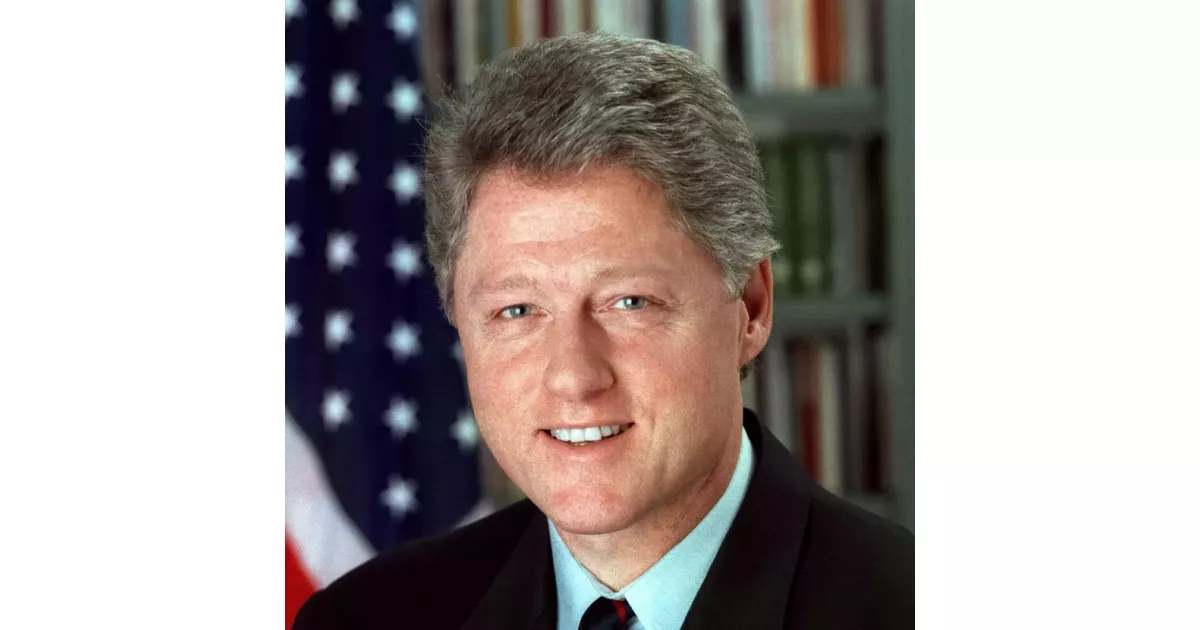
Bill Clinton served as the 42nd U.S. President from 1993 to 2001. A Democrat, he previously served as Arkansas's Attorney General and Governor. His political ideology, known as "Clintonism", centered on a centrist "Third Way" approach. This philosophy significantly shaped his presidency and influenced the Democratic Party for decades.
5 hours ago : Bill Clinton Campaigns With David Jolly Ahead of Midterm Elections
Former President Bill Clinton joins David Jolly on the campaign trail in Florida, visiting local sites including a Hollywood church to rally voter support two weeks before the midterm elections.


1933: Enactment of the Glass-Steagall Act
The Glass–Steagall Act was enacted in 1933. The Financial Services Modernization Act of 1999 repealed the part of the Glass–Steagall Act that had prohibited a bank from offering a full range of investment, commercial banking, and insurance services since its enactment in 1933.
September 4, 1943: Parents' Marriage
On September 4, 1943, Bill Clinton's parents married, though the union was later deemed bigamous.
August 19, 1946: Bill Clinton's Birth
On August 19, 1946, William Jefferson Clinton (né Blythe III) was born.
1950: Family Moves to Hot Springs
In 1950, Bill Clinton's mother returned from nursing school and married Roger Clinton Sr., and the family moved to Hot Springs, Arkansas.
1961: Joins the Order of DeMolay
In 1961, Bill Clinton became a member of the Hot Springs Chapter of the Order of DeMolay.
1963: Influential Moments
In 1963, Bill Clinton had two influential moments: meeting President John F. Kennedy and watching Martin Luther King Jr.'s "I Have a Dream" speech.
1964: First Executions Since 1964
During Bill Clinton's final term as governor, Arkansas performed its first executions since 1964.
1964: Elected Class President
In 1964, Bill Clinton won an election for class president.
1965: Elected Class President
In 1965, Bill Clinton won an election for class president.
1967: Internship with Senator Fulbright
From 1964 to 1967, Bill Clinton was an intern and then a clerk in the office of Arkansas senator J. William Fulbright.
1968: Graduation from Georgetown University
In 1968, Bill Clinton graduated from Georgetown University.
1968: Rhodes Scholarship
In 1968, Bill Clinton won a Rhodes Scholarship to University College, Oxford.
1969: Budget Surplus
During the last three years of Clinton's presidency and in 1969, the Congressional Budget Office reported a budget surplus.
1971: Meets Hillary Rodham
In 1971, Bill Clinton met his future wife, Hillary Rodham, in the Yale Law Library.
1971: Frank Aller's Suicide
In 1971, Frank Aller's suicide had an influential impact on Bill Clinton.
1972: McGovern Campaign in Texas
In 1972, Bill Clinton moved to Texas with Hillary Rodham to lead George McGovern's campaign effort there.
1972: George McGovern Campaign
In 1972, Bill Clinton postponed his summer plans to be a coordinator for the George McGovern campaign for the 1972 United States presidential election to move in with Hillary Rodham in California.
1972: Hammerschmidt Received 77% of the Vote
In 1972, John Paul Hammerschmidt received 77% of the vote.
1973: Graduation from Yale Law School
In 1973, Bill Clinton earned a Juris Doctor (J.D.) degree from Yale Law School.
1974: House of Representatives Run
In 1974, Bill Clinton ran for the House of Representatives against John Paul Hammerschmidt, but was defeated.
October 11, 1975: Marriage to Hillary Rodham
On October 11, 1975, Bill Clinton married Hillary Rodham in Fayetteville, Arkansas. They had met while studying at Yale University.
1976: Death Penalty Reinstated
As governor, Bill Clinton oversaw the first four executions carried out by the state of Arkansas since the death penalty was reinstated there in 1976.
1976: Elected Arkansas Attorney General
In 1976, Bill Clinton was elected as the Arkansas attorney general.
1977: Attorney General of Arkansas
In 1977, Bill Clinton became the attorney general of Arkansas.
1978: Clinton Enters Arkansas Gubernatorial Primary and is Elected Governor
In 1978, Bill Clinton entered the Arkansas gubernatorial primary, becoming one of the youngest candidates in the state's history at age 31. In 1978, Clinton was elected Governor of Arkansas, defeating Republican candidate Lynn Lowe.
1978: Alleged Rape by Clinton
In the spring of 1978, Juanita Broaddrick alleges that Bill Clinton raped her, although she could not recall the exact date. Broaddrick claimed to have told multiple witnesses in 1978 she had been raped by Clinton.
1979: Governor of Arkansas
In 1979, Bill Clinton became the governor of Arkansas.
February 27, 1980: Birth of Chelsea Clinton
On February 27, 1980, Bill and Hillary Clinton had their only child, Chelsea Clinton.
1980: Unpopular Motor Vehicle Tax and Cuban Refugee Anger
In 1980, Governor Clinton's term was marked by an unpopular motor vehicle tax and public anger over the escape of Cuban refugees detained in Fort Chaffee. Monroe Schwarzlose garnered 31% of the vote against Clinton in the Democratic gubernatorial primary of 1980, foreshadowing Clinton's defeat by Republican Frank D. White in the general election.
1980: Nickname "Slick Willie" first applied
In 1980, Pine Bluff Commercial journalist Paul Greenberg first applied the nickname "Slick Willie" to Bill Clinton, believing that Clinton was abandoning the progressive policies of previous Arkansas governors.
January 1981: Clinton Joins Law Firm
In January 1981, after leaving office, Bill Clinton joined the Little Rock law firm of Wright, Lindsey and Jennings.
1981: End of First Term as Governor of Arkansas
In 1981, Bill Clinton's first term as governor of Arkansas ended.
1982: Clinton Re-elected Governor
In 1982, Bill Clinton was elected governor of Arkansas for a second time.
September 1983: Education Reform Passage
In September 1983, the Arkansas education reforms passed after Clinton called a special legislative session, marking what many consider the greatest achievement of his governorship. The reforms included increased school spending, vocational education, higher teachers' salaries, and compulsory teacher competency exams.
1983: Second Term as Governor of Arkansas
In 1983, Bill Clinton became governor of Arkansas again.
1984: Defeated Freeman
In 1984, Bill Clinton defeated Woody Freeman for governor.
1984: Reagan's Landslide Victory
In light of President Ronald Reagan's landslide victory in 1984, the New Democrats, including Clinton, argued that the Democratic Party needed a more centrist stance.
1985: Response to Reagan's State of the Union Address
In 1985, Bill Clinton delivered the Democratic response to President Ronald Reagan's State of the Union Address.
1985: Half-Brother Roger Sentenced
In 1985, Bill Clinton's half-brother Roger was sentenced to prison for possession and smuggling of cocaine.
1986: Term Change and National Governors Association Chair
In 1986, Arkansas changed its gubernatorial term to four years. From 1986 to 1987, Clinton served as chair of the National Governors Association.
1987: National Governors Association Chair
From 1986 to 1987, Bill Clinton served as chair of the National Governors Association, bringing him to a national audience.
1987: Don Henry and Kevin Ives Killing
In 1987, the killing of Don Henry and Kevin Ives started conspiracy theories that accused Bill Clinton and Arkansas authorities of a cover-up.
1987: Media Speculation on Presidential Race
In 1987, the media speculated that Bill Clinton would enter the presidential race, but he decided to remain as Arkansas governor.
1988: Democratic National Convention Address
In 1988, Bill Clinton gave the opening night address at the Democratic National Convention; however, his speech was criticized for being too long.
1989: Iran brought a case against the U.S.
In 1989, Iran brought a case against the U.S. in the International Court of Justice after the shooting down of Iran Air Flight 655 by the U.S. Navy guided missile cruiser, which was settled in February 1996 when the Clinton administration agreed to pay Iran US$131.8 million .
1990: Defeated Nelson
In 1990, Bill Clinton defeated Sheffield Nelson for governor.
1990: Head of Democratic Leadership Council
In 1990, Bill Clinton headed the moderate Democratic Leadership Council.
December 1991: "Safe, legal, and rare" slogan
In December 1991, Bill Clinton first used the slogan "safe, legal, and rare" regarding abortion while campaigning.
1991: Head of Democratic Leadership Council
In 1991, Bill Clinton headed the moderate Democratic Leadership Council.
1991: Alleged unwanted advances towards Paula Jones
In 1991, President Clinton allegedly made unwanted advances towards Paula Jones, which later led to a sexual harassment lawsuit in 1994.
March 26, 1992: "I feel your pain"
On March 26, 1992, during a Democratic fund raiser, Robert Rafsky confronted then Gov. Bill Clinton about AIDS, to which Clinton replied, "I feel your pain".
1992: Factors in the 1992 Election
According to Seymour Martin Lipset, several unique characteristics contributed to the 1992 election, including voter perception of poor economic conditions, a strong third-party candidate, and Clinton uniting his party.
1992: Draft Controversy During Campaign
During the 1992 campaign, it was revealed that Bill Clinton's uncle had attempted to secure him a position in the Navy Reserve. Clinton's actions regarding the draft were criticized.
1992: ROTC Application Controversy
During the 1992 presidential campaign, Colonel Eugene Holmes stated that he suspected Bill Clinton attempted to manipulate the situation to avoid the draft.
1992: Capital Punishment Stance
In 1992, Bill Clinton insisted that Democrats "should no longer feel guilty about protecting the innocent". During his final term as governor, Clinton flew home to Arkansas mid-campaign to affirm the execution of Ricky Ray Rector.
1992: Election as President
In 1992, Bill Clinton was elected president of the United States, defeating George H.W. Bush and Ross Perot.
1992: Time's "Man of the Year"
In 1992, Bill Clinton was selected as Time's "Man of the Year".
1992: Clinton Wins 1992 Presidential Election
In 1992, Bill Clinton won the presidential election against George H.W. Bush and Ross Perot, ending twelve years of Republican rule and giving Democrats full control of Congress.
1992: End of Second Term as Governor
In 1992, Bill Clinton's second term as governor of Arkansas ended.
1992: Clinton proposed sending a peace envoy to Northern Ireland
In 1992, before his presidency, Bill Clinton proposed sending a peace envoy to Northern Ireland, but this was dropped to avoid tensions with the British government.
1992: Nickname "Bubba" emerges
Starting from the 1992 presidential election, Bill Clinton's folksy manner led him to be nicknamed "Bubba".
January 20, 1993: Inauguration as President
On January 20, 1993, Bill Clinton was inaugurated as the 42nd president of the United States. However, his early presidency was marked by an inexperienced staff and a series of missteps.
January 22, 1993: Reversal of Restrictions on Family Planning Programs
On January 22, 1993, Bill Clinton reversed restrictions on domestic and international family planning programs imposed by Reagan and Bush. This was the 20th anniversary of Roe v. Wade.
February 15, 1993: First Address to the Nation
On February 15, 1993, Bill Clinton made his first address to the nation, announcing his plan to raise taxes to close the budget deficit.
April 19, 1993: FBI raid on Branch Davidian community near Waco, Texas
On April 19, 1993, Attorney General Janet Reno authorized the FBI to deploy tear gas into the buildings of the Branch Davidian community near Waco, Texas, in an attempt to end a 51-day siege. The buildings subsequently caught fire, resulting in the deaths of 75 residents, including 24 children.
May 19, 1993: Clinton fired seven employees of the White House Travel Office
On May 19, 1993, Bill Clinton fired seven employees of the White House Travel Office, leading to the White House travel office controversy.
September 1993: Oslo Accords
In September 1993, secret negotiations mediated by President Clinton between Israeli Prime Minister Yitzhak Rabin and Palestine Liberation Organization (PLO) Chairman Yasser Arafat led to a historic declaration of peace, called the Oslo Accords, which were signed at the White House on September 13.
September 22, 1993: Clinton's Speech to Congress on Health Care Reform
On September 22, 1993, President Clinton addressed Congress to present a health care reform plan aimed at achieving universal coverage through a national health care system. The proposal, spearheaded by Hillary Clinton, faced strong opposition and ultimately failed.
November 1993: David Hale's allegation against Bill Clinton
In November 1993, David Hale alleged that while Bill Clinton was Governor of Arkansas, Clinton pressured him to provide an illegal $300,000 loan to Susan McDougal.
November 30, 1993: Signing of the Brady Bill into law
On November 30, 1993, President Clinton signed the Brady Bill into law, mandating federal background checks for firearm purchases and imposing a five-day waiting period until the NICS system was implemented.
1993: President of the United States
In 1993, Bill Clinton became the 42nd president of the United States.
1993: Start of Relationship with Epstein
In 1993, Bill Clinton began a relationship with Jeffrey Epstein, which lasted until 2003.
1993: Clinton pressured Western European leaders regarding Bosnian Serbs
In 1993, Bill Clinton pressured Western European leaders to adopt a strong military policy against Bosnian Serbs during the Bosnian War.
1993: Family and Medical Leave Act Signed
In 1993, Bill Clinton signed the Family and Medical Leave Act, requiring large employers to allow employees to take unpaid leave for pregnancy or a serious medical condition. This action had bipartisan support.
1993: Kathleen Willey Allegation
In 1993, Kathleen Willey alleged that Bill Clinton had groped her in a hallway. An independent counsel later determined Willey provided "false information" to the FBI.
1993: Minimizing import tariffs and offering China most favored nation status
In 1993, President Clinton aimed to increase trade with China, minimizing import tariffs and offering the country most favored nation status. He initially conditioned this status on human rights reforms, but ultimately decided to extend the status despite a lack of reform.
1993: Appointment of Ruth Bader Ginsburg to the Supreme Court
In 1993, President Clinton appointed Ruth Bader Ginsburg as a justice to the Supreme Court.
1993: Signing of the Omnibus Budget Reconciliation Act of 1993
In 1993, President Clinton signed the Omnibus Budget Reconciliation Act, which cut taxes for 15 million low-income families, provided tax cuts to 90 percent of small businesses, and raised taxes on the wealthiest 1.2 percent of taxpayers. The act also mandated budget balancing through spending restraints.
1993: Battle of Mogadishu
In 1993, during the Battle of Mogadishu, two U.S. helicopters were shot down by rocket-propelled grenade attacks, trapping soldiers behind enemy lines, resulting in 18 American soldiers killed and 73 wounded.
1993: Membership at Foundry United Methodist Church
In 1993, upon becoming president, Bill Clinton became a member of Foundry United Methodist Church in Washington, D.C., along with his wife, Hillary, who is also Methodist.
January 1, 1994: Clinton signs North American Free Trade Agreement into law
On January 1, 1994, President Clinton signed the North American Free Trade Agreement (NAFTA) into law, following consistent support for its ratification throughout his first year in office.
April 1994: Genocide broke out in Rwanda
In April 1994, genocide broke out in Rwanda and Bill Clinton chose not to intervene, fearing a reprisal of the events in Somalia.
July 29, 1994: Launch of the first official White House website
On July 29, 1994, the Clinton administration launched the first official White House website, whitehouse.gov, marking a move towards web-based communication.
August 1994: Failure of the national health care system bill
In August 1994, the effort to create a national health care system ultimately failed when compromise legislation by George J. Mitchell failed to gain a majority of support. This defeat marked the first major legislative setback for the Clinton administration.
September 1994: Clinton signs the Omnibus Crime Bill into law
In September 1994, President Clinton signed the Omnibus Crime Bill into law, expanding the death penalty to include crimes not resulting in death and including a subsection of assault weapons ban for a ten-year period.
1994: Clinton declared that Iran was a rogue state
In 1994, Bill Clinton declared that Iran was a "state sponsor of terrorism" and a "rogue state", marking the first time that an American president used that term.
1994: Clinton pressured Western European leaders regarding Bosnian Serbs
In 1994, Bill Clinton pressured Western European leaders to adopt a strong military policy against Bosnian Serbs during the Bosnian War.
1994: Paula Jones initiates lawsuit against Clinton
In 1994, Paula Jones initiated a sexual harassment lawsuit against President Clinton, claiming that he had made unwanted advances towards her in 1991.
1994: Appointment of Stephen Breyer to the Supreme Court
In 1994, President Clinton appointed Stephen Breyer as a justice to the Supreme Court.
1994: Democrats lose control of Congress
In 1994, the Democratic Party lost control of Congress to the Republicans in the mid-term elections, marking the first time in forty years that the Republicans had a majority.
1994: Honorary Degree from Oxford
In 1994, while he was president, Bill Clinton received an honorary Doctor of Civil Law degree and a fellowship from the University of Oxford.
1994: Jimmy Carter's similar visit to North Korea
Jimmy Carter had made a similar visit to North Korea in 1994, before Bill Clinton's trip in 2009.
1994: Defeat of National Democrats
Leading up to the 1996 presidential election, Clinton's chances of being re-elected initially seemed slim, partially due to the lopsided defeat of national Democrats in the 1994 elections.
November 1995: Clinton visited Northern Ireland
In November 1995, during a ceasefire during the Troubles, Bill Clinton became the first president to visit Northern Ireland.
December 6, 1995: White House Conference on HIV/AIDS
On December 6, 1995, President Bill Clinton gave a speech at the White House Conference on HIV/AIDS, projecting the development of a cure and vaccine, highlighting his administration's efforts, and condemning homophobia and discrimination. He also announced new initiatives for AIDS research and prevention.
1995: U.S. and NATO aircraft bombed Bosnian Serb targets
In 1995, U.S. and NATO aircraft bombed Bosnian Serb targets to halt attacks on UN safe zones and pressure them into a peace accord.
1995: Approval Rating Dips and Rebounds
In early 1995, Bill Clinton's approval rating dipped as low as 40 percent, leading to suggestions he drop out of the race. However, by mid-1995, public opinion improved due to a rebounding economy.
February 1996: Clinton administration agreed to pay Iran US$131.8 million
In February 1996, the Clinton administration agreed to pay Iran US$131.8 million in settlement to discontinue a case brought by Iran in 1989 against the U.S.
May 1996: Clinton first documented reference to the issue of gay marriage
It has been noted that other than a brief written response to a Reader's Digest that questioned whether he agreed with it, Clinton had made no documented reference to the issue of gay marriage until May 1996.
June 1996: White House FBI files controversy arose
In June 1996, the White House FBI files controversy arose concerning improper access by the White House to FBI security-clearance documents.
July 17, 1996: Clinton issues Executive Order 13011—Federal Information Technology
On July 17, 1996, President Clinton issued Executive Order 13011—Federal Information Technology, mandating that all federal agencies fully utilize information technology to make agency information easily accessible to the public.
September 21, 1996: Clinton signs the Defense of Marriage Act (DOMA) into law
On September 21, 1996, President Clinton signed into law the Defense of Marriage Act (DOMA), defining marriage for federal purposes as the legal union of one man and one woman and allowing individual states to refuse to recognize gay marriages from other states.
September 30, 1996: Clinton signs the Illegal Immigration Reform and Immigrant Responsibility Act (IIRIRA)
On September 30, 1996, President Clinton signed the Illegal Immigration Reform and Immigrant Responsibility Act (IIRIRA) as part of an initiative to curb illegal immigration.
November 1996: Clinton narrowly escapes possible assassination in the Philippines
In November 1996, President Clinton narrowly avoided a potential assassination attempt in the Philippines, involving a bridge bomb planted by al-Qaeda and masterminded by Osama bin Laden.
1996: Polls favor Clinton in Early 1996
Early 1996 polls found Clinton had a lead of up to 20 points over Bob Dole, as a result of a rebounding economy and the growing unpopularity of congressional Republicans.
1996: Re-election as President
In 1996, Bill Clinton won re-election as President, defeating Bob Dole and Ross Perot.
1996: Chinese foreigners made contributions to Clinton's reelection campaign
In 1996, it was found that several Chinese foreigners made contributions to Bill Clinton's reelection campaign and the Democratic National Committee, which violated United States law.
1996: Employment Non-Discrimination Act fails to pass in the Senate
In 1996, the Employment Non-Discrimination Act, which was advocated for by President Clinton, failed to pass the Senate by a single vote.
1996: First year of decline in new HIV/AIDS diagnoses.
In 1996, the U.S. marked the first year since the beginning of the HIV/AIDS epidemic that the number of new HIV/AIDS diagnoses would decline.
1996: 1996 United States campaign finance controversy
In 1996, the United States faced a campaign finance controversy involving alleged efforts by China to influence domestic policies during the Clinton administration, which also included scrutiny of the administration's fundraising practices. The Chinese government denied all accusations.
January 1997: Clinton proposes new health coverage initiative for children
In January 1997, during the State of the Union address, President Clinton proposed a new initiative to provide health coverage to up to five million children, which later resulted in the creation of the State Children's Health Insurance Program (SCHIP).
February 1997: Donors stayed in the White House
In February 1997, it was discovered that 938 people had stayed at the White House and that 821 of them had made donations to the Democratic Party and got the opportunity to stay in the Lincoln bedroom as a result of the donations, including Steven Spielberg, Tom Hanks, Jane Fonda, and Judy Collins.
October 1997: Clinton announced he was getting hearing aids
In October 1997, Bill Clinton announced that he was getting hearing aids due to hearing loss attributed to his age, and his time spent as a musician in his youth.
1997: Significant decline in AIDS-related deaths
In 1997, the U.S. Centers for Disease Control and Prevention (CDC) reported a significant 47% decline in the number of AIDS-related deaths compared to the previous year, credited to the effectiveness of new drug therapy such as highly active antiretroviral therapy (HAART) promoted by the Clinton Administration.
1997: Gross National Debt
In 1997, the U.S. Treasury reported a gross debt of $5.413 trillion.
March 19, 1998: Julie Hiatt Steele Accusation
On March 19, 1998, Julie Hiatt Steele, a friend of Kathleen Willey, released an affidavit accusing Willey of asking her to lie and corroborate Willey's account of being sexually groped by Bill Clinton in the Oval Office.
April 1998: Dismissal of Paula Jones' sexual harassment lawsuit
In April 1998, Judge Susan Webber Wright initially dismissed Paula Jones' sexual harassment lawsuit against President Clinton on the grounds that it lacked legal merit. Jones later appealed this ruling.
August 1998: Clinton admits to affair with Monica Lewinsky
In August 1998, President Clinton admitted to having an affair with Monica Lewinsky, which gained traction for Paula Jones' appeal in her sexual harassment lawsuit against him.
August 1998: Cruise missile strikes on terrorist targets in Afghanistan and Sudan
In August 1998, President Clinton ordered cruise missile strikes on terrorist targets in Afghanistan and Sudan, including the Al-Shifa pharmaceutical factory in Sudan, suspected of assisting bin Laden in making chemical weapons, and bin Laden's terrorist training camps in Afghanistan, in response to the 1998 U.S. embassy bombings in East Africa. The Al-Shifa factory's destruction resulted in one employee death and a medicine shortage in Sudan. U.S. officials later acknowledged a lack of evidence of nerve gas production at the plant, which drew criticism of Clinton.
October 1998: Settlement offer in Paula Jones lawsuit
In October 1998, President Clinton's attorneys tentatively offered $700,000 to settle the Paula Jones sexual harassment case, which was then the $800,000 which Jones' lawyers sought. Clinton later agreed to an out-of-court settlement and paid Jones $850,000 to end the lawsuit.
October 31, 1998: Clinton signed the Iraq Liberation Act
On October 31, 1998, Bill Clinton signed the Iraq Liberation Act, which instituted a policy of "regime change" against Iraq.
December 1998: House began impeachment hearings against Clinton
In December 1998, the House of Representatives began impeachment hearings against Bill Clinton before the mid-term elections.
December 19, 1998: Clinton was impeached by the House of Representatives
On December 19, 1998, Bill Clinton was impeached by the House of Representatives for perjury and obstruction of justice.
1998: Clinton played a key role in the peace talks that produced the Good Friday Agreement
In 1998, Bill Clinton played a key role in the peace talks that produced the Good Friday Agreement.
1998: Time's "Man of the Year"
In 1998, Bill Clinton was again selected as Time's "Man of the Year", along with Ken Starr.
1998: Juanita Broaddrick Allegation
In 1998, Juanita Broaddrick alleged that Bill Clinton had raped her in the spring of 1978. Broaddrick stated that she had told multiple witnesses about the rape in 1978.
1998: Toni Morrison calls Clinton "the first black president"
In 1998, Nobel laureate Toni Morrison called Bill Clinton "the first black president", citing similarities between his background and common tropes associated with blackness.
1998: Impeachment proceedings
In 1998, President Clinton faced impeachment proceedings, which ultimately led to his highest approval rating.
1998: Budget Surplus
In 1998, the Congressional Budget Office reported a budget surplus of $69 billion.
1998: Lewinsky Scandal Impact
In 1998, the Lewinsky scandal had an enduring impact on Clinton's legacy. The scandal's impact extends beyond his impeachment.
1998: Implementation of NICS system.
In 1998, the National Instant Criminal Background Check System (NICS) was implemented, as mandated by the Brady Bill signed into law by President Clinton on November 30, 1993.
1998: Clinton warned Congress about Saddam Hussein
In Bill Clinton's 1998 State of the Union Address, he warned Congress that Iraqi dictator Saddam Hussein was building an arsenal of chemical, biological and nuclear weapons, although there was no evidence for that claim.
January 1999: Impeachment Trial Begins
In January 1999, Bill Clinton's impeachment trial began in the Senate.
February 12, 1999: Senate acquitted Clinton of impeachment charges
On February 12, 1999, the Senate acquitted Bill Clinton of both impeachment charges of perjury and obstruction of justice.
March 24, 1999: Start of NATO bombing campaign against Yugoslavia
On March 24, 1999, Clinton authorized the use of U.S. Armed Forces in a NATO bombing campaign against Yugoslavia, named Operation Allied Force, to stop the ethnic cleansing of Albanians in Kosovo. Prior to the bombing campaign, approximately 1,800 civilians had been killed in the year-long conflict in Kosovo.
May 1999: American bombing of the Chinese embassy in Belgrade
In May 1999, relations between the U.S. and China were damaged after the American bombing of the Chinese embassy in Belgrade. Clinton apologized for the bombing, stating that it was accidental.
June 10, 1999: End of NATO bombing campaign against Yugoslavia
On June 10, 1999, the NATO bombing campaign against Yugoslavia, known as Operation Allied Force, ended with United Nations Security Council Resolution 1244. The resolution placed Kosovo under UN administration and authorized a peacekeeping force for the region.
December 1999: Gallup's List of Most Widely Admired People
From a poll conducted in December 1999, Bill Clinton was among eighteen included in Gallup's List of Most Widely Admired People of the 20th Century.
1999: American and British aircraft attacked Iraqi air defenses
In 1999, American and British aircraft in the Iraq no-fly zones attacked hostile Iraqi air defenses 166 times.
1999: Clinton signed into law the Financial Services Modernization Act
In 1999, Bill Clinton signed into law the Financial Services Modernization Act, also known as the Gramm–Leach–Bliley Act. This act repealed the part of the Glass–Steagall Act that had prohibited a bank from offering a full range of investment, commercial banking, and insurance services since its enactment in 1933.
1999: Clinton criticizes the implementation of "Don't Ask, Don't Tell" policy
In 1999, President Clinton expressed criticism regarding the implementation of the "Don't Ask, Don't Tell" policy, stating that its application was "out of whack".
1999: Budget Surplus
In 1999, the Congressional Budget Office reported a budget surplus of $126 billion.
1999: Continuation of impeachment proceedings
In 1999, the impeachment proceedings against President Clinton continued, and his approval rating reached its highest point.
January 1, 2000: Clintons' Income Tax Returns
On January 1, 2000, according to their income tax returns, the Clintons' earnings were tracked for the next eight years.
March 2000: Independent Counsel determined there was no credible evidence of any crime
In March 2000, Independent Counsel Robert Ray determined there was no credible evidence of any crime regarding the White House FBI files controversy.
July 21, 2000: Launch of the final version of the White House website
On July 21, 2000, the final version of the White House website was launched, as part of the Clinton administration's wider initiative towards web-based communication.
October 10, 2000: Signing of the United States–China Relations Act
On October 10, 2000, President Clinton signed into law the United States–China Relations Act of 2000, which granted permanent normal trade relations (PNTR) trade status to China. Clinton asserted that free trade would gradually open China to democratic reform.
December 2000: Attempt to end the Israeli–Palestinian conflict at Bolling Air Force Base
In December 2000, Clinton made another attempt to end the Israeli–Palestinian conflict at Bolling Air Force Base, offering the Clinton Parameters. However, the situation broke down completely after the end of the Taba Summit and with the start of the Second Intifada.
2000: American and British aircraft attacked Iraqi air defenses
In 2000, American and British aircraft in the Iraq no-fly zones attacked hostile Iraqi air defenses 78 times.
2000: Budget Surplus
In 2000, the Congressional Budget Office reported a budget surplus of $236 billion during the last year of Clinton's presidency.
2000: Nickname "The Big Dog" or "Big Dog" emerges
Since 2000, Bill Clinton has frequently been referred to as "The Big Dog" or "Big Dog".
January 2001: Income from Speeches, Consulting, and Book-Writing
Starting in January 2001, Bill and Hillary Clinton made about $240 million over the next 15 years, primarily from paid speeches, business consulting, and book-writing.
January 19, 2001: Clinton's law license was suspended for five years
On January 19, 2001, Bill Clinton's law license was suspended for five years after he acknowledged conduct prejudicial to the administration of justice in the Jones case.
January 20, 2001: Clinton issued 141 pardons and 36 commutations on his last day in office
On January 20, 2001, Bill Clinton issued 141 pardons and 36 commutations on his last day in office, leading to controversy surrounding Marc Rich and allegations about Hillary Clinton's brother.
2001: Leaves Office
In 2001, Bill Clinton left office with a high approval rating.
2001: NAACP President's Award
In 2001, Bill Clinton received the NAACP President's Award.
2001: Medal for Distinguished Public Service
In 2001, Bill Clinton was presented with the Medal for Distinguished Public Service. In 2001, The Clinton Presidential Center was also opened in Little Rock, Arkansas.
2001: Kosovo court ruling on genocide
In 2001, the UN-supervised Supreme Court of Kosovo ruled that genocide did not take place in Kosovo, but recognized a systematic campaign of terror. The term "ethnic cleansing" was used as an alternative to "genocide."
2001: Paid Speeches After Leaving Office
Since leaving office in 2001, Bill Clinton has given dozens of paid speeches each year, primarily to corporations and philanthropic groups, often earning $100,000 to $300,000 per speech. A Russian investment bank paid him $500,000 for a speech in Moscow.
2002: Flights on Epstein's plane for charity trips
From 2002 to 2003, Bill Clinton made numerous flights on Jeffrey Epstein's plane for charity trips.
2002: Warning against pre-emptive military action against Iraq
In 2002, Bill Clinton warned that pre-emptive military action against Iraq would have unwelcome consequences.
2002: Gallup poll on Clinton's job approval
In 2002, a Gallup poll showed that fewer Americans approved of the job Clinton did as president compared to a 2006 poll which showed a 10-point increase.
2003: End of relationship and Birthday Message
In 2003, Bill Clinton's relationship with Jeffrey Epstein ended. Clinton sent him a message in his 2003 birthday greeting album.
2003: Grammy Award for Best Spoken Word Album for Children
In 2003, Bill Clinton, along with Mikhail Gorbachev and Sophia Loren, received the Grammy Award for Best Spoken Word Album for Children for "Wolf Tracks and Peter and the Wolf".
June 2004: Unveiling of White House portrait
In June 2004, Bill Clinton's official White House portrait, commissioned by the White House Historical Association, was unveiled. It was painted by Simmie Knox.
September 2004: Quadruple Bypass Surgery
In September 2004, Bill Clinton underwent quadruple bypass surgery.
2004: Relief Effort for Tsunami
In the aftermath of the 2004 Asian tsunami, U.N. secretary-general Kofi Annan appointed Bill Clinton to head a relief effort.
January 2005: Establishment of Bush-Clinton Tsunami Fund
In January 2005, Bill Clinton joined George H. W. Bush to establish the Bush-Clinton Tsunami Fund.
March 2005: Surgery for Collapsed Lung
In March 2005, Bill Clinton underwent surgery for a partially collapsed lung.
2005: Criticism of Bush administration's handling of emissions control
In 2005, Bill Clinton criticized the Bush administration for its handling of emissions control while speaking at the United Nations Climate Change conference in Montreal.
2005: Clinton Global Initiative and Sugary Drinks Agreement
In 2005, the Clinton Global Initiative (CGI) was begun by the Clinton Foundation to address world problems. Clinton also announced through his foundation an agreement with manufacturers to stop selling sugary drinks in schools.
2005: Grammy Award for Best Spoken Word Album
In 2005, the audiobook edition of Bill Clinton's autobiography, "My Life", read by Clinton himself, won the Grammy Award for Best Spoken Word Album, as well as the Audie Award as the Audiobook of the Year.

May 2006: CNN poll comparing Clinton's and Bush's job performance
In May 2006, a CNN poll compared Clinton's job performance with that of his successor, George W. Bush, and found that a strong majority of respondents said Clinton outperformed Bush in six different areas questioned.
June 2006: Gallup poll on Clinton's job approval
In June 2006, a Gallup poll found that 61 percent of Americans approved of the job Clinton did as president, a 10-point increase from the 2002 poll.
2006: Partnership with Large Cities Climate Leadership Group
In 2006, Bill Clinton's foundation joined with the Large Cities Climate Leadership Group to improve cooperation among those cities, and he met with foreign leaders to promote this initiative.
2006: Death of Slobodan Milošević
In 2006, Slobodan Milošević, the president of Yugoslavia during the Kosovo conflict, died before the completion of his trial at the International Criminal Tribunal for the former Yugoslavia in the Hague, where he faced charges including crimes against humanity and war crimes.
April 2007: Appearance at Boris Yeltsin's funeral
In April 2007, Bill Clinton and George H.W. Bush spoke together at the funeral of Boris Yeltsin.
2007: Grammy Nomination for Giving: How Each of Us Can Change the World
In 2007, Bill Clinton received a Grammy nomination for his audiobook, "Giving: How Each of Us Can Change the World".

2007: Release of "Giving: How Each of Us Can Change the World"
In 2007, Bill Clinton released his book "Giving: How Each of Us Can Change the World", which became a New York Times Best Seller and garnered positive reviews.
2007: Gallup poll on greatest U.S. presidents
In 2007, Gallup polls showed that Clinton was regarded by 13 percent of Americans as the greatest president in U.S. history.
December 31, 2007: Clintons' Income Tax Returns
By December 31, 2007, the Clintons' income tax returns showed they had made $109 million in the previous eight years, with almost $92 million coming from Bill Clinton's speaking and book-writing.
August 27, 2008: Endorsement of Barack Obama at the 2008 Democratic National Convention
On August 27, 2008, Bill Clinton enthusiastically endorsed Barack Obama at the 2008 Democratic National Convention, stating that all his experience as president assures him that Obama is "ready to lead".
2008: Campaigns for Hillary Clinton
In 2008, Bill Clinton campaigned for his wife's presidential campaign.
2008: Anti-malaria drug price reduction and support of California Proposition 87
In 2008, Foundation director Inder Singh announced deals to reduce the price of anti-malaria drugs by 30 percent in developing nations. Bill Clinton also spoke in favor of California Proposition 87 on alternative energy, which was voted down.
2008: Clintons' Income Tax Returns
In 2008, The New York Times reported that the Clintons' income tax returns showed they made $109 million in the eight years from January 1, 2000, to December 31, 2007, including almost $92 million from his speaking and book-writing.
July 2009: Clinton comes out for gay marriage
In July 2009, former President Bill Clinton publicly announced his support for gay marriage.
2009: Travel to North Korea for imprisoned journalists
In 2009, Bill Clinton travelled to North Korea on behalf of two American journalists, Euna Lee and Laura Ling, imprisoned there. Kim Jong-il issued a pardon after Clinton met with him.
January 12, 2010: Haitian Earthquake
On January 12, 2010, the Haitian earthquake occurred which prompted later recognition of Clinton's contributions to the reconstruction of the country.
February 11, 2010: Coronary Stents Implanted
On February 11, 2010, Bill Clinton was rushed to New York-Presbyterian/Columbia Hospital in Manhattan after complaining of chest pains, and he had two coronary stents implanted in his heart.
2010: Clinton Bush Haiti Fund
After the 2010 Haiti earthquake, Bill Clinton founded the Clinton Bush Haiti Fund with George W. Bush.
2010: Coordination of Haiti recovery efforts and support for NTR
In 2010, Bill Clinton and George W. Bush coordinated efforts to raise funds for Haiti's recovery after the earthquake. Clinton also announced support of NTR, Ireland's first environmental foundation, and delivered the keynote address for its inauguration.
2010: Gallup survey on Clinton's job approval
In 2010, a Gallup survey showed that 69 percent of respondents approved of the job Clinton did as president, including 47 percent of Republicans and 68 percent of independents. His spike in popularity was attributed to Americans comparing him to then-incumbent Democratic president Barack Obama.
July 2, 2011: The New York Times editorial criticizing DOMA
On July 2, 2011, The New York Times published an editorial characterizing the Defense of Marriage Act (DOMA), which was signed by President Bill Clinton in 1996, as one of his "worst policy moments."
2011: Gallup poll on greatest U.S. presidents
In 2011, Gallup polls showed that Clinton was regarded by 13 percent of Americans as the greatest president in U.S. history.
2011: Awarded National Order of Honour and Merit
In 2011, Haitian president Michel Martelly awarded Bill Clinton with the National Order of Honour and Merit to the rank of Grand Cross "for his various initiatives in Haiti and especially his high contribution to the reconstruction of the country after the earthquake of January 12, 2010".
2011: Repeal of "Don't Ask, Don't Tell" policy
In 2011, the "Don't Ask, Don't Tell" policy was repealed, removing open sexual orientation as a reason for dismissal from the armed forces.
2011: Osama bin Laden's death
Osama bin Laden's death in 2011 marked the end of an objective of the U.S. government during the Clinton presidency.
2012: Speech at the Democratic National Convention
At the 2012 Democratic National Convention, Bill Clinton gave a widely praised speech nominating Barack Obama.
2012: Nickname "Explainer-in-Chief" earned
During the 2012 presidential election, Bill Clinton's prominent role in campaigning for Obama and his widely publicized speech at the 2012 Democratic National Convention, earned him the nickname "Explainer-in-Chief".
2012: Grammy Nomination for Back to Work
In 2012, Bill Clinton received another Grammy nomination for his audiobook, "Back to Work".

2012: Clintons' Income and Net Worth
In 2012, the Clintons made between $16 and $17 million, mostly from speaking fees earned by the former president. At the end of 2012, the Clintons' net worth was reported to be between $5 million and $25.5 million.
June 2013: U.S. Supreme Court strikes down DOMA
In June 2013, the U.S. Supreme Court struck down the Defense of Marriage Act (DOMA) in the case of United States v. Windsor.
November 20, 2013: Awarded Presidential Medal of Freedom
On November 20, 2013, President Obama awarded Bill Clinton the Presidential Medal of Freedom.
2013: Clinton urges the Supreme Court to overturn DOMA
In 2013, former President Bill Clinton urged the Supreme Court to overturn the Defense of Marriage Act (DOMA).
June 2014: Bill Clinton's Speaking Income
In June 2014, ABC News and The Washington Post reported that Bill Clinton had earned over $100 million from paid speeches since leaving public office.
July 2014: Clintons' Net Worth
In July 2014, The Wall Street Journal reported that at the end of 2012, the Clintons' net worth was estimated between $5 million and $25.5 million. In 2012, they made between $16 and $17 million, mostly from the former president's speaking fees.
2014: Quinnipiac University poll on best presidents since World War II
In 2014, a Quinnipiac University Polling Institute poll showed that 18 percent of respondents regarded Clinton as the best president since World War II, making him the third most popular among postwar presidents, behind John F. Kennedy and Ronald Reagan.
May 2015: Speaking Fees and Book Earnings
In May 2015, it was reported that Bill and Hillary Clinton had earned over $25 million in speaking fees since early 2014. Hillary Clinton also earned $5 million or more from her book, "Hard Choices", during the same period.

December 2015: Income from Speeches, Consulting, and Book-Writing
By December 2015, Bill and Hillary Clinton had made about $240 million over the previous 15 years, primarily from paid speeches, business consulting, and book-writing.
2015: Ranking by the American Political Science Association scholars
In 2015, a poll by The Washington Post asked 162 scholars of the American Political Science Association to rank all the U.S. presidents in order of greatness. Clinton ranked eighth overall, with a rating of 70 percent.
2016: Support for Hillary's presidential campaign and Electoral College vote
During the 2016 presidential election, Bill Clinton encouraged voters to support Hillary Clinton. He served as a member of the electoral college for the state of New York and voted for the Democratic ticket of Hillary Clinton and Tim Kaine.
2016: Campaigns for Hillary Clinton
In 2016, Bill Clinton campaigned for his wife's presidential campaign.
2016: Clintons' Earnings
In 2016, it was reported that Bill and Hillary Clinton made about $240 million over 15 years from January 2001 to December 2015, mostly from paid speeches, business consulting, and book-writing. Also in 2016, it was reported that the Clintons combined to receive more than $153 million in paid speeches from 2001 until spring 2015.
September 7, 2017: Partnership with former presidents for Hurricane relief
On September 7, 2017, Bill Clinton partnered with former presidents Jimmy Carter, George H. W. Bush, George W. Bush, and Barack Obama to work with One America Appeal to help the victims of Hurricane Harvey and Hurricane Irma.
November 2017: Donna Brazile Urges Clinton to Campaign
In November 2017, former DNC interim chair Donna Brazile urged Bill Clinton to campaign during the 2018 midterm elections, despite Kirsten Gillibrand's recent criticism of the Lewinsky scandal.
2017: FOIA request on Clinton's visit to Epstein's island
In 2017, a Freedom of Information Act request showed that Secret Service records found no evidence to back claims Bill Clinton ever visited Jeffrey Epstein's private Caribbean island in Little Saint James.
2018: Revisiting the Lewinsky Affair
In 2018, commentators, Democratic political leaders, and Monica Lewinsky revisited the Lewinsky affair, characterizing it as an abuse of power. Clinton stated he made the right decision in not resigning. The New York Times alleged the lack of Democratic candidates asking Clinton to campaign was a change attributed to the revised understanding of the Lewinsky scandal.
2018: Revisiting of sexual misconduct allegations in light of the #MeToo movement
In 2018, in light of the #MeToo movement, allegations of sexual misconduct against President Clinton were revisited, with many commentators and Democratic leaders now saying Clinton should have been compelled to resign after the Lewinsky affair.
2020: Electoral College Vote in New York
In 2020, Bill Clinton served as a member of the United States Electoral College from New York, casting his vote for the Democratic ticket of Joe Biden and Kamala Harris.
October 2021: Treatment for Sepsis
In October 2021, Bill Clinton was treated for sepsis at the University of California, Irvine Medical Center.
December 2022: Positive COVID-19 Test
In December 2022, Bill Clinton tested positive for COVID-19.
March 2024: Details about Clinton's near assassination released.
As of March 2024, Reuters reported that details about President Clinton's near assassination attempt in the Phillipines in November 1996 remained classified. Reuters spoke with eight retired secret service agents about the incident.
November 2024: Publication of "Citizen: My Life After the White House"
In November 2024, Bill Clinton's second volume of memoirs, "Citizen: My Life After the White House", was published.

December 2024: Earliest-Serving Living Former U.S. President
Following Jimmy Carter's death in December 2024, Bill Clinton became the earliest-serving living former U.S. president and the last surviving president to have served in the 20th century.
December 2024: Hospitalization for Fever
In December 2024, Bill Clinton was hospitalized after developing a fever at the MedStar Georgetown University Hospital in Washington D.C.
2024: Endorsement of Biden's re-election campaign
In 2024, Bill Clinton was one of the first public figures to endorse Joe Biden's re-election campaign. Following Biden's withdrawal, both Bill and Hillary Clinton endorsed Kamala Harris. Clinton gave a critically acclaimed speech at the 2024 DNC.
August 2025: Seen With Portable Defibrillator
In August 2025, Bill Clinton was seen with a portable defibrillator.
November 20, 2025: Attendance at Arkansas Governor's Mansion anniversary event
On November 20, 2025, Bill Clinton returned to Little Rock, Arkansas to attend an event celebrating the 75th anniversary of the Arkansas Governor's Mansion.
Mentioned in this timeline
Barack Obama the th U S President - was the...
John F Kennedy JFK was the th U S President...
Hillary Diane Rodham Clinton is a prominent American politician lawyer...
Joe Biden served as the th President of the United...
George W Bush the rd U S President - is...
Martin Luther King Jr was a pivotal leader in the...
Trending

7 days ago Marie Bouzková Faces Maja Chwalinska at WTA Wuhan Open

3 hours ago Severe Thunderstorm Warning Issued for Phoenix With Potential Flooding and Tornado Risks
4 hours ago Lilli Tagger Faces Tereza Valentova in Japan Women's Open Tennis Match

4 hours ago Zazie Beetz Debuts Baby Bump at Nocturne Movie Premiere

5 hours ago Drake Maye and Esports Developments in Rocket League Scene

5 hours ago Roseanne Barr Reveals John Goodman Declined Cameo in Her Recent Television Project
Popular

Ilhan Omar is a prominent American politician currently serving as...

Ken Paxton is an American politician and lawyer serving as...

Elon Musk is a visionary entrepreneur and engineer known for...

Michael Joseph Jackson the King of Pop was a highly...

Cristiano Ronaldo widely considered one of the greatest footballers captains...

Linda Ronstadt is a versatile American singer renowned for her...