


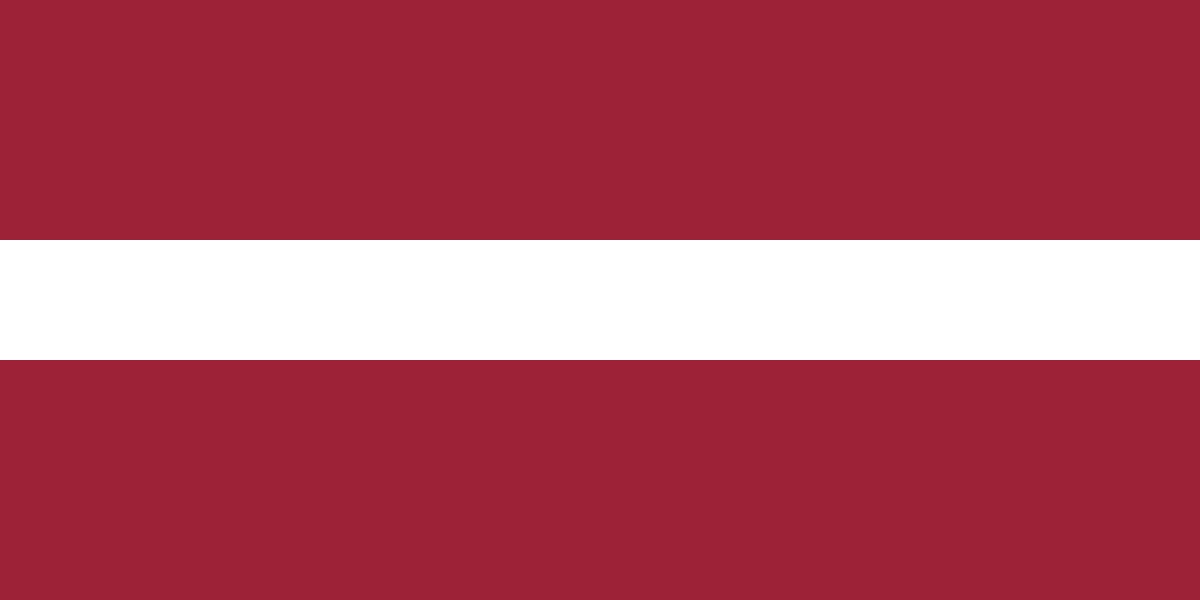
Latvia, officially the Republic of Latvia, is a Baltic state in Northern Europe, bordered by Estonia, Lithuania, Russia, and Belarus, with a maritime border with Sweden. Its capital and largest city is Riga. It covers 64,573 km2 and has a population of approximately 1.83 million. The titular nation are Latvians, comprising about 65.5% of the population, speaking Latvian. Russians are the most prominent minority, making up almost a quarter of the population, with 37.7% speaking Russian as their native tongue.
1905: 1905 Russian Revolution
In 1905, popular discontent exploded during the Russian Revolution, which took on a nationalist character in the Baltic provinces, including Latvia.


1915: Industrial base evacuated
In 1915, with most of Latvia's industrial base evacuated to the interior of Russia, radical land reform became a central political question.
1917: Power vacuum created by Russian Revolution
In 1917, the Russian Revolution created a power vacuum in the region, impacting Latvia's path towards self-determination.
November 1918: Proclamation of Independence
In November 1918, the People's Council of Latvia proclaimed independence, and Kārlis Ulmanis was entrusted to set up a government as prime minister.
1918: Latvia becomes an independent country
After the collapse of the Russian Empire, Latvia became an independent country in 1918.
June 1919: Battle of Wenden
In June 1919, Estonian and Latvian forces defeated the Germans at the Battle of Wenden.
May 1920: Constituent assembly convened
On 1 May 1920, a freely elected constituent assembly convened in Latvia.
1920: Eastern Latvia cleared of Red Army forces
In early 1920, Eastern Latvia was cleared of Red Army forces by Latvian and Polish troops during the Polish–Soviet War.
1921: Latvia Joins League of Nations
In 1921, Latvia became a member of the League of Nations.
February 1922: Adoption of the Satversme
In February 1922, the constituent assembly adopted a liberal constitution, the Satversme.
1931: Latvian Hockey Higher League held
The national tournament is the Latvian Hockey Higher League, held since 1931.
May 1934: Ulmanis staged a coup
On 15 May 1934, Ulmanis staged a bloodless coup, establishing a nationalist dictatorship that lasted until 1940.
1934: Coup established dictatorship of Kārlis Ulmanis
In 1934, a coup established the dictatorship of Kārlis Ulmanis in Latvia, leading to an increasingly autocratic state.
1935: Latvian national basketball team won the first ever EuroBasket
In 1935, the Latvian national basketball team won the first ever EuroBasket.
1935: Share of ethnic Latvians
In 1935, the share of ethnic Latvians in the population was 77% (1,467,035).
1936: Reduction of landless population
By 1936, the percentage of the rural population that had been landless was reduced to 18%, down from 61.2% in 1897.
August 1939: Molotov-Ribbentrop Pact signed
On 24 August 1939, the Soviet Union and Nazi Germany signed the Molotov–Ribbentrop Pact, which included a secret protocol assigning Latvia to the Soviet sphere of influence.
October 1939: Latvia forced to accept pact with Soviet Union
In October 1939, Latvia was forced to accept a "mutual assistance" pact with the Soviet Union, allowing the Soviets to station troops on Latvian territory.
1939: Latvia won silver medals in EuroBasket
In 1939, Latvia won silver medals in EuroBasket, after losing the final to Lithuania by one point.
1939: Establishment of Latvia University of Life Sciences and Technologies
In 1939, the Latvia University of Life Sciences and Technologies was established on the basis of the Faculty of Agriculture.
August 1940: Incorporation into USSR
On 5 August 1940, the Soviet Union incorporated Latvia as the Latvian Soviet Socialist Republic.
1940: Citizenship granted
Citizenship was granted to persons who had been citizens of Latvia on the day of loss of independence in 1940 as well as their descendants.
1940: Latvia occupied by the Soviet Union
In 1940, Latvia was occupied by the Soviet Union and remained under Soviet rule until 1991.
1940: End of Ulmanis's dictatorship
In 1940, the nationalist dictatorship established by Ulmanis in 1934 came to an end.
1940: Baltic Germans resettled
In the summer of 1940, most of the Baltic Germans who remained in Latvia after the Molotov-Ribbentrop Pact left for Germany under a second resettlement scheme.
June 1941: German troops attacked Soviet forces
On 22 June 1941, German troops attacked Soviet forces in Operation Barbarossa, and by 29 June, Riga was reached, leading to German control of Latvia by early July.
December 1941: Massacre in Rumbula Forest
In November and December 1941, 30,000 Jews from the Riga ghetto were killed in the Rumbula Forest as part of the Holocaust.
1941: Invasion and occupation by Nazi Germany
In 1941, Latvia's de facto independence was interrupted by the invasion and occupation by Nazi Germany during World War II.
January 1944: End of siege of Leningrad
In January 1944, after the siege of Leningrad ended, Soviet troops advanced, eventually capturing Riga in October.
October 1944: Capture of Riga
On 13 October 1944, Soviet troops captured Riga.
1944: Re-occupation by the Soviets
In 1944, Latvia was re-occupied by the Soviets, forming the Latvian SSR for the next 45 years.
1944: Soviet re-occupation
In 1944, the Soviets reoccupied the country leading to further deportations.
1945: Revelation of secret protocol
In 1945, after Germany's defeat, the secret protocol of the Molotov-Ribbentrop Pact was revealed, detailing the division of Northern and Eastern Europe into German and Soviet "spheres of influence".
1945: Collectivization and Sovietization
In 1945, further deportations followed as the country was collectivised and Sovietised.
1946: End of League of Nations Membership
In 1946, Latvia's membership in the League of Nations ended.
1950: Establishment of Riga Stradiņš University
In 1950, Riga Stradiņš University was established on the basis of the Faculty of Medicine.
1956: Estimated members of the Evangelical Lutheran Church
In 1956, the Evangelical Lutheran Church had an estimated 600,000 members.
1959: Arrival of Russian settlers
By 1959, about 400,000 Russian settlers had arrived in Latvia, causing the ethnic Latvian population to fall to 62%.
1973: Gauja National Park Established
In 1973, Gauja National Park was established in Vidzeme.
1977: Latvia's Red Book Established
In 1977, Latvia's Red Book (Endangered Species List of Latvia) was established, containing 112 plant species and 119 animal species.
March 1987: Shrinking membership of the Evangelical Lutheran Church
In March 1987, an internal document near the end of communist rule indicated that the active membership of the Evangelical Lutheran Church in Latvia had shrunk to only 25,000.
1987: Singing Revolution started
In 1987, the peaceful Singing Revolution started among the Baltic Soviet republics, contributing to the eventual restoration of independence.
1987: First large demonstrations held
In the summer of 1987, the first large demonstrations were held in Riga at the Freedom Monument, which was a symbol of independence.
1988: Emergence of national movement
In the summer of 1988, a national movement coalesced in the Popular Front of Latvia, opposing the Interfront.
1989: Resolution on the Occupation of the Baltic states
In 1989, the Supreme Soviet of the USSR adopted a resolution on the Occupation of the Baltic states, declaring the occupation "not in accordance with law".
1989: Share of ethnic Latvians
In 1989, the share of ethnic Latvians in the population was 52% (1,387,757).
March 1990: Pro-independence candidates gained majority
In March 1990, pro-independence Popular Front of Latvia candidates gained a two-thirds majority in the Supreme Council in democratic elections.
May 1990: Declaration on the Restoration of Independence
On 4 May 1990, the Supreme Council adopted the Declaration on the Restoration of Independence of the Republic of Latvia, renaming the Latvian SSR to the Republic of Latvia.
1990: Latvia regarded as a Soviet republic
In 1990, the central power in Moscow continued to regard Latvia as a Soviet republic.
1990: Reaffirmation of the constitution
In 1990, the constitution, partly suspended by Ulmanis after his coup in 1934, was reaffirmed.
1990: Population peak
In 1990, the population of Latvia reached its peak at just under 2.7 million people.
January 1991: Attempted overthrow by Soviet forces
In January 1991, Soviet political and military forces unsuccessfully tried to overthrow the Republic of Latvia authorities by occupying the central publishing house in Riga.
August 1991: Automatic entitlement to citizenship for children
After the re-establishment of independence on 21 August 1991, children born to non-nationals or stateless persons were automatically entitled to citizenship.
August 1991: Restoration of Independence
In August 1991, Latvia restored both de facto and official independence following the Singing Revolution. Since then, Latvia has been a democratic unitary parliamentary republic.
1991: Latvia Regains Independence
In 1991, Latvia regained independence, marking the point from which active and former KGB agents' data were revealed.
1992: Baltic Assembly and Nordic Council Cooperation
In 1992, interparliamentary cooperation between the Baltic Assembly and Nordic Council was signed.
1993: Saeima elected
In 1993, the Saeima, Latvia's parliament, was again elected.
1994: End of Russian military presence
In 1994, Russia ended its military presence by completing its troop withdrawal.
1995: Latvia signs Europe Agreement with the EU
In 1995, Latvia signed a Europe Agreement with the EU, with a 4-year transition period. This agreement laid the groundwork for Latvia's eventual accession to the European Union.
1996: Participation in Bosnia and Herzegovina Operation
In 1996, the Latvian armed forces contributed to NATO and EU military operations in Bosnia and Herzegovina, continuing until 2009.
1997: Law expanding scope for selling land passed
In 1997, Latvia passed a law expanding the scope for selling land, including to foreigners. This legislation aimed to attract foreign investment and promote economic development.
1997: Ķemeri National Park Established
In 1997, Ķemeri National Park was established in Zemgale.
1998: Shutting down of Skrunda-1 radar station
In 1998, Russia shut down the Skrunda-1 radar station in Latvia.
1999: American companies invest in Latvia
In 1999, American companies invested $127 million in Latvia, representing 10.2% of Latvia's total foreign direct investment. This investment reflected growing economic ties between Latvia and the United States.
1999: Latvia becomes a member of the World Trade Organization
In 1999, Latvia became a member of the World Trade Organization (WTO). This membership marked Latvia's integration into the global trade system and its commitment to free and fair trade practices.
1999: Slītere National Park Established
In 1999, Slītere National Park was established in Kurzeme.
1999: Vaira Vīķe-Freiberga becomes President
In 1999, Vaira Vīķe-Freiberga became the President of Latvia, serving until 2007.
2000: Latvia experiences high GDP growth
Since the year 2000, Latvia experienced one of the highest GDP growth rates in Europe. This period marked a phase of rapid economic development for the country.
April 2003: Latvia signs Schengen Agreement
On April 2003, Latvia signed the Schengen Agreement.
2003: Participation in Macedonia Operation
In 2003, the Latvian armed forces contributed to NATO and EU military operations in Macedonia.
March 2004: Baltic states joined NATO
In March 2004, the Baltic states, including Latvia, joined NATO. Following this, NATO members began deploying fighter jets on a rotational basis to Šiauliai Airport in Lithuania for the Baltic Air Policing mission to guard the Baltic airspace. This marked a significant step in Latvia's integration into Western security structures.
2004: Latvian neopagans, Dievturi
As of 2004, there were more than 600 Latvian neopagans, Dievturi (The Godskeepers), whose religion is based on Latvian mythology.
2004: Real estate prices begin to rise
From 2004, the prices of real estate in Latvia began to rise significantly. From 2004 to 2006, prices rose 150%, this rise was a significant contributor to the economic bubble.
2004: Latvia joins NATO and EU
In 2004, Latvia achieved its major goals of joining NATO and the European Union.
2004: Latvia joins the European Union
In 2004, Latvia joined the European Union (EU). This accession marked a significant step in Latvia's integration into the European economic and political framework.
2004: Latvian national football team's participation in UEFA European Championship
In 2004, the Latvian national football team participated in the UEFA European Championship.
2006: Schools closed
Between 2006 and 2010, 131 schools were closed in Latvia.
2006: Real estate prices continue to rise
From 2004 to 2006, the prices of real estate rose 150%, this rise was a significant contributor to the economic bubble.
2006: Rule of Law Missions in Iraq
In 2006 and 2007, Latvian civilian experts contributed to rule of law missions in Iraq.
2006: Private sector accounts for 70% of Latvia's GDP
In 2006, the private sector accounted for 70% of Latvia's GDP. This indicated a significant shift towards a market-oriented economy and the dominance of private enterprise.
2006: Number of hospitals in Latvia
In 2006, there were 121 hospitals in Latvia.
2006: Latvia's current account in deficit
In late 2006, Latvia's current account was in deficit by 27%. By February 2010, Latvia's current account, which had been in deficit by 27% in late 2006, was in surplus.
2006: Annual Meetings of Baltic Assembly and Nordic Council
Since 2006, annual meetings are held between the Baltic Assembly and Nordic Council.
2006: IIHF World Championship
The 2006 IIHF World Championship was held in Riga.
January 2007: Latvia Switches to Professional Army
From 1 January 2007, Latvia switched to a professional fully contract-based army.
November 2007: Unemployment rate at a low of 5.4%
In November 2007, Latvia's unemployment rate was at a low of 5.4%.
December 2007: Implementation of Schengen Agreement
In December 2007, Latvia started the implementation of the Schengen Agreement.
2007: Rule of Law Missions in Iraq and Police Mission in Afghanistan
In 2007, Latvian civilian experts contributed to rule of law missions in Iraq, since 2008. They also started participating in a police mission in Afghanistan.
2007: Rāzna National Park Established
In 2007, Rāzna National Park was established in Latgale.
2007: National account deficit represents over 22% of GDP
In 2007, the national account deficit represented more than 22% of Latvia's GDP for the year, while inflation was running at 10%. These figures highlighted growing economic imbalances.
2007: Number of hospitals in Latvia
In 2007, there were 94 hospitals in Latvia.
December 2008: Paul Krugman writes about Latvia in his New York Times column
On 15 December 2008, Paul Krugman, the Nobel Laureate in economics for 2008, wrote about Latvia in his New York Times Op-Ed column. This commentary drew attention to Latvia's economic challenges during the global financial crisis.
2008: Latvian economy enters phase of fiscal contraction
During the second half of 2008, the Latvian economy entered a phase of fiscal contraction. This contraction followed an extended period of credit-based speculation and unrealistic appreciation in real estate values.
2008: End of Participation in Iraq Operation
In 2008, Latvian armed forces took part in the US-led Multi-National Force operation in Iraq.
2008: Māris Štrombergs became an Olympic champion
In 2008, Māris Štrombergs became an Olympic champion in Men's BMX.
2008: Collapse of Latvian GDP begins
In late 2008, Latvia experienced the collapse of its GDP. This economic downturn was exacerbated by the global economic crisis, shortage of credit, and the bailout of Parex Bank.
2008: Latvia experiences deep economic downturn
Latvia experienced deep economic downturn from 2008–09. Since 2010, Latvia's economy has been recovering strongly following the deep downturn in 2008–09.
2008: Monitoring Mission in Georgia
Since 2008, Latvian civilian experts have contributed to monitoring missions in Georgia.
2009: Creation of Planning Regions
In 2009, five planning regions of Latvia were created to promote balanced development of all regions.
2009: End of Participation in Bosnia and Herzegovina Operation
In 2009, the Latvian armed forces ended its contribution to NATO and EU military operations in Bosnia and Herzegovina, starting in 1996.
2009: Number of hospitals in Latvia
In 2009, there were 59 hospitals in Latvia.
2009: Sharp decline in Latvian economy
In early 2009, the Latvian economy fell by 18% in the first three months, marking the biggest fall in the European Union. This sharp decline was a consequence of the global economic crisis and domestic economic vulnerabilities.
2009: Valdis Dombrovskis in Office
Since 2009, Valdis Dombrovskis has been in office as the Latvian Prime Minister.
2009: Economic crisis exposes assumptions
The economic crisis of 2009 highlighted the unsustainability of the fast-growing Latvian economy, which was driven mainly by domestic consumption financed by private debt and a negative foreign trade balance. This period exposed vulnerabilities in the economic model.
February 2010: Latvia's current account in surplus
By February 2010, Latvia's current account, which had been in deficit by 27% in late 2006, was in surplus. This improvement signaled signs of stabilization in the Latvian economy following the economic crisis.
April 2010: Latvia has highest unemployment rate in the EU
In April 2010, Latvia had the highest unemployment rate in the EU, at 22.5%, ahead of Spain, which had 19.7%. This high unemployment rate reflected the severity of the economic crisis in Latvia.
2010: Eurobarometer Poll regarding belief in God
According to the Eurobarometer Poll conducted in 2010, 38% of Latvian citizens believed in God, 48% believed in some sort of spirit or life force, and 11% did not believe in any sort of spirit, God, or life force.
2010: Schools closed
Between 2006 and 2010, 131 schools were closed in Latvia, which is a 12.9% decline.
2010: Latvia launches Residence by Investment program
In 2010, Latvia launched a Residence by Investment program, also known as the Golden Visa, to attract foreign investors. The program allowed investors to obtain a Latvian residence permit by investing at least €250,000 in property or in an enterprise.
2010: Parliamentary Election
In 2010, the ruling centre-right coalition won 63 out of 100 parliamentary seats in the parliamentary election.
2010: Latvia's economy recovers strongly
Since 2010, Latvia's economy has been recovering strongly following the deep downturn in 2008–09. The recovery was underpinned by export growth and a recovery in domestic demand.
January 2011: Baltic states invited to join Nordic Defence Cooperation
In January 2011, the Baltic states, including Latvia, were invited to join Nordic Defence Cooperation, which is the defense framework of the Nordic countries. This invitation signaled closer collaboration in defense matters between the Baltic and Nordic regions.
2011: More than half of non-citizens naturalized
By 2011, more than half of non-citizens had taken naturalization exams and received Latvian citizenship.
2011: Religion in Latvia
In 2011, Christianity was the largest religion in Latvia, accounting for 79% of the population.
2011: Real GDP growth underpinned by export growth and recovery in domestic demand
In 2011, Latvia's real GDP growth of 5.5 percent was underpinned by export growth and a recovery in domestic demand. This growth marked a positive trend in Latvia's economic recovery.
2011: OSCE urges Latvia to allow non-citizens to vote in municipal elections
In 2011, the OSCE High Commissioner on National Minorities urged Latvia to allow non-citizens to vote in municipal elections. This recommendation addressed the limited political rights of non-citizens, who were excluded from participating in parliamentary or municipal elections.
2011: Share of ethnic Latvians
In 2011, there were fewer Latvians than in 1989, but their share of the population was larger – 1,285,136 (62.1% of the population).
February 2012: Constitutional referendum on Russian as a second official language
In February 2012, Latvia held a constitutional referendum regarding the adoption of Russian as a second official language. The results showed that 74.8% voted against, while 24.9% voted in favor, with a voter turnout of 71.1%.
July 2012: IMF concludes monitoring discussions with Latvia
In July 2012, the IMF concluded the First Post-Program Monitoring Discussions with the Republic of Latvia. The IMF announced that Latvia's economy has been recovering strongly since 2010, following the deep downturn in 2008–09.
November 2012: Agreement to create a joint military staff
In November 2012, the three Baltic countries, including Latvia, agreed to create a joint military staff in 2013. This agreement was aimed at enhancing military cooperation and coordination among the Baltic states.
2012: Percentage of births to unmarried women
In 2012, 45.0% of births in Latvia were to unmarried women.
2012: Māris Štrombergs became a two-time Olympic champion
In 2012, Māris Štrombergs became a two-time Olympic champion in Men's BMX.
2012: Environmental Performance Index Ranking
In 2012, the Environmental Performance Index ranked Latvia second, after Switzerland, based on the environmental performance of the country's policies.
November 2013: Prime Minister Resigns After Supermarket Collapse
In November 2013, Latvian Prime Minister Valdis Dombrovskis resigned after a supermarket collapse killed at least 54 people.
November 2013: Shopping Center Roof Collapse in Riga
In November 2013, the roof of a shopping center in Riga collapsed, resulting in the deaths of 54 people, marking Latvia's worst post-independence disaster.
2013: Riga Hosts Northern Future Forum
In 2013, Riga hosted the annual Northern Future Forum, a meeting of prime ministers from Nordic-Baltic countries and the UK.
2013: Planned creation of a joint military staff
In 2013, according to the agreement established in November 2012, the three Baltic countries planned to create a joint military staff. This initiative aimed to further enhance military cooperation among the Baltic states.
2013: Economy expected to expand
In 2013, despite deteriorating external conditions, the economy is expected to expand. In 2013, the growth momentum continued despite deteriorating external conditions.
2013: Life expectancy in Latvia
In 2013, the life expectancy in Latvia was estimated at 73.2 years (68.1 years for males and 78.5 years for females).
2013: Public opinion on the introduction of the euro
In late 2013, statistics indicated that 45% of the Latvian population supported the introduction of the euro, while 52% opposed it. These figures reflected divided public opinion regarding the adoption of the euro as the country's currency.
January 2014: Introduction of the euro as Latvia's currency
On 1 January 2014, Latvia adopted the euro as its official currency, replacing the Lats. Following the introduction of the Euro in January 2014, Eurobarometer surveys indicated that public support for the euro was around 53%, which was close to the European average.
January 2014: Latvia Joins Eurozone
On 1 January 2014, Latvia joined the Eurozone.
January 2014: Laimdota Straujuma in Office
Since January 2014, Laimdota Straujuma has been in office as the country's first female prime minister.
July 2014: Riga hosted the eighth World Choir Games
In July 2014, Riga hosted the eighth World Choir Games, with over 27,000 choristers representing over 450 choirs and over 70 countries.
2014: Schools for minorities that use Russian
As of 2014 there were 109 schools for minorities that use Russian as the language of instruction (27% of all students) for 40% of subjects (the remaining 60% of subjects are taught in Latvian).
2014: GDP at current prices rose to €23.7 billion
In 2014, GDP at current prices rose to €23.7 billion. The employment rate rose in the same period from 59.1% to 65% with unemployment falling from 10.8% to 6.5%.
2014: Nordic and Baltic ISAF Forces Withdrawal
In 2014, Latvia was part of the Nordic Transition Support Unit (NTSU), which renders joint force contributions in support of Afghan security structures ahead of the withdrawal of Nordic and Baltic ISAF forces.
2014: Economy expected to expand by 4.1 percent
In 2014, the economy is expected to expand by 4.1 percent. The unemployment rate has receded from its peak of more than 20 percent in 2010 to around 9.3 percent in 2014.
December 2015: Laimdota Straujuma Resigns
In December 2015, Laimdota Straujuma, the country's first female prime minister, resigned.
2015: Latvia estimated to have the lowest male-to-female ratio in the world
As of 2015, Latvia was estimated to have the lowest male-to-female ratio in the world, at 0.85 males per female.
2015: Latvia Contributed to Nordic Battlegroup
In 2015, the Latvian armed forces contributed to the Nordic Battlegroup under the Common Security and Defence Policy (CSDP) of the European Union.
2015: Non-citizens in Latvia
In 2015, there were still 290,660 non-citizens in Latvia, representing 14.1% of the population.
2015: Latvia Holds EU Council Presidency
In the first half of 2015, Latvia held the Presidency of the Council of the European Union.
2015: Latvia hosted EuroBasket
Latvia was one of the EuroBasket 2015 hosts.
February 2016: New Coalition Formed by Maris Kucinskis
In February 2016, a coalition of Union of Greens and Farmers, The Unity and National Alliance was formed by new Prime Minister Maris Kucinskis.
2016: Biocapacity in Latvia
In 2016, Latvia had 8.5 global hectares of biocapacity per person, exceeding the world average. It used 6.4 global hectares of biocapacity per person, resulting in a biocapacity reserve.
2017: Mairis Briedis held the WBC cruiserweight title
From 2017 to 2018, Mairis Briedis held the WBC cruiserweight title.
2017: Jeļena Ostapenko won the French Open Women's singles title
In 2017, Latvian tennis player Jeļena Ostapenko won the 2017 French Open Women's singles title, being the first unseeded player to do so in the open era.
2017: Female and male population living in Latvian territory
In 2017, there were 1,054,433 females and 895,683 males living in Latvian territory.
2017: Licensed vehicles in Latvia
In 2017, there were a total of 803,546 licensed vehicles in Latvia.
2018: Mairis Briedis held the WBC cruiserweight title
From 2017 to 2018, Mairis Briedis held the WBC cruiserweight title.
2018: Parliamentary Election
In 2018, the pro-Russian Harmony was again the biggest party securing 23 out of 100 seats in the parliamentary election.
2018: National Archives Release KGB Agents Index
In late 2018, the National Archives of Latvia released a full alphabetical index of approximately 10,000 individuals recruited as agents or informants by the Soviet KGB.
January 2019: Krisjanis Karins Becomes Prime Minister
In January 2019, Latvia got a government led by new Prime Minister Krisjanis Karins of the centre-right New Unity.
2019: GDP at current prices rose to €30.5 billion
In 2019, GDP at current prices rose to €30.5 billion. The employment rate rose in the same period from 59.1% to 65% with unemployment falling from 10.8% to 6.5%.
2019: Warmest Year on Record
In 2019, Latvia experienced its warmest year in the history of weather observation, with an average temperature +8.1 °C higher.
2019: Forest Landscape Integrity Index
In 2019, Latvia had a Forest Landscape Integrity Index mean score of 2.09/10, ranking it 159th globally out of 172 countries.
2019: Mairis Briedis held the WBO cruiserweight title
In 2019, Mairis Briedis held the WBO cruiserweight title.
2019: Riga International Airport serves 7.8 million passengers
In 2019, Riga International Airport served 7.8 million passengers, making it the busiest airport in the Baltic states. The airport has direct flights to over 80 destinations in 30 countries.
2019: Inaugural Riga Jurmala Music Festival
Starting in 2019 Latvia hosts the inaugural Riga Jurmala Music Festival, a new festival in which world-famous orchestras and conductors perform across four weekends during the summer.
2019: Instruction in Russian language gradually discontinued
Starting in 2019, instruction in the Russian language was gradually discontinued in private colleges and universities in Latvia, as well as general instruction in Latvian public high schools, except for subjects related to culture and history of the Russian minority, such as Russian language and literature classes.
2020: Government aims to spend 1.5% of GDP on research and development
By 2020, the Latvian government aimed to spend 1.5% of GDP on research and development, with half of the investments coming from the private sector.
2020: Mairis Briedis held the IBF / The Ring magazine cruiserweight titles
In 2020, Mairis Briedis held the IBF / The Ring magazine cruiserweight titles.
July 2021: Riga Jurmala Music Festival
The Riga Jurmala Music Festival was archived on July 2, 2021.
February 2022: Deterioration of Relations with Russia
Since February 2022, Latvia's relations with Russia have deteriorated.
April 2022: Saeima passes amendments for increasing the defence budget
On 21 April 2022, the Latvian Saeima passed amendments developed by the Ministry of Defence, called Amendments to the Law on Financing of National Defence, which will gradually increase the defense budget to 2.5% of the country's GDP over the course of the next three years.
September 2022: Law removing influence over the Orthodox Church from non-Latvians
In September 2022, a law was enacted in Latvia removing all influence or power over the Orthodox Church from non-Latvians, including the patriarch of Moscow.
October 2022: Latvian Parliamentary Election
Following the October 2022 Latvian parliamentary election, Prime Minister Krišjānis Kariņš formed the Second Kariņš cabinet in December 2022.
December 2022: Formation of the Second Kariņš Cabinet
In December 2022, following the October 2022 election, Prime Minister Krišjānis Kariņš formed the Second Kariņš cabinet.
2022: Latvian Prime Minister announces planned investments in new wind farms
In 2022, the Latvian Prime Minister announced planned investments of 1 billion euros in new wind farms. The completed project is expected to provide an additional 800 MW of capacity.
2022: Ventspils linked to Russian oil transportation routes until this year
Prior to 2022, the free port of Ventspils was linked to oil extraction fields and transportation routes of the Russian Federation via a system of two pipelines from Polotsk, Belarus.
January 2023: Expulsion of Ambassadors and Entry Ban for Russians
In January 2023, Latvia withdrew its ambassador from Russia, expelled Russia's ambassador to Latvia, and banned Russians from entering Latvia.
May 2023: Edgars Rinkēvičs Elected as President
In May 2023, the parliament elected Edgars Rinkēvičs as the new President of Latvia.
August 2023: Kariņš Resigns as Prime Minister
On 14 August 2023, Prime Minister Kariņš resigned, citing opposition to expanding the coalition.
September 2023: Evika Siliņa Becomes Prime Minister
On 15 September 2023, Evika Siliņa became the new prime minister of Latvia.
September 2023: Siliņa Cabinet Sworn In
On 15 September 2023, the Siliņa cabinet was sworn in, comprising New Unity, Union of Greens and Farmers, and The Progressives.
November 2023: Latvia Ratifies Istanbul Convention
In November 2023, Latvia ratified the EU Convention on Preventing and Combating Violence Against Women and Domestic Violence, also known as the Istanbul Convention.
2023: Russian language usage in Latvia
In 2023, Russian was spoken as the mother tongue by 37.7% of the population and spoken at home by 34.6%, including people who were not ethnically Russian.
2023: Transition to Latvian in all classes
In 2023, all schools in Latvia, including pre-schools, that were still using the Russian language were required to transition to using Latvian in all classes within three years.
2023: Total fertility rate in Latvia
In 2023, the total fertility rate (TFR) in Latvia was estimated to be 1.36 children born per woman, which is lower than the replacement rate of 2.1.
2023: Expected return of Russian citizens to Russia
In late 2023, it is expected that around 5,000–6,000 Russians will be returned to Russia as they have made little effort to learn the Latvian language, integrate with Latvia, or apply to become Latvian citizens.
2025: Ethnic composition of Latvia
In 2025, Latvians formed about 65.5% of the population, while Russians were 24.1%, Belarusians 2.9%, Ukrainians 2.9%, Poles 1.9%, Lithuanians 1.1%, and other ethnic groups 1.6%.
2025: Global Innovation Index Ranking
Latvia was ranked 41st in the Global Innovation Index in 2025.
2025: Latvia will be one of the hosts of EuroBasket
Latvia will be one of the hosts once again in 2025.
2026: Rail Baltica railway set to be completed
The Rail Baltica railway, linking Helsinki-Tallinn-Riga-Kaunas-Warsaw, is under construction and is set to be completed in 2026. This railway will connect Latvia to the European standard gauge lines.
Mentioned in this timeline
Basketball is a team sport played on a rectangular court...
Ukraine is a country in Eastern Europe the second-largest on...
Radar Radio Detection and Ranging is a detection system that...
The Union of Soviet Socialist Republics USSR existed from to...
Belarus is a landlocked country in Eastern Europe bordered by...
Germany officially the Federal Republic of Germany is located in...
Trending
4 hours ago Cade Cunningham's Rising Impact and Performance With Detroit Pistons
4 hours ago L'Jarius Sneed Cleared to Play for Chiefs in Week 7 Matchup
4 hours ago Cason Wallace and Jaylin Williams Exit Game Against Clippers Due to Injuries
4 hours ago Gadi Eisenkot Challenges Benjamin Netanyahu in Crucial 2026 Israeli Elections
4 hours ago Steve Spagnuolo Praises Seahawks Receiver Jaxon Smith-Njigba as Elite

5 hours ago Quinn Hughes Nears Potential Contract Extension Agreement With Minnesota Wild
Popular
Ilhan Omar is a prominent American politician currently serving as...

Ken Paxton is an American politician and lawyer serving as...

Elon Musk is a visionary entrepreneur and engineer known for...

Michael Joseph Jackson the King of Pop was a highly...
Barack Obama the th U S President - was the...
Greg Abbott is the current and th Governor of Texas...