History of Supreme Court of the United States in Timeline


The Supreme Court of the United States (SCOTUS) is the highest court in the U.S. federal judiciary, possessing ultimate appellate jurisdiction over federal and state cases involving U.S. constitutional or federal law. It also holds original jurisdiction in limited cases, such as those involving ambassadors or disputes between states. The court established its power of judicial review in 1803, granting it the authority to invalidate statutes or presidential directives that conflict with the Constitution or statutory law. This power enables the Supreme Court to shape the interpretation and application of law in the United States.
1906: United States v. Shipp Contempt Proceeding
In 1906, the Supreme Court asserted its original jurisdiction to prosecute individuals for contempt of court in United States v. Shipp. The contempt proceeding arose from the lynching of Ed Johnson in Chattanooga, Tennessee the evening after Justice John Marshall Harlan granted Johnson a stay of execution to allow his lawyers to file an appeal. The court found nine individuals guilty of contempt.


1910: Death of David Brewer
David Brewer, who was born to American missionaries in Smyrna, Ottoman Empire (now İzmir, Turkey), and served as a foreign-born justice in the Supreme court, died in 1910.
1910: End of the Fuller Courts
In 1910, the Fuller Courts (1864–1910) ended. These courts interpreted the new Civil War amendments to the Constitution and developed the doctrine of substantive due process.
1910: Start of the White and Taft Courts
In 1910, the White and Taft Courts began. During this period, the court addressed the incorporation of the Bill of Rights against the states, antitrust statutes, military conscription, and the substantive due process doctrine.
1911: Abolishment of circuit riding
In 1911, circuit riding by Supreme Court justices was officially abolished by Congress. This practice, which required justices to travel within assigned circuits and consider cases alongside local judges, had been criticized due to travel difficulties and potential conflicts of interest.
1916: Appointment of Louis Brandeis
In 1916, Louis Brandeis became the first Jewish Justice appointed to the Supreme Court.
1922: Appointment of George Sutherland
In 1922, George Sutherland, born in Buckinghamshire, England, was appointed to the Supreme Court.
1925: First nominee appearance before the Senate Judiciary Committee
In 1925, Harlan Fiske Stone became the first Supreme Court nominee to appear before the Senate Judiciary Committee to address concerns about his ties to Wall Street.
1930: Start of the Hughes, Stone, and Vinson courts
In 1930, the Hughes, Stone, and Vinson courts began. During this time, the court interpreted the Constitution more broadly, expanding the powers of the federal government to support President Franklin D. Roosevelt's New Deal.
1930: End of the White and Taft Courts
In 1930, the White and Taft Courts ended. During this period, the court addressed the incorporation of the Bill of Rights against the states, antitrust statutes, military conscription, and the substantive due process doctrine.
1935: Humphrey's Executor v. United States decision
In 1935, the Supreme Court case Humphrey's Executor v. United States imposed limitations on the scope of Executive authority.
1935: The Supreme Court gained its own accommodation
In 1935, the Supreme Court gained its own accommodation and changed its interpretation of the Constitution, giving a broader reading to the powers of the federal government to facilitate President Franklin D. Roosevelt's New Deal.
1935: Supreme Court Moves into its Own Building
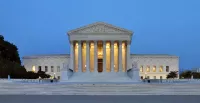
In 1935, the Supreme Court moved into its own purpose-built home in Washington, D.C., designed by Cass Gilbert.
1936: United States v. Curtiss-Wright Export Corp.
In 1936, the Supreme Court case United States v. Curtiss-Wright Export Corp. helped define the scope and nature of the powers and separation between the legislative and executive branches of the federal government.
1937: Roosevelt's Court-Packing Plan
In 1937, President Franklin D. Roosevelt proposed a plan to expand the Supreme Court by adding one justice for each sitting justice over the age of 70 years and 6 months who declined to retire, with a maximum of 15 justices. This "court-packing plan" was intended to appoint justices who would support Roosevelt's New Deal policies. However, the plan was defeated in Congress, as it was deemed unconstitutional, with the Senate voting against it 70-20.
1940: Law clerks education backgrounds
From 1882 to 1940, 62% of law clerks were graduates of Harvard Law School.
1944: First female clerk hired
In 1944, Lucile Lomen became the first female clerk for the Supreme Court, hired by Justice William O. Douglas. This marked a significant milestone in the court's history.
1945: United States v. Alcoa case
In 1945, in the case of United States v. Alcoa, the chief justice ordered the case remanded to the appropriate U.S. Court of Appeals for a final decision there. This has only occurred once in U.S. history.
1948: First African-American clerk hired
In 1948, William T. Coleman Jr. became the first African-American clerk for the Supreme Court, hired by Justice Felix Frankfurter. This was an important step towards diversity within the court.
1952: Steel Seizure Case
In 1952, the Steel Seizure Case imposed limitations on the scope of Executive authority. The Supreme Court defined the scope and nature of the powers and separation between the legislative and executive branches of the federal government.
1953: First Judiciary Committee hearing for William O. Douglas
In 1953, William O. Douglas was subjected to the first of two hearings from the Judiciary Committee.
1953: End of the Hughes, Stone, and Vinson courts
In 1953, the Hughes, Stone, and Vinson courts ended. During this time, the court interpreted the Constitution more broadly, expanding the powers of the federal government to support President Franklin D. Roosevelt's New Deal. The court also ruled on issues related to World War II, including the internment of Japanese Americans.
1953: Start of the Warren Court
In 1953, the Warren Court began and dramatically expanded the force of Constitutional civil liberties, addressing segregation, legislative districts, privacy, religion in public schools, and rights of criminal suspects.
November 1954: Initial nomination of John Marshall Harlan II
In November 1954, President Dwight Eisenhower's first nomination of John Marshall Harlan II was not acted on by the Senate.
1954: Desegregation of public schools resisted
After the 1954 judgment in Brown v. Board of Education, some state governments in the South resisted the desegregation of public schools. This shows the impact and challenges of implementing Supreme Court decisions.
January 1955: Re-nomination of John Marshall Harlan II
In January 1955, President Dwight Eisenhower re-nominated John Marshall Harlan II to the Supreme Court after the Senate did not act on his initial nomination in November 1954.
1955: Modern questioning of nominees begins
In 1955, the modern practice of questioning Supreme Court nominees by the Senate Judiciary Committee began with John Marshall Harlan II.
1960: Senate resolution on recess appointments
In 1960, the Senate passed a "sense of the Senate" resolution stating that recess appointments to the Supreme Court should only be made in "unusual circumstances".
1962: End of Felix Frankfurter's Tenure
In 1962, Felix Frankfurter's tenure on the Supreme Court came to an end.
1967: Thurgood Marshall Becomes First African-American Justice
In 1967, Thurgood Marshall made history by becoming the first African-American Justice to serve on the Supreme Court.
1968: First successful filibuster of a Supreme Court nominee
In 1968, President Lyndon B. Johnson's nomination of Abe Fortas to succeed Earl Warren as Chief Justice was the first successful filibuster of a Supreme Court nominee.
1969: Abe Fortas resigns while hearings are being organized
In 1969, Abe Fortas resigned from the Supreme Court while hearings were being organized by the Judiciary Committee.
1969: Start of the Burger Court
In 1969, the Burger Court began, marking a conservative shift. The court addressed privacy, affirmative action, campaign finance regulation, and the death penalty.
1970: Second Judiciary Committee hearing for William O. Douglas
In 1970, William O. Douglas was subjected to the second hearing from the Judiciary Committee.
September 1971: Hugo Black and John Marshall Harlan II left within days of each other
In September 1971, Hugo Black and John Marshall Harlan II left the Supreme Court within days of each other, marking the shortest period of time between vacancies in the court's history.
1973: Roe v. Wade and Mootness Exception
In 1973, Roe v. Wade was heard. The Supreme Court addresses the merits of claims pressed by pregnant women seeking abortions even if they are no longer pregnant because it takes longer than the typical human gestation period to appeal a case through the lower courts to the Supreme Court.
1973: Establishment of Code of Conduct for U.S. Judges
In 1973, the Code of Conduct for U.S. Judges was established for lower courts. As of April 2023, this code, enforced by the Judicial Conduct and Disability Act of 1980, contrasts with the Supreme Court's self-monitoring approach to ethics.
1973: Roe v. Wade decision
In 1973, the Roe v. Wade decision legalized abortion. It was later overturned in 2022 by Dobbs v. Jackson Women's Health Organization.
1974: DeFunis v. Odegaard Mootness Ruling
In 1974, in DeFunis v. Odegaard, the Supreme Court dismissed a lawsuit challenging the constitutionality of a law school affirmative action policy because the plaintiff student had graduated, rendering the case moot.
1974: United States v. Nixon decision
In 1974, the Supreme Court case United States v. Nixon imposed limitations on the scope of Executive authority, defining the separation of powers between the legislative and executive branches of the federal government.
1975: Start date for Congressional Research Service's data on nomination process
1975 is the start date for the Congressional Research Service's data on the average and median number of days from nomination to the final Senate vote, which is 67 and 71 days respectively.
1979: Goldwater v. Carter decision
In 1979, the Supreme Court's decision in Goldwater v. Carter effectively gave the presidency the power to terminate ratified treaties without the consent of Congress. This case defined the scope and nature of the powers and separation between the legislative and executive branches of the federal government.
1980: Enactment of the Judicial Conduct and Disability Act
In 1980, the Judicial Conduct and Disability Act was enacted to enforce the 1973 Code of Conduct for U.S. Judges in lower courts, while the Supreme Court maintains a self-monitoring approach.
1981: Sandra Day O'Connor Becomes First Female Justice
In 1981, Sandra Day O'Connor was appointed as the first female Justice of the Supreme Court.
1981: Slower approval process of justices begins
In 1981, starting with the Reagan administration, the approval process for Supreme Court justices began to take longer, due to Congress seeing justices as playing a more political role.
1981: Dames & Moore v. Regan decision
In 1981, the Supreme Court case Dames & Moore v. Regan helped define the scope and nature of the powers and separation between the legislative and executive branches of the federal government.
1986: Antonin Scalia Becomes First Italian-American Justice
In 1986, Antonin Scalia was appointed as the first Italian-American Justice to the Supreme Court.
1986: End of the Burger Court
In 1986, the Burger Court ended. During this time, the court expanded privacy, but divided deeply on affirmative action and campaign finance regulation, and wavered on the death penalty.
1986: Start of the Rehnquist Court
In 1986, the Rehnquist Court began. This court was known for reviving judicial enforcement of federalism and made rulings on issues such as single-sex state schools, laws against sodomy, the line-item veto, school vouchers, and abortion laws.
1987: Senate rejects Robert Bork's nomination
In 1987, the Senate rejected Robert Bork, who was nominated by President Ronald Reagan. This was the most recent explicit rejection of a Supreme Court nominee by the Senate.
December 1989: Supreme Court rules revision
In December 1989, the Supreme Court revised its rules, removing specific mentions of injunctions. Previously, the rules stated that a writ of injunction could be granted by any Justice in a case where it might be granted by the Court.
1990: Changes to the rules of the Supreme Court
Before 1990, the Supreme Court rules also stated that "a writ of injunction may be granted by any Justice in a case where it might be granted by the Court." However, this part of the rule (and all other specific mention of injunctions) was removed in the Supreme Court's rules revision of December 1989.
1991: Clarence Thomas' confirmation
Clarence Thomas' confirmation in 1991 to the Supreme Court was decided by senators representing a minority of Americans, highlighting potential selection biases.
1991: Clarence Thomas Succeeds Thurgood Marshall
In 1991, Clarence Thomas, an African-American, succeeded Thurgood Marshall as a Justice on the Supreme Court.
1991: Shift Towards Ideological Appointments to the Supreme Court
Since 1991, Devins and Baum argue that ideology has been much more important in choosing justices—all Republican appointees have been committed conservatives, and all Democratic appointees have been liberals.
1993: Ruth Bader Ginsburg Joins the Court
In 1993, Ruth Bader Ginsburg, the first Jewish woman, joined Sandra Day O'Connor on the Supreme Court.
1994: Retirement of Harry Blackmun
In 1994, Harry Blackmun retired from the Supreme Court, beginning an 11-year span until the death of William Rehnquist in 2005, which was the second-longest timespan between vacancies in the court's history.
2000: Decision in Bush v. Gore
In 2000, the Rehnquist Court made the decision in Bush v. Gore, which ended the electoral recount during the 2000 United States presidential election. The ruling remains controversial, with ongoing debate over its implications.
2000: Bush v. Gore Decision
In 2000, the Supreme Court intervened in the presidential election with the Bush v. Gore decision, awarding George W. Bush the presidency over Al Gore. The decision received scrutiny as political, based on controversial justifications used by the conservative justices.
2005: President George W. Bush withdraws nomination of Harriet Miers
In 2005, President George W. Bush withdrew the nomination of Harriet Miers to the Supreme Court before a confirmation vote, due to the likelihood of Senate rejection.
2005: Death of William Rehnquist
In 2005, William Rehnquist died, ending an 11-year span since the retirement of Harry Blackmun in 1994, which was the second-longest timespan between vacancies in the court's history.
2005: End of the Rehnquist Court
In 2005, the Rehnquist Court ended. This court was known for reviving judicial enforcement of federalism and made rulings on issues such as single-sex state schools, laws against sodomy, the line-item veto, school vouchers, and abortion laws.
2005: Supreme Court Lets Stand Ruling on Endangered Species Act
In 2005, the Supreme Court let stand without comment a ruling by the Fifth Circuit Court of Appeals that upheld the Endangered Species Act using the Commerce Clause. The act protected six endemic species of insect near Austin, Texas, despite the insects having no commercial value and not traveling across state lines.
2007: Review of Jeffrey Toobin's Book
In 2007, a review of Jeffrey Toobin's book compared the Supreme Court to a cartel, arguing that its lack of transparency reduces scrutiny and hurts ordinary Americans.

2007: Ledbetter v. Goodyear Tire & Rubber Co.
In 2007, the case of Ledbetter v. Goodyear Tire & Rubber Co. set limitations that were later superseded by the Lilly Ledbetter Fair Pay Act of 2009, passed by Congress. This case highlights the interplay between judicial decisions and legislative action.
2008: Adam Liptak writes about the court declining in relevance
In 2008, Adam Liptak wrote that the Supreme Court has declined in relevance compared to other constitutional courts, citing American exceptionalism, few updates to the constitution or the courts, the court's rightward shift, and the diminished stature of the United States abroad as factors.
2009: Congress passes the Lilly Ledbetter Fair Pay Act of 2009
In 2009, Congress passed the Lilly Ledbetter Fair Pay Act of 2009, superseding the limitations given in Ledbetter v. Goodyear Tire & Rubber Co. in 2007. This demonstrates that legislative action can reverse Supreme Court decisions on the interpretation of federal statutes.
2009: Sonia Sotomayor Joins the Court
In 2009, Sonia Sotomayor became the first Hispanic and Latina Justice on the Supreme Court, joining Ruth Bader Ginsburg.
2009: Study on Supreme Court clerkships
In 2009, a study published by the law review of Vanderbilt University Law School found that "Supreme Court clerkship appeared to be a nonpartisan institution from the 1940s into the 1980s".
2010: Increased Partisanship in Supreme Court Appointments
According to Devins and Baum, before 2010, the Court never had clear ideological blocs that fell perfectly along party lines. Republican presidents sometimes appointed liberals, and Democratic presidents sometimes appointed conservatives. However, since 2010, ideology has been much more important in choosing justices—all Republican appointees have been committed conservatives, and all Democratic appointees have been liberals.
2010: Elena Kagan Joins the Court
In 2010, Elena Kagan joined the Supreme Court, alongside Sonia Sotomayor.
2010: Poll on Televising Court Hearings
In 2010, a poll found that 61% of American voters agreed that televising Supreme Court hearings would "be good for democracy," and 50% stated they would watch the proceedings if they were televised.
2010: Citation example: Citizens United v. Federal Election Com'n
In 2010, the case Citizens United v. Federal Election Com'n, 585 U.S. 50, 130 S. Ct. 876, 175 L. Ed. 2d 753 was decided. This case is used as an example of how case citations are generally formatted in court documents, legal periodicals, and other legal media, including citations from the Supreme Court Reporter and the Lawyers' Edition.
March 2012: U.S. Reports published 30,161 Supreme Court opinions
As of March 2012, the U.S. Reports have published a total of 30,161 Supreme Court opinions, covering decisions from February 1790 to March 2012. Several cases can be addressed by a single opinion, as demonstrated by Parents v. Seattle, where Meredith v. Jefferson County Board of Education was also decided in the same opinion.
March 2012: 30,161 Supreme Court opinions published
As of March 2012, the U.S. Reports had published a total of 30,161 Supreme Court opinions, covering the decisions handed down from February 1790 to March 2012.
2014: National Labor Relations Board v. Noel Canning decision
In 2014, the Supreme Court's decision in National Labor Relations Board v. Noel Canning limited the president's ability to make recess appointments, ruling that the Senate decides when it is in session or in recess.
March 2016: Nomination of Merrick Garland
In March 2016, Merrick Garland was nominated to the Supreme Court, but the Senate failed to act on the nomination.
2016: Merrick Garland's blocked confirmation
Merrick Garland's blocked confirmation in 2016 to the Supreme Court was decided by senators representing a minority of Americans, highlighting potential selection biases.
2016: Stonewalling of Merrick Garland's confirmation
The 2016 stonewalling of Merrick Garland's confirmation to the Supreme Court, and subsequent filling of the seat with Neil Gorsuch, has been critiqued as a 'stolen seat'.
January 2017: Expiration of Merrick Garland's nomination
In January 2017, Merrick Garland's nomination to the Supreme Court expired without Senate action, after being nominated in March 2016. The vacancy was subsequently filled by Neil Gorsuch, an appointee of President Trump.
April 2017: Gorsuch joins Kennedy on the Supreme Court
From April 2017, Neil Gorsuch served alongside Anthony Kennedy on the Supreme Court. Gorsuch is the first justice to clerk for and subsequently serve alongside the same justice.
2017: Neil Gorsuch sells property
In 2017, Neil Gorsuch sold a property he co-owned for $1.8 million to the CEO of a prominent law firm, who was not listed on his ethics form when reporting a profit of between $250,000 and $500,000. This transaction has raised questions about transparency and ethics.
2017: Elimination of filibuster for Supreme Court nominations
In 2017, the Republican majority in the Senate changed the rules to eliminate the filibuster for Supreme Court nominations, following a Democratic filibuster of Neil Gorsuch's nomination.
2018: Kennedy's retirement
In 2018, Justice Kennedy retired from the Supreme Court, ending his time serving alongside Justice Gorsuch, who had previously clerked for him.
January 2019: Supreme Court composition
As of January 2019, the text indicates that there are changes to the Supreme Court. The specifics are not detailed in the text.
2019: Adoption of a new rule on oral arguments
In 2019, the Supreme Court adopted a rule allowing advocates to speak uninterrupted for the first two minutes of their argument. The petitioner gives the first presentation, and may reserve some time to rebut the respondent's arguments after the respondent has concluded. Amici curiae may also present oral argument on behalf of one party if that party agrees.
September 18, 2020: Death of Ruth Bader Ginsburg
Ruth Bader Ginsburg, a Justice of the Supreme Court, passed away on September 18, 2020.
October 26, 2020: Confirmation of Amy Coney Barrett
On October 26, 2020, Amy Coney Barrett was confirmed as the fifth woman in the Supreme Court's history, following the death of Ruth Bader Ginsburg.
2020: Composition of the Court After Amy Coney Barrett's Confirmation
In 2020, following the confirmation of Amy Coney Barrett after the death of Ruth Bader Ginsburg, the Supreme Court was composed of six justices appointed by Republican presidents and three appointed by Democratic presidents.
January 2021: Biden Establishes Presidential Commission on Supreme Court Reform
In January 2021, shortly after taking office, President Joe Biden established a presidential commission to study possible reforms to the Supreme Court.
April 2021: Introduction of the Judiciary Act of 2021
In April 2021, during the 117th Congress, some Democrats in the House of Representatives introduced the Judiciary Act of 2021, a bill to expand the Supreme Court from nine to 13 seats, after the expansion of a 5–4 conservative majority to a 6–3 supermajority during the first presidency of Donald Trump. However, Speaker of the House Nancy Pelosi did not bring it to the floor for a vote.
December 2021: Presidential Commission Report on Supreme Court Reform
In December 2021, the presidential commission established by President Joe Biden released its final report, which discussed potential reforms to the Supreme Court but took no position on expanding the size of the court.
2021: Decline in Supreme Court approval ratings
After recording recent high approval ratings in the late 1980s around 66% approval, the court's ratings have declined to an average of around 40% between mid-2021 and February 2024.
2021: Kavanaugh as Median Justice
In 2021, Darragh Roche argues that Kavanaugh as the median justice exemplifies the rightward shift in the Supreme court.
2021: Increase in Party-Line Rulings
In 2021, FiveThirtyEight found the number of unanimous decisions dropped from the 20-year average of nearly 50% to nearly 30%, while party-line rulings increased to a record high of 21%.
2021: Start of 2021-2022 term
The 2021-2022 term of the Supreme Court was the first full term following the appointment of three judges by Republican president Donald Trump: Neil Gorsuch, Brett Kavanaugh, and Amy Coney Barrett. Some members of Congress considered the results from this term a shift of government power into the Supreme Court, and a "judicial coup".
June 30, 2022: Ketanji Brown Jackson Joins the Supreme Court
On June 30, 2022, Ketanji Brown Jackson began her tenure as a Supreme Court Justice, after being confirmed by the Senate on April 7.
July 2022: Campaign Legal Center Paper: "The Supreme Court's Role in the Degradation of U.S. Democracy"
In July 2022, the Campaign Legal Center published a research paper titled "The Supreme Court's Role in the Degradation of U.S. Democracy", asserting that the Roberts Court had "turned on our democracy" and was on an "anti-democratic crusade," especially after Trump's appointments.
September 28, 2022: Allotment of justices among the circuits
As of September 28, 2022, a new allotment of justices among the circuits was determined. The text does not provide any details on the specifics of this change.
October 2022: Order of Precedence on the Supreme Court
Since the October 2022 term, the Supreme Court sits in order from left to right (from the perspective of those facing the court): Barrett, Gorsuch, Sotomayor, Thomas (most senior associate justice), Roberts (chief justice), Alito, Kagan, Kavanaugh, and Jackson.
2022: End of 2021-2022 term with landmark decisions
At the end of the 2021-2022 term, the Supreme Court issued a number of decisions that favored its conservative majority while significantly changing the landscape with respect to rights, including Dobbs v. Jackson Women's Health Organization, New York State Rifle & Pistol Association, Inc. v. Bruen, Carson v. Makin, Kennedy v. Bremerton School District and West Virginia v. EPA.
2022: Critique of the U.S. Supreme Court as a Partisan Institution
In 2022, Simon Lazarus of Brookings critiqued the U.S. Supreme Court as an increasingly partisan institution.
2022: Overturning of Roe v. Wade by Dobbs v. Jackson
In 2022, the Dobbs v. Jackson decision overturned Roe v. Wade (1973), ending the recognition of abortion access as a constitutional right and returning the issue to the states. The Dobbs decision was criticized by David Litt as activism on the part of the court's conservative majority.
2022: Dobbs v. Jackson Women's Health Organization decision
In 2022, the Supreme Court case Dobbs v. Jackson Women's Health Organization overturned Roe v. Wade (1973). Following the ruling, PBS reported that the case could initiate a reconsideration of substantive due process, particularly as Justice Clarence Thomas advocated for it, which has been the primary tool for incorporating the Bill of Rights against state and local governments.
2022: Dobbs ruling and public trust in the court
Since the 2022 Dobbs ruling that overturned Roe v. Wade and devolved the regulation of abortion, Democrats and independents have increasingly lost trust in the court, seen the court as political, and expressed support for reforming the institution.
2022: Increased scrutiny of Supreme Court justices
Supreme Court justices have come under greater scrutiny since 2022, following public disclosures that began with the founder of Faith and Action admissions regarding the organization's long-term influence-peddling scheme, dubbed "Operation Higher Court", designed for wealthy donors among the religious right to gain access to the justices through events held by The Supreme Court Historical Society.
April 2023: Chief Justice Roberts Refuses to Testify Before Senate Judiciary Committee
In April 2023, Chief Justice Roberts declined to testify before the Senate Judiciary Committee, maintaining that the Supreme Court should oversee its own ethical conduct, despite increasing ethics scandals. Lower courts, however, adhere to the 1973 Code of Conduct for U.S. judges, which is enforced by the Judicial Conduct and Disability Act of 1980.
November 13, 2023: Issuance of Code of Conduct for Justices of the Supreme Court
On November 13, 2023, the Supreme Court issued its first Code of Conduct for Justices, designed to set forth "ethics rules and principles" for members of the Court. The Code has been criticized as being a weaker version of the rules for other federal judges and lacking an enforcement mechanism, leading some to believe the court hopes to legitimize past and future scandals through this Code.
February 2024: Decline in Supreme Court approval ratings
After recording recent high approval ratings in the late 1980s around 66% approval, the court's ratings have declined to an average of around 40% between mid-2021 and February 2024.
June 26, 2024: Erroneous Posting of Moyle v. United States Opinion
On June 26, 2024, the Supreme Court inadvertently posted an opinion for Moyle v. United States to its website, which seemed to indicate that the court would temporarily allow abortions in medical emergencies in Idaho. The official opinion was posted the next day, which returned the case to the lower courts without a ruling on the merits.
July 10, 2024: Articles of Impeachment filed against Clarence Thomas and Samuel Alito
On July 10, 2024, Representative Alexandria Ocasio-Cortez filed Articles of Impeachment against justices Clarence Thomas and Samuel Alito, citing their "widely documented financial and personal entanglements".
July 2024: Articles of Impeachment against Thomas and Alito
In July 2024, Representative Alexandria Ocasio-Cortez filed Articles of Impeachment against Justices Thomas and Alito, citing their "widely documented financial and personal entanglements". As of late July 2024, nearly 1.4 million people had signed a moveon.org petition asking Congress to remove Justice Thomas.
2024: Public Perception of Supreme Court Partisanship
A 2024 AP-NORC poll showed that 7 in 10 respondents believed the Supreme Court decides cases to "fit their own ideologies" rather than acting as an independent check on other branches of government.
2024: Salaries of Justices in 2024
As of 2024, associate justices receive a yearly salary of $298,500, and the chief justice is paid $312,200 per year.
2024: Criticism of Supreme Court's Handling of Trump Cases
Critics have accused the Supreme Court of "slow-walking" important cases relating to former president Donald Trump to benefit his election chances in the 2024 United States presidential election. The Court is considering a presidential immunity claim as part of the Federal prosecution of Donald Trump (election obstruction case).
2024: Justices Alito and Thomas refuse to recuse themselves
In 2024, Justices Alito and Thomas refused calls to recuse themselves from January 6 cases where their spouses have taken public stances or been involved in efforts to overturn the election. These refusals have led to increased scrutiny and criticism.
2024: Criticism of Supreme Court's Secrecy and Shadow Docket
In 2024, Matt Ford compared the analysis of shadow-docket decisions to Kremlinology, calling the trend of secrecy "increasingly troubling." The criticism argued that the court's power comes entirely from persuasion and explanation.
2024: Op-Ed Expressing Similar Views on the Supreme Court
In 2024, legal reporters Dahlia Lithwick and Mark Joseph Stern expressed a similar view to the 2022 Campaign Legal Center paper regarding the Supreme Court's impact on democracy.
2024: Reform legislation blocked by Republicans
In 2024, reform legislation aimed at addressing the lack of external enforcement of ethics violations within the Supreme Court has been blocked by congressional Republicans.
April 9, 2026: Clarence Thomas's Tenure Milestone
As of April 9, 2026, Clarence Thomas will have served on the Supreme Court for 12,587 days (34 years, 168 days), making him the longest-serving justice.
Mentioned in this timeline

Donald John Trump is an American politician media personality and...

Nancy Pelosi is a prominent American politician notably serving as...

George W Bush the rd U S President - is...
Joe Biden served as the th President of the United...

Alexandria Ocasio-Cortez AOC is a prominent American politician and activist...

Ronald Reagan the th U S President - was a...
Trending

4 hours ago UCLA Quarterback Nico Iamaleava Out for Season Following Knee Injury

5 hours ago Selma Blair Arrested Following Mid-Air Altercation with Flight Crew

5 hours ago Peggy Flanagan Maintains Lead Against Michele Tafoya in Competitive Minnesota U.S. Senate Race

5 hours ago Sean Combs Rushed to Hospital From Prison Following Medical Emergency

6 hours ago Packers Defensive Lineman Javon Hargrave Out for Season With Torn Achilles
7 hours ago Supreme Court Reassesses Religious Rights and LGBTIQ Protections in Forthcoming Legal Battles
Popular

Ken Paxton is an American politician and lawyer serving as...

Jameis Winston is an American football quarterback currently playing for...

Cristiano Ronaldo widely considered one of the greatest footballers captains...

Michael Joseph Jackson the King of Pop was a highly...

Elon Musk is a visionary entrepreneur and engineer known for...

Marco Rubio is a prominent American politician serving as the...