


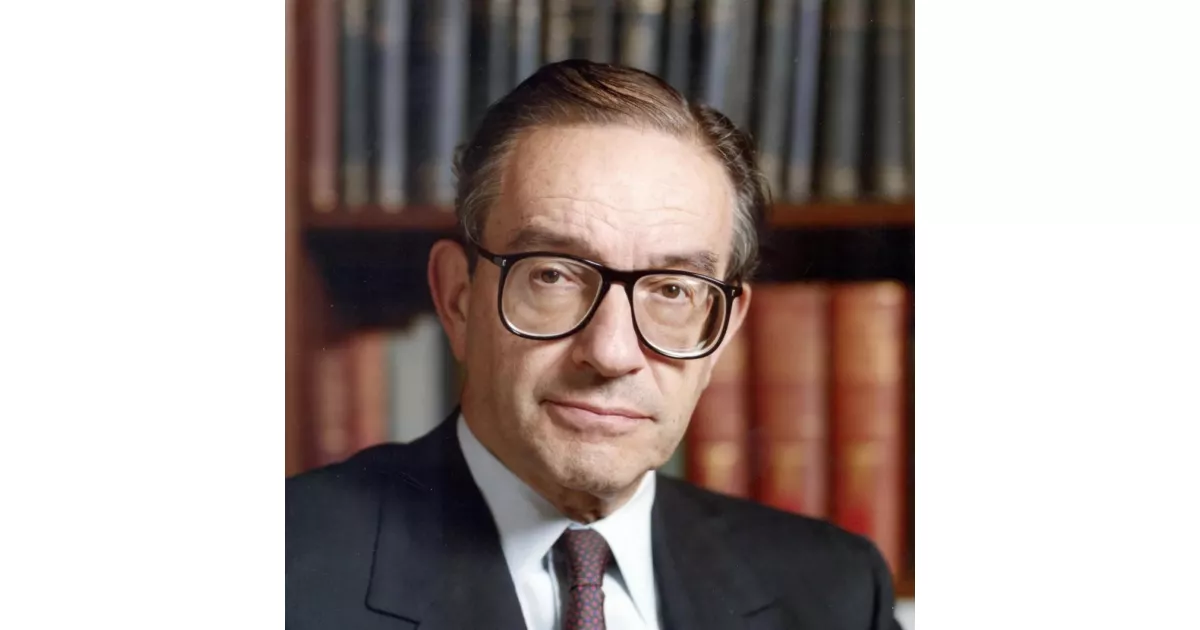
Alan Greenspan is an American economist notable for serving as the 13th chairman of the Federal Reserve from 1987 to 2006. Following his tenure at the Federal Reserve, he transitioned to private consulting through Greenspan Associates LLC, providing economic advice to firms.
March 6, 1926: Alan Greenspan Born
On March 6, 1926, Alan Greenspan was born. He would later become an American economist and the 13th chairman of the Federal Reserve.


1940: Attended George Washington High School
In 1940, Alan Greenspan began attending George Washington High School.
June 1943: Graduated High School
In June 1943, Alan Greenspan graduated from George Washington High School.
1944: Studied at Juilliard School and Rejected from Military Service
In 1944, Alan Greenspan studied clarinet at the Juilliard School. In the same year, he was rejected from military service in World War II due to a spot on his lung.
1945: Attended New York University's Stern School of Business
In 1945, Alan Greenspan began attending New York University's Stern School of Business.
1948: Worked at National Industrial Conference Board
From 1948, Alan Greenspan worked as an analyst at the National Industrial Conference Board, which is now known as the Conference Board.
1948: Earned B.A. Degree in Economics
In 1948, Alan Greenspan earned a B.A. degree in economics summa cum laude from New York University's Stern School of Business.
1950: Earned M.A. Degree in Economics
In 1950, Alan Greenspan earned an M.A. degree in economics from New York University's Stern School of Business.
October 1952: Marriage to Joan Mitchell
In October 1952, Alan Greenspan married artist Joan Mitchell; however, the marriage was declared invalid (not a legally completed marriage) 10 months later.
1953: Left National Industrial Conference Board
In 1953, Alan Greenspan ended his employment as an analyst at the National Industrial Conference Board.
1955: Chairman and President of Townsend-Greenspan & Co., Inc.
In 1955, Alan Greenspan became chairman and president of Townsend-Greenspan & Co., Inc., an economics consulting firm in New York City.
1966: Contribution to "Capitalism: The Unknown Ideal"
In 1966, Alan Greenspan contributed several essays to Ayn Rand's book "Capitalism: The Unknown Ideal", including one supporting the gold standard, solidifying his role as a proponent of Objectivism.
1968: Coordinator on Domestic Policy
In mid-1968, Alan Greenspan agreed to serve as Richard Nixon's coordinator on domestic policy in the nomination campaign.
1971: Back Injury
In 1971, Alan Greenspan injured his back which led to a habit of writing in longhand mostly while soaking in the bathtub.
1974: Chairman of the Council of Economic Advisers
In 1974, Alan Greenspan served as chairman of the Council of Economic Advisers, under President Gerald Ford.
1974: Swearing-in as Chairman of the Council of Economic Advisers
In 1974, Ayn Rand stood beside Alan Greenspan at his swearing-in ceremony as chairman of the Council of Economic Advisers, highlighting their close relationship and his growing influence in economic policy.
1976: U.S. Senator John Heinz Award
In 1976, Alan Greenspan received the U.S. Senator John Heinz Award for Greatest Public Service by an Elected or Appointed Official, an award given out annually by Jefferson Awards.
1977: Obtained Ph.D. in Economics
In 1977, Alan Greenspan obtained a Ph.D. in economics from New York University.
1977: Resumed Position at Townsend-Greenspan & Co., Inc.
In 1977, Alan Greenspan resumed his role as chairman and president of Townsend-Greenspan & Co., Inc. after serving as chairman of the Council of Economic Advisers.
1982: Director of the Council on Foreign Relations
In 1982, Alan Greenspan became a director of the Council on Foreign Relations foreign policy organization.
1982: Death of Ayn Rand
In 1982, Alan Greenspan's friend and Objectivist philosopher Ayn Rand died. They remained friends until her death.
December 1984: Began Dating Andrea Mitchell
In December 1984, Alan Greenspan, at the age of 58, began dating journalist Andrea Mitchell, who was 38 at the time.
June 2, 1987: Nomination as Federal Reserve Chairman
On June 2, 1987, President Ronald Reagan nominated Alan Greenspan as the successor to Paul Volcker as chairman of the Board of Governors of the Federal Reserve.
August 11, 1987: Confirmed as Chairman of the Federal Reserve
On August 11, 1987, the Senate confirmed Alan Greenspan as chairman of the Board of Governors of the Federal Reserve.
August 1987: Nominated to Federal Reserve
In August 1987, Alan Greenspan was first nominated to the Federal Reserve by President Ronald Reagan.
1987: Dissertation Removed and Discussion of Housing Bubble
In 1987, Alan Greenspan's dissertation was removed from New York University's archives at his request, coinciding with his appointment as chairman of the Federal Reserve Board. The dissertation included a discussion of soaring housing prices and their potential effect on consumer spending, anticipating a possible housing bubble.
1987: End of Tenure at Townsend-Greenspan & Co., Inc.
In 1987, Alan Greenspan's tenure as chairman and president of Townsend-Greenspan & Co., Inc., came to an end.
1987: Greenspan Put
In 1987, following the stock market crash, Alan Greenspan affirmed the Fed's readiness to provide liquidity to support the economic and financial system, an action later known as the Greenspan put.
1988: End of Term as Director of the Council on Foreign Relations
In 1988, Alan Greenspan's term as a director of the Council on Foreign Relations foreign policy organization ended.
1989: Elected as Fellow of the American Statistical Association
In 1989, Alan Greenspan was elected as a fellow of the American Statistical Association.
1993: Support for Clinton's Deficit Reduction Program
In 1993, Alan Greenspan lent support to President Bill Clinton's deficit reduction program.
April 1997: Marriage to Andrea Mitchell
In April 1997, Alan Greenspan married journalist Andrea Mitchell, with Supreme Court Justice Ruth Bader Ginsburg officiating the ceremony. Because of the annulment, the marriage to Mitchell is legally considered his first marriage.
1999: Taylor Rule Prescriptions Followed
In 1999, Alan Greenspan's monetary policy decisions largely followed standard Taylor rule prescriptions.
1999: Government Report on Derivatives Regulation
In 1999, Alan Greenspan, joined by Treasury Secretary Lawrence Summers, Securities and Exchange Commission Chairman Arthur Levitt, and Commodity Futures Trading Commission Chairman William Ranier, concluded in a government report that the trading of financial derivatives by eligible swap participants should be excluded from the Commodity Exchange Act.
2000: Interest Rate Hikes and Dot-Com Bubble
In 2000, Alan Greenspan raised interest rates several times, which some believe contributed to the bursting of the dot-com bubble.
2000: Elected to the American Philosophical Society
In 2000, Alan Greenspan was elected to the American Philosophical Society.
2000: Commodity Futures Modernization Act
In 2000, the Commodity Futures Modernization Act was passed, driven by a 1999 government report, clarifying that most over-the-counter derivatives were outside the regulatory authority of any government agency. Alan Greenspan supported this view.
January 2001: Support for Bush's Tax Cut
In January 2001, Alan Greenspan supported President George W. Bush's proposed tax decrease, stating that the federal surplus could accommodate a significant tax cut while paying down the national debt.
September 11, 2001: Federal Funds Rate Reduction
On September 11, 2001, the Federal Open Market Committee voted to reduce the federal funds rate from 3.5% to 3.0% in response to the attacks.
2001: Criticism for Supporting Bush's Tax Cut Plan
In 2001, Alan Greenspan received criticism for supporting President George W. Bush's tax cut plan.
2001: Federal Reserve Interest Rate Cuts
In autumn 2001, the Greenspan-led Federal Reserve initiated a series of interest rate cuts in response to the September 11 attacks and corporate scandals, ultimately lowering the federal funds rate to 1% by 2004.
July 2002: Remarks on Greed and Financial Regulation
In July 2002, while presenting the Federal Reserve's Monetary Policy Report, Alan Greenspan remarked on the increased avenues to express greed and suggested the need for more regulated financial markets.
September 26, 2002: Honorary Knighthood from Queen Elizabeth II
On September 26, 2002, Alan Greenspan received an honorary knighthood from Queen Elizabeth II.
2002: Federal Funds Rate Dropped After Scandals
In 2002, following accounting scandals, the Federal Reserve dropped the federal funds rate from 1.25% to 1.00%, which Greenspan stated would lead to a surge in home sales and refinancing.
February 23, 2004: Recommendation of Adjustable-Rate Mortgages
On February 23, 2004, Alan Greenspan suggested that more homeowners should consider taking out adjustable-rate mortgages (ARMs), as the Fed's own funds rate was at a then all-time-low of 1%.
May 18, 2004: Nominated for Fifth Term as Chairman of the Federal Reserve
On May 18, 2004, President George W. Bush nominated Alan Greenspan to serve for an unprecedented fifth term as chairman of the Federal Reserve.
2004: Federal Funds Rate at 1% and Rising Gold Prices
By 2004, the Greenspan-led Federal Reserve had brought the federal funds rate down to 1%. By late 2004, the price of gold was higher than its 12-year moving average. Critics like Steve Forbes attributed the rise in commodity prices and gold to Greenspan's monetary policy.
2004: Interest Rate Reduction
In 2004 Alan Greenspan lowered interest rates to 1%, enabling banks to borrow money for free, adjusted for inflation, which lead to lending to unfit borrowers.
2004: Greenspan received Dwight D. Eisenhower Medal
In 2004, Alan Greenspan was awarded the Dwight D. Eisenhower Medal for Leadership and Service by Eisenhower Fellowships.
2004: Businessweek Analysis of Fed's Role in Housing Bubble
In 2004, Businessweek analysts argued that the Federal Reserve-engineered decline in rates inflated the housing bubble and that many recent buyers were exposed to rising rates because they were taking advantage of the lower rates available from adjustable-rate mortgages.
March 2005: Criticism for Supporting Bush's Social Security Plan
In March 2005, Alan Greenspan was attacked as "one of the biggest political hacks we have in Washington" by then-Democratic Senate Minority Leader Harry Reid for supporting President George W. Bush's plan to partially privatize Social Security.
April 6, 2005: Call for Increased Regulation of Fannie Mae and Freddie Mac
On April 6, 2005, Alan Greenspan called for a substantial increase in the regulation of Fannie Mae and Freddie Mac before the Senate Banking Committee, citing significant risks to the nation's financial system due to their enormous portfolios.
May 2005: Remarks on Derivatives and Risk Management
In a May 2005 speech, Alan Greenspan discussed the role of derivatives and risk management in the resilience of the banking system, while also noting concerns about risks associated with derivatives.
2005: End of Interview Absence
Alan Greenspan did not give any broadcast interviews from 1987 through 2005.
2005: Greenspan received Harry S. Truman Medal
In 2005, Alan Greenspan became the first recipient of the Harry S. Truman Medal for Economic Policy, presented by the Harry S. Truman Library Institute.
2005: Late Realization of the Bubble
In 2005, Alan Greenspan noted he didn't realize the housing market bubble until very late in 2005.
January 31, 2006: Retirement from the Federal Reserve
On January 31, 2006, Alan Greenspan retired from his position at the Federal Reserve after serving the second-longest tenure in the position. President George W. Bush then appointed Ben Bernanke as his successor.
2006: Criticism of Republican Party after 2006 Election
In "The Age of Turbulence: Adventures in a New World", published in 2007, Alan Greenspan criticizes President George W. Bush, Vice President Dick Cheney, and the Republican-controlled Congress for abandoning the Republican Party's principles on spending and deficits, following the 2006 election.
2006: Late Realization of the Bubble
In 2006, Alan Greenspan noted he didn't realize the housing market bubble until very late in 2006.
February 26, 2007: Forecasted Possible Recession
On February 26, 2007, Alan Greenspan forecast a possible recession in the United States before or in early 2008. The Dow Jones Industrial Average decreased by 416 points the following day, losing 3.3% of its value.
March 2007: Subprime Mortgage Industry Collapse
In March 2007, the subprime mortgage industry collapsed, leading to bankruptcy filings by many of the largest lenders due to spiraling foreclosure rates. This contributed to criticism of Greenspan's role in the rise of the housing bubble.
May 2007: Hired by PIMCO as a Special Consultant
In May 2007, Alan Greenspan was hired as a special consultant by Pacific Investment Management Company (PIMCO) to participate in their quarterly economic forums and speak privately with the bond managers about Fed interest rate policy.
August 2007: Senior Advisor to Deutsche Bank
In August 2007, Deutsche Bank announced that it would be retaining Alan Greenspan as a senior advisor to its investment banking team and clients.
September 17, 2007: Publication of "The Age of Turbulence"
On September 17, 2007, Alan Greenspan's memoir "The Age of Turbulence: Adventures in a New World" was published.
2007: Greenspan received Thomas Jefferson Foundation Medal
In 2007, Alan Greenspan received the inaugural Thomas Jefferson Foundation Medal in Citizen Leadership, presented by the University of Virginia.
2007: Advised Deposing Saddam Hussein
In 2007, Alan Greenspan stated in an interview that he advised senior members of the George W. Bush administration to depose Saddam Hussein for the sake of the oil markets and the global economy.
2007: Housing Market Bubble Statement
In 2007, Alan Greenspan stated that there was a bubble in the U.S. housing market, warning of "large double-digit declines" in home values.
2007: Paulson & Co. Foresaw Collapse of Sub-Prime Housing Market
In 2007, Paulson & Co. foresaw the collapse of the sub-prime housing market and hired Goldman Sachs to package their sub-prime holdings into derivatives and sell them. Some economic commentators blamed this collapse on Alan Greenspan's policies while at the Fed.
2007: Belief in Free Markets and History of Low Risk Premiums
In his 2007 biography, Alan Greenspan wrote, "History has not dealt kindly with the aftermath of protracted periods of low risk premiums" as seen before the credit crisis of 2008, despite his claims to be a firm believer in free markets.
January 2008: Hired as Adviser by Paulson & Co.
In mid-January 2008, hedge fund Paulson & Co. hired Alan Greenspan as an adviser.
March 2008: Article on the 2008 Financial Crisis
In March 2008, Alan Greenspan wrote an article for the Financial Times' Economists' Forum, stating that the 2008 financial crisis in the United States is likely to be judged as the most wrenching since the end of World War II. He argued for market flexibility and open competition.
April 2008: Barron's Obtains Greenspan's Dissertation
In April 2008, Barron's obtained a copy of Alan Greenspan's dissertation. It included a discussion of soaring housing prices and their effect on consumer spending and anticipated a bursting housing bubble.
September 2008: Stiglitz's Criticism of Greenspan's Regulation Beliefs
In September 2008, Joseph Stiglitz stated that Greenspan "didn't really believe in regulation" and called for self-regulation, which he termed an oxymoron.
October 15, 2008: Analysis of Greenspan's Opposition to Derivatives Regulation
On October 15, 2008, The Washington Post published an article analyzing the origins of the economic crisis, claiming that Alan Greenspan vehemently opposed any regulation of derivatives and actively sought to undermine the office of the Commodity Futures Trading Commission.
October 23, 2008: Congressional Hearing Admission
On October 23, 2008, during a congressional hearing, Alan Greenspan admitted that his free-market ideology, which shunned certain regulations, was flawed. He clarified his stance on laissez-faire capitalism, asserting that in a democratic society, there could be no better alternative and that the errors stemmed from the application of competitive markets.
2008: Frustration over ARM Criticism
In 2008, Alan Greenspan expressed frustration that his February 23 speech was used to criticize him on ARMs and the subprime mortgage crisis. He stated he had made countervailing comments eight days after it that praised traditional fixed-rate mortgages and suggested lenders should offer a greater variety of mortgage product alternatives.
2008: Cited as Responsible for Financial Crisis
In 2008, Alan Greenspan was cited as one of the persons responsible for the 2008 financial crisis in the documentary film "Inside Job", and he was also named in Time magazine as one of the "25 People to Blame for the Financial Crisis".
2008: Forecasted Possible Recession
In early 2008, Alan Greenspan forecast a possible recession in the United States.
April 30, 2009: Defense of the H-1B Visa Program
On April 30, 2009, Alan Greenspan offered a defense of the H-1B visa program, telling a U.S. Senate subcommittee that the visa quota is "far too small to meet the need" and that it protects U.S. workers from global competition, creating a "privileged elite".
2009: Reich's Criticism of Greenspan's Contribution to the Housing Bubble
In 2009, Robert Reich wrote that Greenspan's worst move was to contribute to the giant housing bubble and the worst worldwide crash since the Great Depression, by lowering interest rates to 1% in 2004 and refusing government oversight of lending institutions.
October 2011: Chomsky's Criticism of Greenspan's Testimony
In October 2011, Noam Chomsky criticized Alan Greenspan's February 1997 testimony to the U.S. Senate as an example of the self-serving attitudes of the so-called 1%, where Greenspan stated that growing worker insecurity promotes long-term investment by keeping inflation low.
April 19, 2012: Greenspan received the Eugene J. Keogh Award
On April 19, 2012, Alan Greenspan was awarded the Eugene J. Keogh Award for Distinguished Public Service from NYU.
March 6, 2026: Greenspan Turns 100
On March 6, 2026, Alan Greenspan turned 100 years old.
Mentioned in this timeline
Bill Clinton served as the nd U S President from...
George W Bush the rd U S President - is...
Elizabeth II reigned as Queen of the United Kingdom and...
Ronald Reagan the th U S President - was a...
The United States of America is a federal republic primarily...
Ruth Bader Ginsburg was an American lawyer and Supreme Court...
Trending
3 hours ago Hubert Hurkacz faces Yi Zhou in the third round of ATP 1000 Shanghai tournament
3 hours ago Indian Activists and YouTuber Dhruv Rathee Released Amid Ongoing New Delhi Protests

3 hours ago Will Shipley Prepares for First Career NFL Start With Philadelphia Eagles in London
3 hours ago Upcoming Tennis Match Predictions and ATP Shanghai Masters Betting Analysis
3 hours ago Anthony Mackie to Star in Macbeth on Broadway Following West End Run
3 hours ago Tech Industry Faces Major Uncertainty Over Trump Administration Visa Restrictions and PERM Suspension
Popular

Ken Paxton is an American politician and lawyer serving as...
Cristiano Ronaldo widely considered one of the greatest footballers captains...

Michael Joseph Jackson the King of Pop was a highly...

Elon Musk is a visionary entrepreneur and engineer known for...

Shakira Isabel Mebarak Ripoll the Queen of Latin Music is...
Bernie Sanders is a prominent American politician and the senior...